


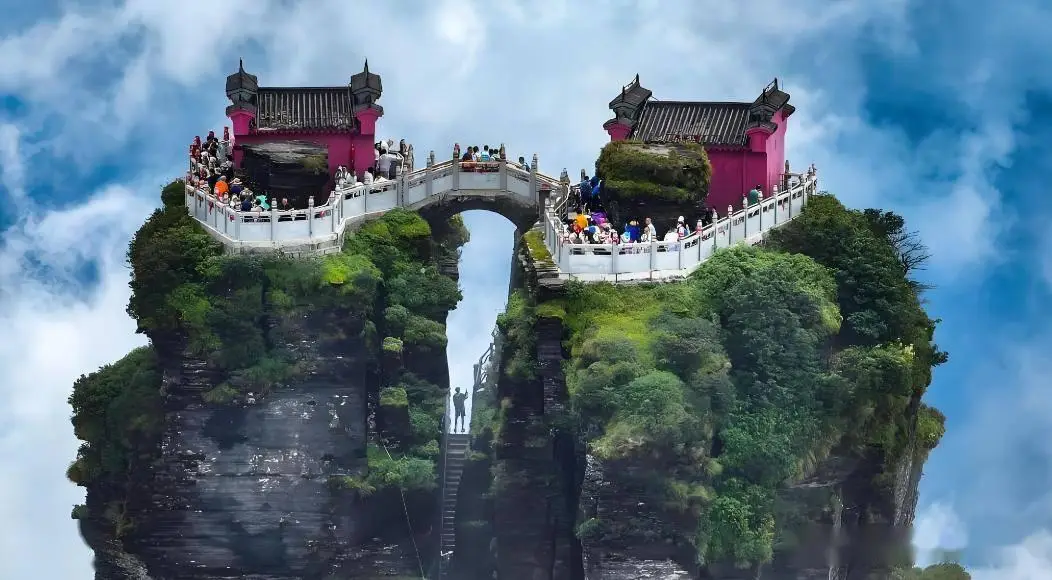
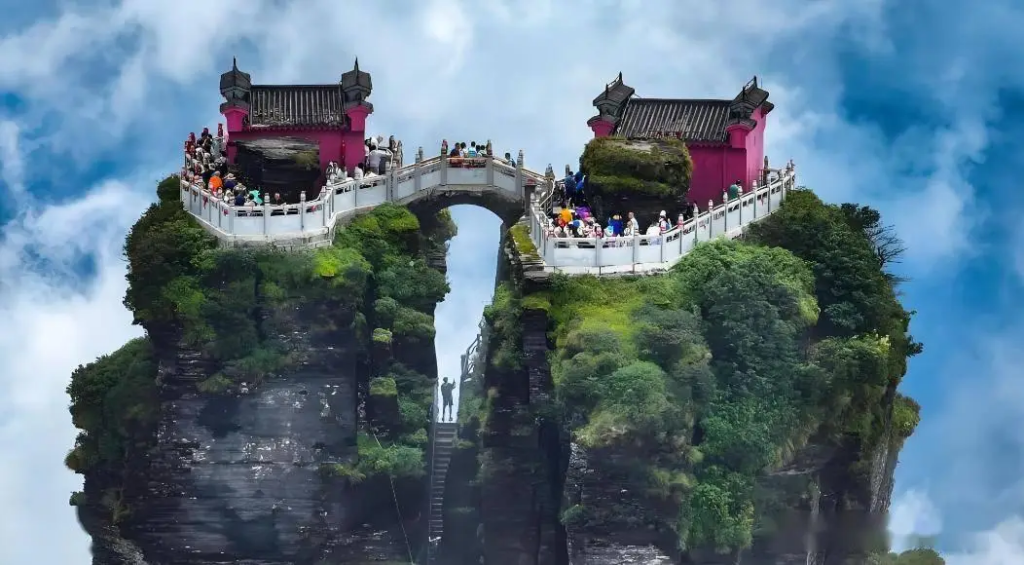
Imagine climbing a mountain where two ancient Buddhist temples sit atop separate rock pinnacles, connected only by a narrow stone bridge suspended high above the clouds. It sounds like something from a fantasy movie—but this extraordinary place is real.
Welcome to Mount Fanjing (Fanjingshan, 梵净山), one of China’s most spectacular natural and spiritual landmarks. Rising above the forests of Guizhou Province, this UNESCO World Heritage Site is famous for its dramatic peaks, rare wildlife, and breathtaking summit that seems to float in the sky.
Although millions of domestic tourists visit every year, Mount Fanjing remains surprisingly unknown outside China. For travelers looking to discover a different side of the country, it is one of China’s most unforgettable destinations.
Where Is Mount Fanjing?
Mount Fanjing is located in Tongren, in northeastern Guizhou Province, southwestern China.
The mountain forms the highest peak of the Wuling Mountain Range, reaching an elevation of 2,570 meters (8,432 feet).
Despite its remote appearance, improved transportation has made the mountain increasingly accessible. Visitors can reach Tongren by high-speed rail or domestic flights before continuing by bus or car to the scenic area.
A UNESCO World Heritage Site
In 2018, Mount Fanjing was added to the UNESCO World Heritage List for its exceptional biodiversity and geological significance.
Unlike many famous mountains shaped primarily by volcanic activity, Mount Fanjing is the result of hundreds of millions of years of tectonic uplift and erosion.
Its isolated location has allowed countless ancient plant and animal species to survive, earning it the nickname:
“A biological treasure house of China.”
Scientists consider the mountain one of East Asia’s most important biodiversity hotspots.
The Incredible Red Clouds Golden Summit
The highlight of Mount Fanjing is undoubtedly the Red Clouds Golden Summit (Hongyun Jinding).
From a distance, the peak appears split into two towering rock spires separated by a narrow vertical crack.
Perched on top of each pinnacle is a small Buddhist temple.
Connecting them is a steep stone staircase and a narrow bridge that crosses the gap between the cliffs.
Standing on the bridge, visitors are rewarded with panoramic views of endless mountain ranges stretching into the distance.
On misty mornings, clouds fill the valleys below, making the temples appear to float above a white sea.
It is one of the most photographed mountain landscapes in China.
More Than 8,000 Steps to the Summit
Reaching the summit is an adventure in itself.
Visitors have two options:
- Take a cable car that climbs dramatically above the forest before hiking the remaining distance.
- Hike the entire mountain on foot, climbing more than 8,000 stone steps through ancient forests.
While the cable car makes the journey easier, the final ascent to the Golden Summit is steep and requires climbing narrow staircases carved directly into the rock.
The climb can be physically demanding, but the spectacular scenery makes every step worthwhile.
A Sacred Buddhist Mountain
Mount Fanjing has been an important center of Buddhism for over a thousand years.
Its name can be translated as “Pure Brahma Mountain,” reflecting its connection to Buddhist teachings.
According to tradition, the mountain is associated with Maitreya Buddha, the future Buddha who is expected to appear in the world.
Over the centuries, monks built temples, meditation halls, and pilgrimage routes throughout the mountain.
Today, many visitors come not only for the scenery but also for the peaceful spiritual atmosphere.
Even travelers with no religious background often describe the summit as one of the most tranquil places they have ever visited.
A Home for Rare Wildlife
Mount Fanjing is famous for its remarkable biodiversity.
The forests are home to more than 7,000 species of plants and animals, including several found nowhere else on Earth.
Among its most famous residents are:
- Guizhou snub-nosed monkeys, one of the world’s rarest primates.
- The Fanjingshan fir, an ancient tree species that survives only in this region.
- Hundreds of bird species.
- Rare orchids and alpine plants.
Because much of the mountain has remained untouched for centuries, it serves as an important refuge for wildlife.
Nature lovers often consider Mount Fanjing one of China’s best destinations for eco-tourism.
A Sea of Clouds
One of Mount Fanjing’s greatest attractions is its spectacular cloud scenery.
Thanks to the mountain’s elevation and humid climate, clouds frequently gather around the peaks.
Early in the morning, visitors may witness the famous “sea of clouds,” where only the highest summits rise above a blanket of white mist.
As the sun rises, the changing light creates dramatic shadows and golden reflections across the mountains.
For photographers, these conditions provide some of the most beautiful landscapes in China.
Best Time to Visit
Spring (April–May)
Fresh greenery, blooming flowers, and comfortable temperatures make spring ideal for hiking.
Summer (June–August)
Lush forests and frequent cloud formations create magical scenery, although afternoon rain showers are common.
Autumn (September–November)
Clear skies, colorful forests, and cooler weather make autumn the most popular season.
Winter (December–February)
Snow occasionally covers the temples and peaks, creating a breathtaking winter landscape.
Travel Tips
To enjoy your visit:
- Book tickets in advance during holidays.
- Wear comfortable hiking shoes.
- Bring warm clothing, even in summer, as temperatures at the summit are much cooler.
- Start early to avoid crowds at the Golden Summit.
- Carry water and snacks for the climb.
Visitors should also be prepared for sudden changes in mountain weather.
Why Mount Fanjing Is Unlike Anywhere Else
China has many famous mountains, but few combine dramatic geology, ancient religion, unique wildlife, and unforgettable scenery quite like Mount Fanjing.
Its iconic twin temples perched high above the clouds have become one of the country’s most recognizable natural landmarks.
Whether you’re interested in hiking, photography, Buddhism, or simply discovering places that most international tourists have never heard of, Mount Fanjing offers an experience that is both inspiring and unforgettable.
For many travelers, it is not just one of China’s most beautiful mountains—it is one of the most extraordinary landscapes on Earth.
Frequently Asked Questions
Is Mount Fanjing worth visiting?
Yes. It is widely regarded as one of China’s most spectacular mountain destinations and a UNESCO World Heritage Site.
How difficult is the hike?
The cable car reduces much of the climb, but the final ascent to the Golden Summit involves steep staircases and requires moderate fitness.
When is the best time to visit?
Spring and autumn offer the best combination of weather, visibility, and comfortable temperatures.
Can beginners hike Mount Fanjing?
Yes. Most visitors use the cable car and complete the remaining hike without difficulty, though the final section is steep.
Why is Mount Fanjing famous?
It is famous for the Red Clouds Golden Summit, twin mountaintop temples, rare wildlife, and its UNESCO World Heritage status.