



The Dragon Boat Festival, also known as Duanwu Festival, stands firmly among China’s most cherished and significant traditional festivals. With a history spanning more than 2,000 years, it carries profound cultural meanings, timeless folk customs and precious national memories, and is celebrated across the whole nation every year on the fifth day of the fifth lunar month.


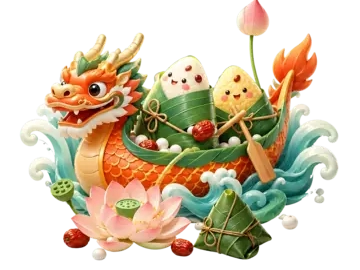
Caption:Exciting dragon boat races, a highlight of Duanwu Festival.
There are three core reasons why the Dragon Boat Festival holds such an important position in Chinese culture.
First of all, it is rooted in a touching historical legend and noble spiritual heritage. The festival is widely celebrated in memory of Qu Yuan, a great patriotic poet of ancient China. Living in a turbulent era, Qu Yuan devoted his whole life to caring about his country and people. After falling into despair amid political chaos, he chose to drown himself in the Miluo River. Local villagers respected him deeply. They rowed boats frantically to search for him and threw rice dumplings into the river to stop fish and shrimp from eating his body. These acts gradually evolved into today’s dragon boat races and zongzi-eating traditions. For thousands of years, the festival has passed down the spirit of patriotism, loyalty and integrity, which has become an important part of Chinese national spirit.

Caption:Colorful dragon boat head, symbol of the festival.
Secondly, it gathers rich folk customs and inherits ancient life wisdom. Unlike many single-themed festivals, the Dragon Boat Festival features diverse and distinctive traditions that integrate health preservation, folk activities and family reunion. Eating zongzi (glutinous rice dumplings) is the most well-known custom; different regions create zongzi with various fillings and flavors, reflecting local food culture. The exciting dragon boat races are the highlight of the festival. Teams paddle in unison on the river, accompanied by loud drums and cheers, symbolizing unity, courage and teamwork. Besides, people hang wormwood and calamus at their doorways, wear fragrant sachets and drink realgar wine. These customs originated from ancient people’s wisdom to ward off diseases and evil spirits in the hot rainy early summer, recording the harmonious relationship between humans and nature.

Caption:Zongzi (glutinous rice dumplings), traditional Duanwu food.
Thirdly, it is a grand festival for family bonding and cultural inheritance. On Duanwu, families get together to make zongzi, watch dragon boat races and enjoy festive moments. It strengthens family affection and connects generations. Moreover, the festival has long broken regional boundaries and become a shared cultural symbol for all Chinese people. In 2009, the Dragon Boat Festival was inscribed on the UNESCO Representative List of the Intangible Cultural Heritage of Humanity, proving its outstanding cultural value to the whole world.

Caption:Wormwood and sachets, traditional Duanwu decorations.
Today, the Dragon Boat Festival is no longer just an ancient tradition. It combines history, food, sports and folk art. It not only reminds Chinese people of their history and roots, but also becomes a wonderful window for the world to understand Chinese traditional culture. That is why it remains one of the most important traditional festivals in China.
Hi, this is a comment.
To get started with moderating, editing, and deleting comments, please visit the Comments screen in the dashboard.
Commenter avatars come from Gravatar.