


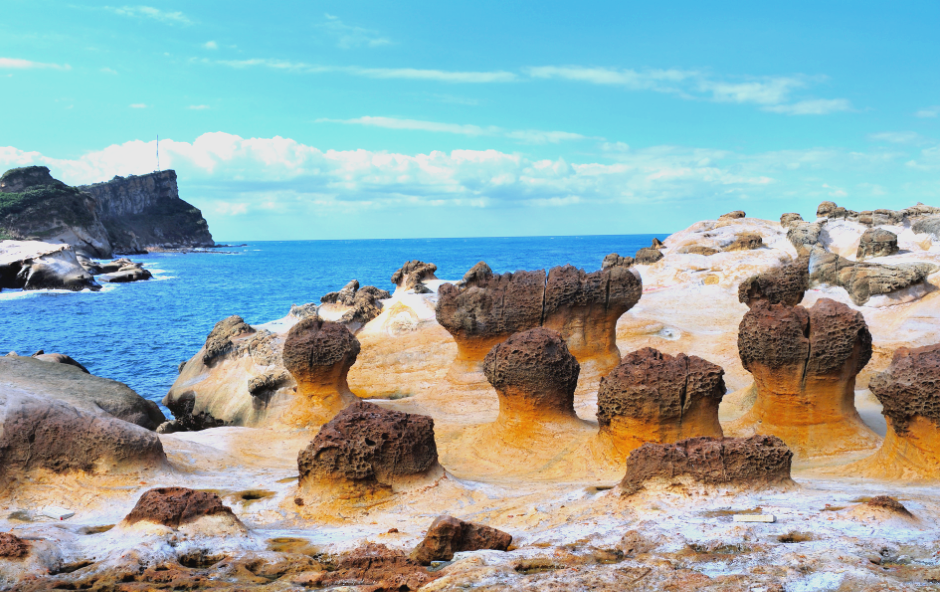
Along Taiwan’s rugged northern coastline lies a landscape so unusual that it often feels more like another planet than a seaside park.
Here, hundreds of strangely shaped rock formations rise from a narrow peninsula stretching into the Pacific Ocean. Some resemble mushrooms, others look like candles, dragons, sea creatures, or giant pieces of honeycomb. The most famous of them all is a graceful rock that resembles the profile of a queen.
Welcome to Yehliu Geopark (野柳地質公園)—one of Taiwan’s most iconic natural attractions and one of the finest coastal geological landscapes in Asia.
For visitors interested in nature, photography, or geology, Yehliu is an unforgettable destination where millions of years of natural forces have created an outdoor sculpture gallery unlike anywhere else.
Where Is Yehliu Geopark?
Yehliu Geopark is located in the Wanli District of New Taipei City, about 40 kilometers (25 miles) northeast of central Taipei.
The park occupies a narrow cape extending nearly 1.7 kilometers (about 1 mile) into the sea. Because it is surrounded by powerful ocean currents and seasonal monsoon winds, the coastline has been continuously shaped by nature for countless centuries.
Its convenient location makes it one of the most popular day trips from Taipei.
How Nature Became an Artist
Unlike mountains formed by volcanoes or rivers, Yehliu owes its extraordinary appearance to the relentless power of the ocean.
Over millions of years, waves, sea spray, wind, and temperature changes slowly eroded the sandstone coastline.
Softer layers wore away faster than harder layers, leaving behind hundreds of bizarre formations with remarkably smooth surfaces.
Geologists describe this process as differential weathering, but many visitors simply describe it as nature’s artwork.
Walking through the park often feels like exploring a giant outdoor museum created entirely by wind and water.
The Famous Queen’s Head
The undisputed symbol of Yehliu Geopark is the Queen’s Head.
From the right angle, the slender rock closely resembles the profile of a queen wearing an elegant crown.
Its graceful shape has become one of Taiwan’s most recognizable natural landmarks.
Thousands of visitors line up every day to photograph this remarkable formation.
However, the Queen’s Head is also fragile.
The narrow “neck” supporting the rock becomes thinner each year due to natural erosion. Scientists carefully monitor its condition, while conservation measures help reduce unnecessary damage caused by tourism.
Although no one knows exactly how much longer it will survive, it remains one of Asia’s most famous geological wonders.
More Than Just One Rock
While the Queen’s Head attracts most of the attention, the park contains hundreds of equally fascinating formations.
Among the most popular are:
- Mushroom Rocks
- Candle Rocks
- Fairy Shoe Rock
- Ginger Rocks
- Sea Candles
- Ice Cream Rocks
- Elephant-shaped formations
Many visitors enjoy inventing their own names as they discover new shapes hidden among the sandstone.
Every section of the park offers something different, making it easy to spend several hours exploring.
A Living Geological Laboratory
Yehliu is more than a scenic destination—it is also an important site for geological research.
The exposed rock layers record millions of years of Earth’s history, providing scientists with valuable information about ancient marine environments.
Educational displays throughout the park explain how erosion, tectonic activity, and coastal processes continue shaping the landscape today.
This combination of science and natural beauty makes Yehliu especially popular with students and families.
Sunrise, Sunset, and Photography
Photographers consider Yehliu one of Taiwan’s best coastal photography locations.
During sunrise, warm golden light highlights the textures of the sandstone.
Late afternoon often provides softer lighting and fewer harsh shadows.
Stormy weather can create dramatic waves crashing against the rocks, while calm days reveal beautiful reflections in the tide pools.
Because the landscape constantly changes with light and weather, no two visits are exactly alike.
Marine Life Along the Coast
Beyond the famous rock formations, the surrounding coastline supports a rich marine ecosystem.
During low tide, visitors may observe:
- Small crabs
- Sea snails
- Starfish
- Seaweed
- Tide pool fish
The combination of geological formations and coastal wildlife makes the park an excellent destination for nature lovers.
Visitors are encouraged to observe wildlife without disturbing the delicate ecosystem.
Best Time to Visit
Spring (March–May)
Comfortable temperatures and clear skies make spring ideal for sightseeing.
Summer (June–August)
Expect warm weather and larger crowds, especially during weekends.
Autumn (September–November)
Many photographers consider autumn the best season because of pleasant weather and excellent visibility.
Winter (December–February)
The northeast monsoon brings stronger winds and rougher seas, creating dramatic coastal scenery.
Travel Tips
To make your visit more enjoyable:
- Arrive early in the morning to avoid tour groups.
- Wear comfortable shoes with good grip.
- Bring sun protection, as much of the park has little shade.
- Stay behind safety barriers to protect both yourself and the fragile rock formations.
- Avoid climbing on protected geological features.
Why Yehliu Is One of Taiwan’s Greatest Natural Wonders
Few places demonstrate the creative power of nature as beautifully as Yehliu Geopark.
Every curve, column, and mushroom-shaped rock has been patiently sculpted over millions of years by nothing more than wind, waves, and time.
Whether you’re fascinated by geology, passionate about photography, or simply searching for one of Taiwan’s most memorable landscapes, Yehliu offers an experience unlike any other.
It is a reminder that some of Earth’s greatest artists are the forces of nature themselves.
Frequently Asked Questions
Is Yehliu Geopark worth visiting?
Absolutely. It is one of Taiwan’s most famous natural attractions and one of Asia’s best coastal geological parks.
How long should I spend there?
Most visitors spend two to three hours exploring the park.
Why is the Queen’s Head famous?
Its unique profile closely resembles the head of a queen wearing a crown, making it Taiwan’s most recognizable rock formation.
Can you touch the rocks?
Visitors should avoid climbing or touching protected formations to help preserve them for future generations.
Is Yehliu suitable for children?
Yes. The walking paths are well maintained, making the park suitable for families.