
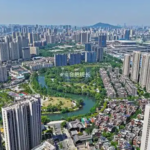
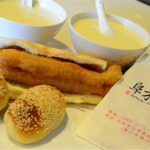

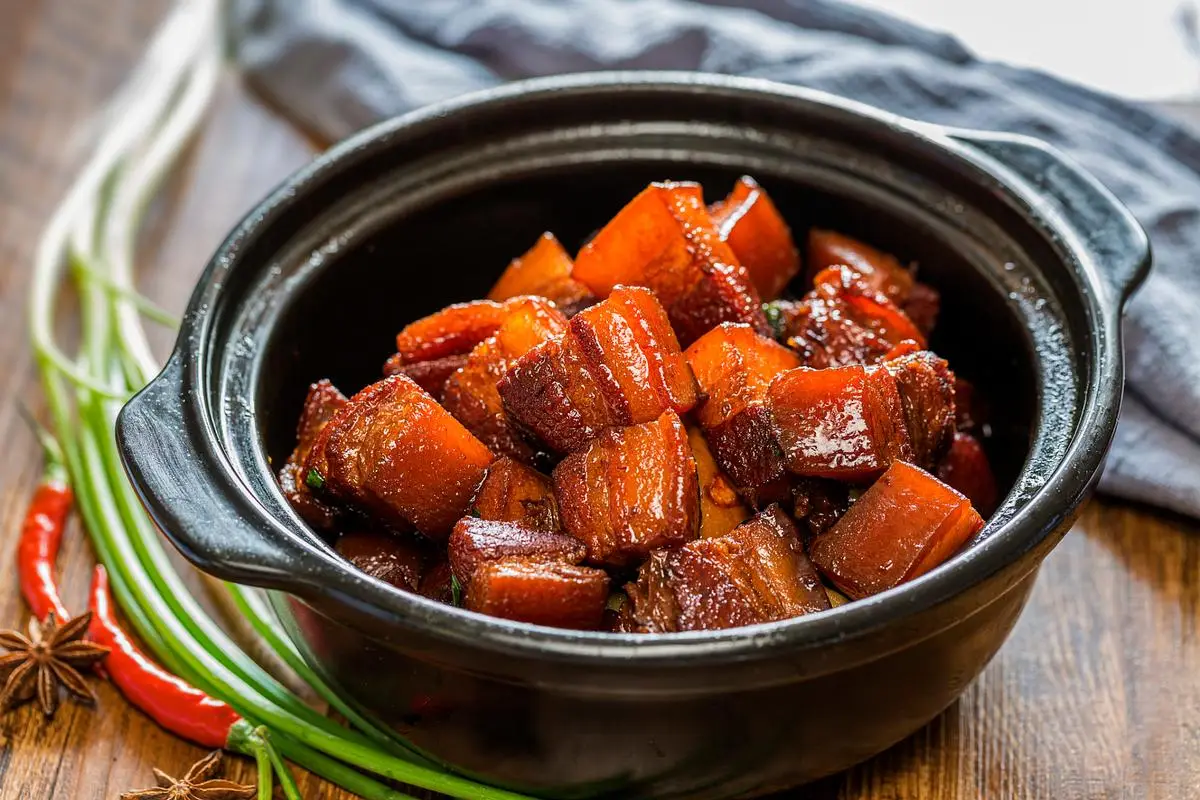
If you think Xiangtan is only about red tourism, think again. As one of the birthplaces of Hunan cuisine (Xiangcai), this city on the Xiang River has given China not only Mao Zedong, Peng Dehuai, and Qi Baishi, but also half a history of Hunan gastronomy. From the first bowl of rice noodles at dawn on the wharves to late-night crayfish feasts, from century-old intangible cultural heritage chicken to imperial tribute pastries—Xiangtan’s flavors are etched into the DNA of its people and haunt the dreams of visiting food lovers.
1. Mao-Style Braised Pork (Mao Shi Hong Shao Rou): The Chairman’s Favorite
“You haven’t truly visited Xiangtan until you’ve eaten Mao’s Braised Pork.”
Xiangtan’s undisputed culinary calling card, this dish is said to have been Chairman Mao’s favorite hometown meal. It uses pork belly from local Shaziling pigs, braised with rock sugar and cooking wine until the meat glows amber-red, melts in the mouth, and delivers a perfect sweet-savory balance. The defining technique? Not a single drop of soy sauce—the color comes entirely from caramelized sugar, giving the pork its signature glossy finish.
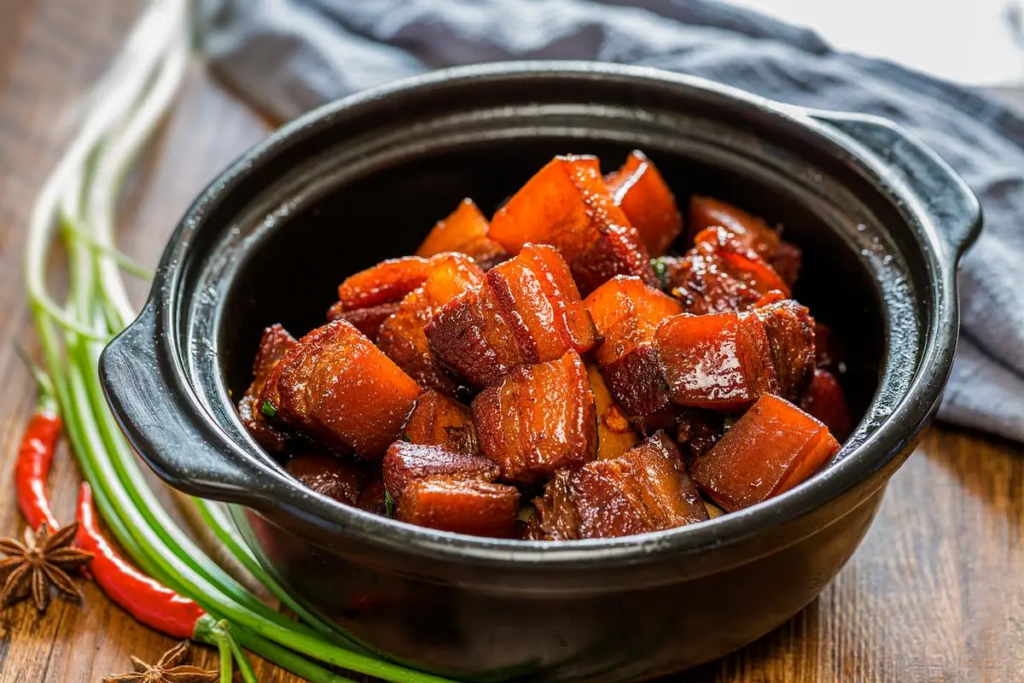
Listed among “Hunan’s Signature Dishes,” it is served at iconic venues like Mao’s Restaurant (Shaoshan flagship) and Shaoshan Hotel. In 2026, it remains the first dish every visitor orders.
Where to eat: Mao’s Restaurant (Shaoshan flagship), Shaoshan Hotel
2. Hetang Free-Range Chicken: 130 Years of Intangible Heritage
“Four generations of craft, one wok of tea-oil firewood chicken—this is Xiangtan’s pride.”
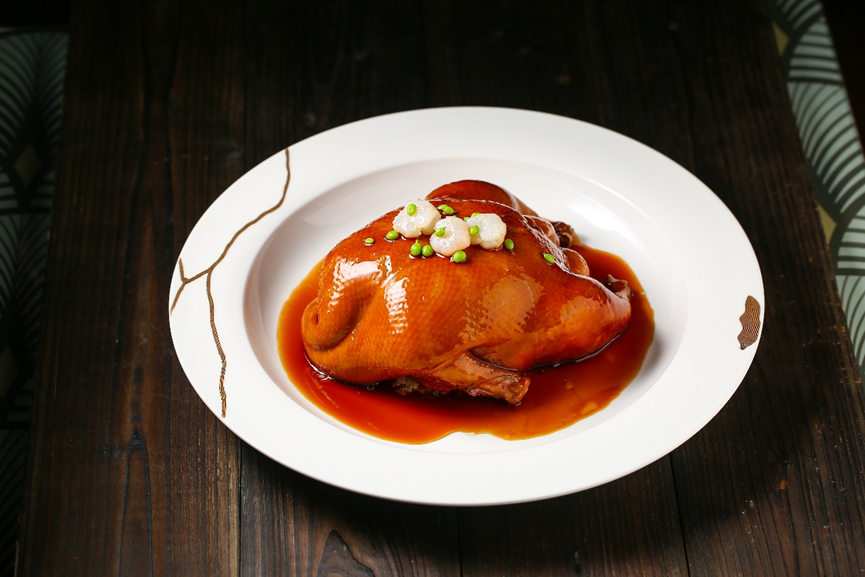
The 2026 breakout star of Xiangtan dining. Founded in 1897 by rural chef Dai Yunshan and passed down through four generations, the brand’s cooking technique was inscribed as Xiangtan Intangible Cultural Heritage in 2020, and it earned the “Hunan Time-Honored Brand” designation the same year.
The signature “Tea-Oil Firewood Braised Chicken” uses free-range local chickens raised for over 240 days, stir-fried over firewood with cold-pressed tea oil, ginger, and red chili. The first bite explodes with wok-hei (breath of the wok) and tea-leaf fragrance, while the meat remains tender yet chewy with layers of spice and sweetness.
The brand upholds a “Seven Promises” charter: no oyster sauce, no chicken powder, no pre-packaged ingredients, no pre-made dishes, no overnight meat, free replacement of wrong orders, and no charges for tea, tableware, or rice. In an era of industrial pre-made meals, this transparency is rare.
Where to eat: Hetang Free-Range Chicken (Jinxia Mountain location)
3. Xiangtan Water-Boiled Fresh Fish: Wharf Culture on a Plate
“One bowl of fish soup down, and you can shoulder a hundred-pound load without shaking.”
This dish is inseparable from Xiangtan’s wharf culture. In the late Qing and early Republican periods, the 18th Wharf saw over 100 merchant boats daily; fish and noodle stalls powered dockworkers through grueling shifts.
Chefs select approximately 1.5kg bighead carp (aristichthys nobilis), kill and cook it alive, then season with local perilla and chopped chili. The technique demands “three boils and three bubbles” to keep the skin intact and the flesh silky. The resulting broth is milky-white and rich, the fish firm and clean-tasting with a numbing-spicy kick.
In 2026, young chef Yan Hong innovated the recipe with red-broth and white-broth variations, training nearly 200 apprentices to keep this tradition alive.
Where to eat: 18-Wharf Water-Boiled Fish (Riverside location), Xinyu Yan Restaurant
4. 18-Wharf Rice Noodles (Shiba Zong Mi Fen): A Morning Ritual
“At 4:00 AM, while the city still sleeps, noodle-shop masters are already grinding rice and simmering bone broth.”
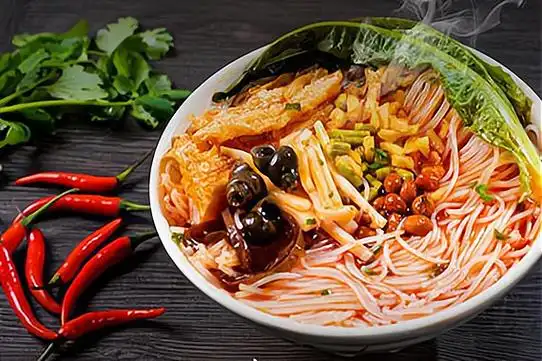
Xiangtan rice noodles trace back to the Xianfeng era of the Qing Dynasty (1850s), with Xiangxiang District as the epicenter. In 1978, the local food service company developed an automated “noodle processing line,” winning a regional science award. Today, Yueshan Town in Xiangxiang is known as the “Hometown of Rice Noodles,” supplying approximately 70% of the fresh noodle market across the Changsha-Zhuzhou-Xiangtan metropolitan area.
“Wharf” (zong) is a unique Xiangtan street designation dating to Yuan Dynasty administrative divisions. From the late Qing through the early PRC, Wharves 9 through 18 formed the city’s “Golden Street,” with the 18th Wharf as the most famous. The 18-Wharf Big Dock Noodle Shop originally opened riverside in 1979, organized by the neighborhood committee to provide jobs for the elderly and unemployed.
Xiangtan noodles are the “delicate lady” of Hunan rice noodles—supple, elastic, never turning mushy in soup or breaking when stir-fried. The broth is not heavy or oily but a clear bone stock with no additives. The topping is humble: shredded pork, lard, and fresh scallions.
Most charming are the wooden tokens (or bamboo tallies) used to claim your order—a living relic of the planned-economy ration-ticket era that lets diners taste history with every bowl.
Where to eat: 18-Wharf Big Dock Noodle Shop, Guoyi Eatery
5. Majiahe Black Goat: A Ming-Qing Dynasty Tonic
“A dish with roots in the late Ming and early Qing dynasties—Xiangtan people love goat, and they know how to cook it.”
This signature dish dates to the late Ming and early Qing dynasties. Majiahe in Xiangtan County is famous for its black goats, whose meat is tender and smooth. The classic preparation is yellow-braised with special chili sauce.
The New Maowu Black Goat Restaurant has elevated this to a full “goat banquet,” drawing crowds year-round. The braised meat is soft but not falling apart, spicy and fragrant, with warming, nourishing properties—especially prized in winter.
Where to eat: New Maowu Black Goat Restaurant (Majiahe)
6. Chopped-Chili Fish Head: A Classic of Good Fortune
“Eat this fish head, and your days will turn red and prosperous.”
This iconic Hunan dish is said to originate with Qing scholar Huang Zongxian, who fled literary persecution and stayed with a farmer. The farmer caught a bighead carp; his wife salted the meat, made soup, and steamed the head with home-grown chopped chilies. Huang later had his chef refine the recipe, creating a legend.
Authentic versions use the massive head of a bighead carp (called “xiong fish” locally), steamed with fermented chopped chilies and soy sauce until the flesh is silky and the spice penetrates every crevice.
Where to eat: Yiyuan Fish Head Restaurant, Red Moon Restaurant
7. Crayfish (Kou Wei Xia): Summer Night Carnival
“Suck the broth, bite the meat, drink strong liquor—this is a Xiangtan summer night.”
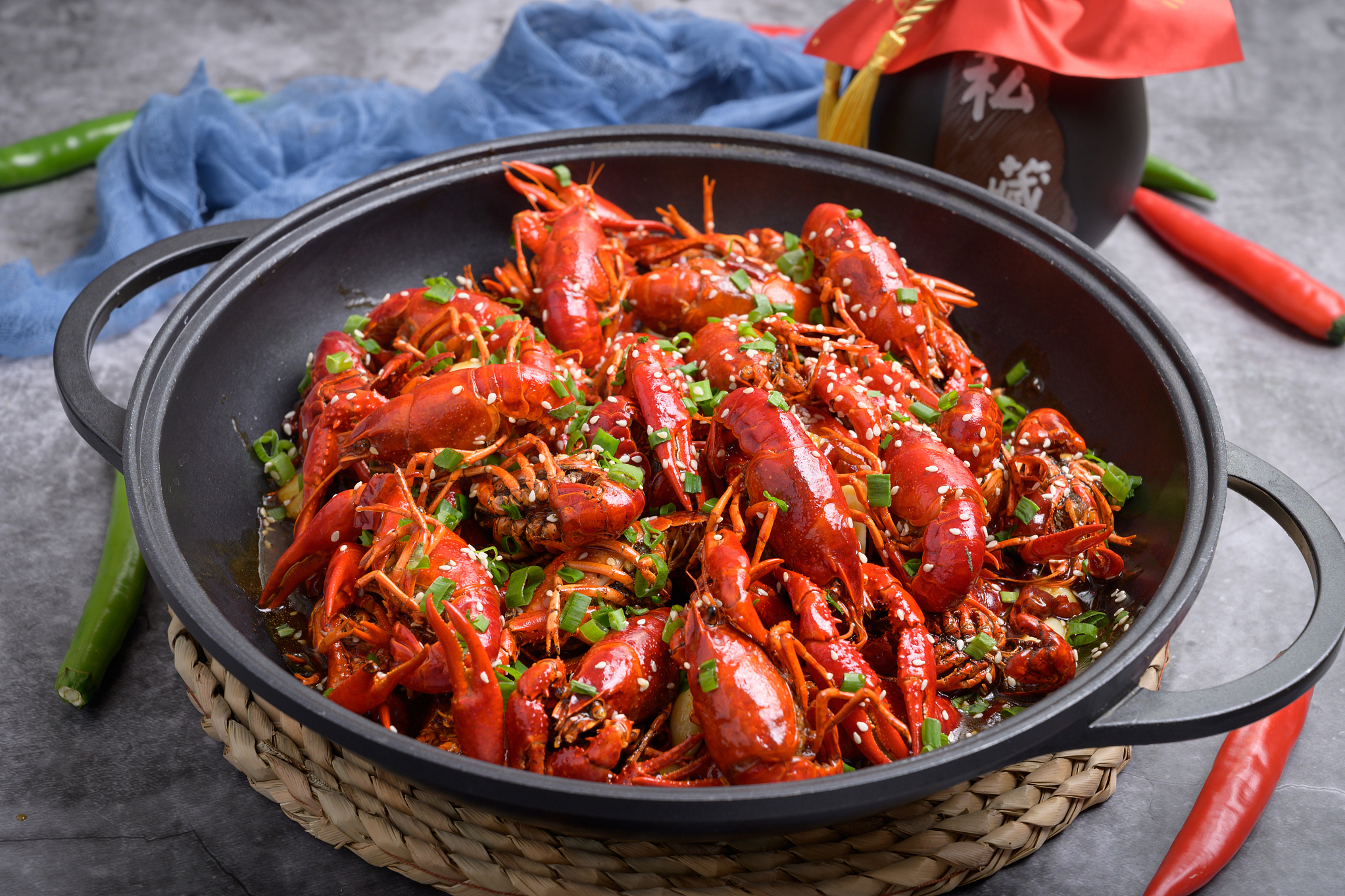
Crayfish is the undisputed king of Hunan summer street food. According to Hunan provincial standards, the dish features freshwater crayfish, first deep-fried, then stir-fried with chili sauce and simmered in broth. The official flavor profile: “spicy, fragrant, soft, and chewy.”
The Xiangtan method is meticulous: crayfish are soaked in clean water for 1-2 days to purge mud, scrubbed with toothbrushes, then beheaded, de-gilled, de-veined, and butterflied. After a flash-fry in 80% heat oil, they are stir-fried with star anise, cinnamon, perilla, and chili sauce, then simmered in stock for 15 minutes. The finishing touch: a bowl of plain noodles tossed in the leftover broth—the true essence of the meal.
Where to eat: Xiangtan Night Market stalls, Wen Aijie Crayfish
8. Fire-Baked Fish (Huo Bei Yu): Triple-Threat Texture
“It has the freshness of live fish, the crunch of dried fish, and the savoriness of salted fish—all at once.”
A traditional Xiangtan Han dish, fire-baked fish is slow-roasted over low flames until half-dry, half-moist, golden outside and fresh inside. The “crispy fire-baked” version is especially addictive, delivering intense umami and making it a perfect rice companion.
Where to eat: Local Xiangtan farm-to-table restaurants
9. Rock-Sugar White Lotus Seeds: The Sweet Side of “Lotus City”
“Xiangtan is called ‘Lotus City,’ and its seeds were once imperial tribute.”
Xiangtan’s nickname “Lotus City” comes from its premium Xiang lotus seeds. The prized “Cunsanlian” variety—three seeds lined up measure exactly one cun (approx. 3.3cm)—features short-oval shape, reddish-brown skin, and ivory-white flesh that turns soft and fragrant when cooked. Revered as the “ginseng of southern China.”
Rock-Sugar White Lotus is Xiangtan’s signature sweet dish, simmering local lotus seeds with rock sugar until the broth is clear and the seeds are powdery-tender. It defies the stereotype that all Hunan food must be spicy.
Where to eat: Local Xiangtan restaurants, Huashi Town Lotus Market
10. Xiangxiang Egg Roll (Cake Flower): The First Dish of Every Feast
“In Xiangxiang tradition, no feast is complete without the egg roll.”
Xiangxiang’s number-one dish, this egg roll is the ceremonial first course at every local banquet. Made with farm pork, free-range duck eggs, and sweet potato starch in a secret ratio, it is wrapped in thin egg crepes, steamed, and sliced into golden, cloud-soft rounds.
Where to eat: Maohu Waterside Village, Xiangxiang banquet halls
11. Lampwick Cake (Deng Xin Gao): 400 Years of Sweet Memory
“Dragon-Brand soy sauce and lampwick cake—if you don’t buy them, you haven’t been to Xiangtan.”
This famous Xiangtan pastry boasts over 400 years of history. Made from refined glutinous rice flour, sugar, lard, cinnamon, and red silk threads, it is shaped like a lamp wick—white, soft, sweet with a hint of spice, and coolly aromatic. The finest grade can actually be lit with fire, releasing a pure cinnamon fragrance.
Awarded first-class tribute status at a national expo during the Xianfeng era, today’s artisans still follow ancient methods to preserve this nostalgic flavor.
Where to buy: Xinhuazhai Pastry Shop, Xiangtan specialty stores
12. Xiangxiang Baked Cake (Hong Gao): Imperial Tribute Since 1723
“Ivory color, melts on the tongue, fire-roasted fragrance, pure and refreshing.”
First created in 1723 by Tianyuanzhai Restaurant in Xiangxiang County and designated as imperial tribute, this cake uses premium white rice and sugar, processed through soaking, grinding, sifting, sugar-mixing, molding, slicing, and baking.
Oil-free and salt-free, directly fire-baked for sterility and long shelf life, it serves equally well as travel rations, baby food, or gifts.
Where to buy: Xiangxiang specialty shops, Bubugao Supermarket
13. Brain-Marrow Roll (Nao Sui Juan): A Poet’s Weakness
“Smooth as oil, melts on the tongue, sweet but not cloying, spiced with pepper—savor its beauty, endless joy.”
This jingle was composed by the late-Qing scholar Wang Kaiyun, one of China’s greatest classicists, proving the roll’s irresistible charm. Shaped like roof tiles, glistening and thin-skinned with a thick filling, it melts instantly. Created by Xiangtan’s Xianghua Studio in the late Qing, it spread across Hunan and gained national fame.
Despite the name, it contains no actual brain—just pork fat and sugar wrapped in semi-fermented dough. When done right, it dissolves on the tongue, leaving a lingering sweetness.
Where to eat: Weisheng Eatery, Dongting Spring Restaurant
14. Dragon-Brand Soy Sauce (Long Pai Jiang You): A Century of Gold-Medal Flavor
“Visiting Xiangtan without buying Dragon-Brand soy sauce is like never having been there at all.”
Born in 1740, this soy sauce follows ancient brewing methods: 22 processes and 8-10 months of natural sun fermentation per batch. In 1915, it won gold at the Panama International Exposition, cementing its status as a “China Time-Honored Brand.”
With its reddish-brown color, rich bean aroma, and perfectly balanced salty-sweet taste, it is the secret weapon behind Xiangtan’s braised pork, steamed fish, and cold dishes alike.
Where to buy: Dragon-Brand Soy Sauce Factory, major Xiangtan supermarkets
15. Xiangtan Betel Nut: The City’s Social Code
“One good betel nut can flush your cheeks, heat your body, and make sweat break out all over.”
Xiangtan people have a unique passion for betel nut, refined through distinctive local processing. Xiangtan betel nut is stronger, richer, and more potent than Hainan or Taiwan varieties. As one of the “Four Southern Medicines,” moderate consumption aids digestion and dispels phlegm.
Major brands include Pangge, Xiaolongwang, and Binzhilang. However, moderation is advised due to oral health risks.
Where to buy: Convenience stores and specialty shops across Xiangtan
Souvenir Combinations:
- Classic Xiangtan Flavor: Xiang lotus seeds (Cunsanlian) + Lampwick Cake + Dragon-Brand Soy Sauce
- Tea-Time Set: Xiangxiang Baked Cake + Shaofeng Tea
- For Spice Lovers: Xiangtan Betel Nut + Spicy Preserved Duck
Key Shopping Hubs: Bubugao Supermarket (Yuhu District), Huashi Town Lotus Market, Shaoshan Scenic Area souvenir shops, Xiangxiang Industrial New District specialty street.
Best Dining Times:
- Breakfast 7:00-9:00 AM: Rice noodles, Brain-Marrow Rolls
- Lunch 11:30 AM-1:30 PM: Mao’s Braised Pork, Hetang Chicken, Water-Boiled Fish
- Dinner 5:30-8:00 PM: Chopped-Chili Fish Head, Black Goat
- Late Night 9:00 PM-midnight: Crayfish, Fire-Baked Fish
Summary: Xiangtan’s culinary landscape is a tapestry woven from revolutionary heritage, wharf culture, imperial tribute, and street-level ingenuity. Whether you come for the history or stay for the flavor, this city proves that in Hunan, the way to the heart is indeed through the stomach.