

Introduction: The Palace That Touches the Sky
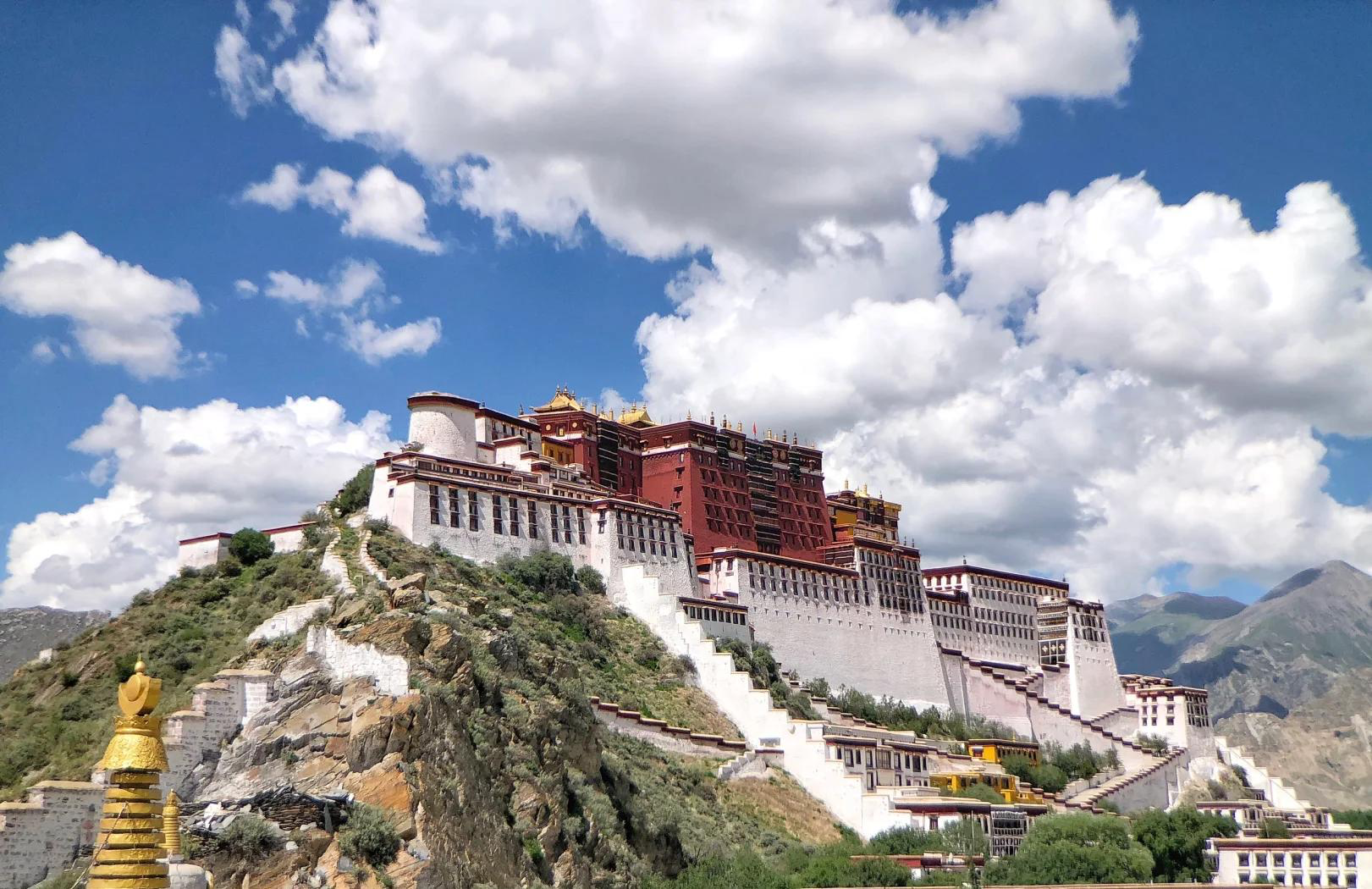
High on the Red Hill in the heart of Lhasa, Tibet, stands a structure so extraordinary that it seems less like a human creation and more like a mountain sculpted by divine hands. Rising over 3,700 meters (12,100 feet) above sea level, the Potala Palace dominates the skyline of Tibet’s capital with an almost mythical presence.
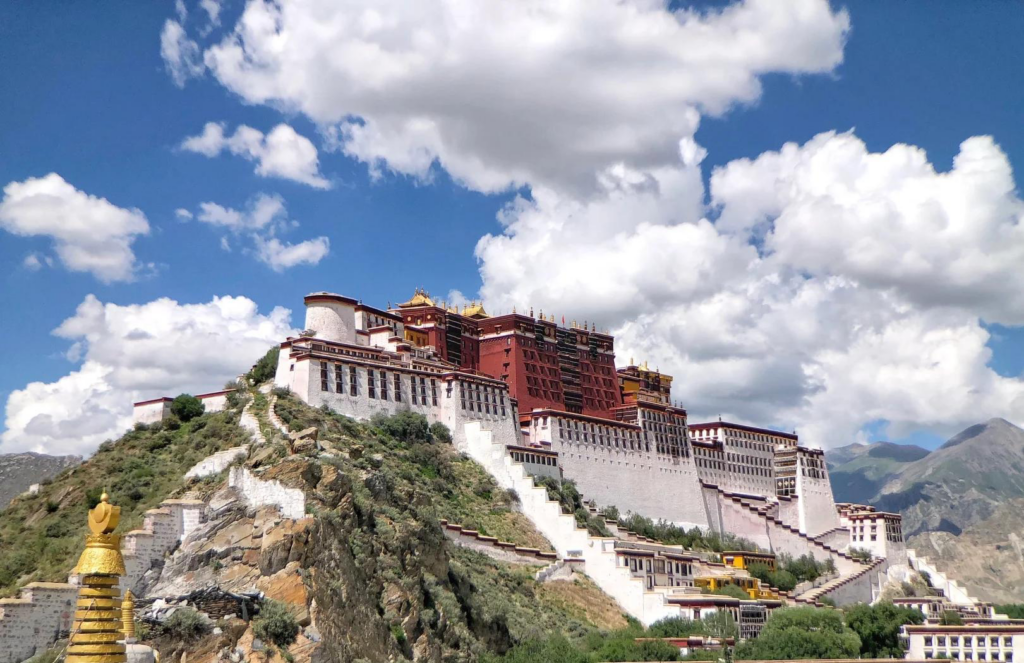
For centuries, travelers crossing the Himalayan Plateau described their first sight of the Potala as a moment of awe. Emerging from the thin mountain air, its massive white walls and crimson towers appear suspended between earth and heaven.
To many people outside China, Tibet remains one of the world’s most mysterious regions—a land of snow-capped mountains, ancient monasteries, colorful prayer flags, and profound spiritual traditions. At the center of this fascination stands the Potala Palace, perhaps the most recognizable symbol of Tibet and one of humanity’s greatest architectural achievements.
Yet the Potala Palace is far more than a beautiful building. It is a royal residence, a religious sanctuary, a political center, a treasure house of art, and a monument that encapsulates over 1,300 years of Tibetan history.
Understanding the Potala Palace means understanding Tibet itself.
A Name Rooted in Buddhist Mythology
The name “Potala” originates from Mount Potalaka, the mythical abode of Avalokiteshvara, the Bodhisattva of Compassion.

In Tibetan Buddhism, Avalokiteshvara is one of the most revered figures, believed to embody infinite compassion for all living beings. Tibetan tradition holds that the Dalai Lamas are earthly manifestations of Avalokiteshvara.
Thus, naming the palace “Potala” was deeply symbolic. It represented not merely a residence but a sacred bridge between the human world and the spiritual realm.
Even today, many Tibetan pilgrims regard a visit to the Potala Palace as a profoundly religious experience rather than simply a sightseeing excursion.
The Origins: A Palace Born in the Age of Kings
The story of the Potala Palace begins in the 7th century.
At that time, Tibet was united under the powerful Tibetan king Songtsen Gampo, one of the most influential rulers in Tibetan history.

Songtsen Gampo established Lhasa as his capital and ordered the construction of an early palace on Red Hill. Historical records suggest that the original complex contained hundreds of rooms and served as a royal residence as well as a political center.
The king’s reign marked a transformative period for Tibet. He married princesses from both the Tang Dynasty of China and Nepal, helping introduce Buddhism, advanced technologies, and cultural influences from neighboring civilizations.
Although much of the original palace was later destroyed through wars and natural disasters, its location became forever associated with political authority and spiritual significance.
The Potala we see today stands upon this ancient foundation.
The Great Reconstruction of the Fifth Dalai Lama
The modern Potala Palace owes its existence largely to the Fifth Dalai Lama, one of the most influential figures in Tibetan history.
During the 17th century, Tibet entered a period of political consolidation. The Fifth Dalai Lama emerged as both a spiritual leader and temporal ruler, uniting much of Tibet under a centralized government.
In 1645, he initiated the construction of a monumental new palace atop Red Hill.
The project was unprecedented in scale.
Thousands of workers, artisans, engineers, monks, and craftsmen labored for decades. Materials had to be transported across difficult mountain terrain, often by yak caravans.
The construction represented not only an architectural endeavor but also a political statement. The palace symbolized a unified Tibet and the authority of the Dalai Lama.
When completed, the Potala became one of the largest and most ambitious palace complexes ever built at high altitude.
An Architectural Wonder of the World
The Potala Palace is astonishing in both size and engineering.
Key statistics include:
- Height: Approximately 117 meters (384 feet)
- Width: More than 360 meters
- Rooms: Over 1,000
- Chapels and shrines: More than 40
- Floors: 13
- Altitude: Over 3,700 meters above sea level
The palace consists primarily of two major sections:
The White Palace
The White Palace served as the administrative and residential center.
Here, Dalai Lamas lived, studied, received visitors, and conducted governmental affairs. The White Palace contained offices, living quarters, assembly halls, and administrative chambers.
Its bright white walls symbolize peace, purity, and spiritual enlightenment.
The Red Palace
The Red Palace forms the spiritual heart of the complex.
It contains sacred chapels, meditation halls, scriptures, reliquaries, and stupas housing the remains of several Dalai Lamas.
The deep red color symbolizes religious authority and spiritual power.
Together, these two sections perfectly express the fusion of politics and religion that characterized traditional Tibetan governance.
Engineering Against Nature
Constructing a massive palace at such an extreme altitude was an extraordinary achievement.
The builders faced formidable challenges:
- Thin air
- Severe winters
- Strong ultraviolet radiation
- Earthquakes
- Difficult transportation routes
To ensure durability, craftsmen used innovative techniques.
The walls, some over five meters thick at the base, were built using stone, earth, timber, and traditional binding materials.
Historical accounts suggest that copper was incorporated into parts of the structure to enhance earthquake resistance.
The inward-sloping walls provide additional stability while creating the palace’s distinctive appearance.
Remarkably, after centuries of harsh weather and seismic activity, the Potala Palace remains standing.
A Treasure House of Tibetan Art
Beyond its exterior grandeur lies one of the richest collections of Tibetan artistic heritage in existence.
The palace contains:
- Thousands of thangka paintings
- Ancient Buddhist scriptures
- Rare manuscripts
- Gold statues
- Silk embroideries
- Murals covering vast interior surfaces
- Precious gemstones and ritual objects
The murals alone cover tens of thousands of square meters.
These artworks document:
- Tibetan history
- Buddhist teachings
- Royal ceremonies
- Trade routes
- Diplomatic exchanges
- Daily life across centuries
For historians, the palace functions as an invaluable archive preserving the cultural memory of Tibet.
The Golden Stupas of the Dalai Lamas
Among the most sacred features of the Potala Palace are the magnificent stupas containing the remains of successive Dalai Lamas.
The stupa of the Fifth Dalai Lama is especially spectacular.
Covered with gold and adorned with jewels, it is considered one of the most impressive religious monuments in Asia.
Some of these structures contain:
- Gold measured in tons
- Pearls
- Coral
- Turquoise
- Jade
- Precious stones donated by devotees over centuries
They represent not only artistic mastery but also the profound devotion of Tibetan Buddhists.
A Living Pilgrimage Destination
Unlike many historic monuments that serve solely as museums, the Potala Palace remains a living spiritual center.
Every day, pilgrims from across Tibet travel great distances to visit.
Many walk clockwise around the palace, spinning prayer wheels and chanting sacred mantras.
Some perform full-body prostrations for hundreds or even thousands of meters as an act of devotion.
For these pilgrims, the palace is not merely architecture.
It is a sacred path toward spiritual merit and enlightenment.
UNESCO Recognition: A Heritage of Humanity
In 1994, the Potala Palace was inscribed as a UNESCO World Heritage Site, joining the ranks of humanity’s most treasured cultural landmarks.
UNESCO recognized the palace not merely because of its architectural grandeur, but because it represents an extraordinary fusion of history, religion, politics, art, and engineering.
Later, the nearby Jokhang Temple and Norbulingka Palace were added as extensions to the World Heritage designation, creating a broader protected heritage zone that reflects the evolution of Tibetan civilization.
For visitors, UNESCO status offers an important reminder: the Potala Palace does not belong only to Tibet or China—it belongs to all humanity.
It stands alongside monuments such as the Pyramids of Egypt, the Acropolis of Athens, and Machu Picchu in Peru as one of the world’s irreplaceable cultural treasures.
The Dalai Lama and the Potala Palace
No discussion of the Potala Palace is complete without understanding its connection to the Dalai Lama.
For centuries, the Potala served as the winter residence of successive Dalai Lamas.
Within its walls, religious teachings were delivered, political decisions were made, diplomatic missions were received, and ceremonies shaping Tibetan history were conducted.
The palace functioned as both a monastery and a government headquarters.
The relationship between the Dalai Lama institution and the Potala Palace gave the building a unique dual identity rarely seen elsewhere in the world.
Unlike European royal palaces focused primarily on political power, the Potala embodied the Tibetan belief that spiritual wisdom and governance should coexist.
Today, regardless of political perspectives, the historical connection between the Dalai Lama institution and the palace remains central to understanding Tibet’s past.
Foreign Explorers and the Mystery of Tibet
For centuries, Tibet was one of the least accessible places on Earth.
Its remote location, harsh climate, and political restrictions created an aura of mystery that fascinated explorers, missionaries, geographers, and adventurers.
Many Western travelers spent years attempting to reach Lhasa.
When they finally arrived and saw the Potala Palace, their descriptions often bordered on disbelief.
British, Russian, French, and American explorers frequently described the palace as one of the most extraordinary sights they had ever witnessed.
Some compared it to a giant fortress suspended above the city.
Others described it as a heavenly castle emerging from the clouds.
Long before the era of mass tourism, the Potala Palace had already become one of the world’s most legendary destinations.
Hidden Rooms and Sacred Secrets
Behind the palace’s imposing walls lies a labyrinth of corridors, chapels, stairways, shrines, and meditation rooms.
Not every chamber was intended for public access.
Historically, certain areas were reserved exclusively for senior monks, high-ranking officials, or the Dalai Lama himself.
Some rooms contain ancient manuscripts that survived wars, political upheavals, and natural disasters.
Others house sacred relics believed to possess profound spiritual significance.
The atmosphere inside these spaces is difficult to describe.
Dim butter-lamp light flickers across centuries-old murals.
The scent of incense fills the air.
Ancient prayers seem embedded within the stone itself.
For many visitors, entering the Potala feels less like walking through a museum and more like stepping into a living chapter of history.
A Symbol of Tibetan Identity
Few buildings anywhere in the world are as deeply connected to the identity of a people as the Potala Palace.
For Tibetans, it represents continuity across centuries of change.
It symbolizes:
- Religious devotion
- Cultural resilience
- Historical memory
- Artistic achievement
- Spiritual aspiration
Its image appears on countless paintings, photographs, books, and souvenirs.
Even Tibetans who live far from Lhasa often regard the Potala as the ultimate symbol of their homeland.
The palace transcends architecture.
It has become an emotional and cultural landmark deeply embedded in Tibetan consciousness.
Preservation on the Roof of the World
Preserving a structure of this size and complexity is a monumental challenge.
The high-altitude environment subjects the palace to:
- Extreme temperature fluctuations
- Intense ultraviolet radiation
- Seasonal moisture
- Wind erosion
- Structural stress from tourism
Over recent decades, major conservation projects have been undertaken to ensure the palace survives for future generations.
Experts in architecture, engineering, archaeology, and cultural preservation have collaborated to stabilize walls, restore murals, protect ancient artifacts, and improve environmental monitoring.
The goal is not merely to maintain a famous tourist attraction but to safeguard one of humanity’s most significant cultural achievements.
The Visitor Experience: Climbing Toward the Sky
Visiting the Potala Palace is unlike visiting most historic sites.
The journey begins long before entering the building itself.
Visitors must climb hundreds of stone steps that wind upward along the mountainside.
At high altitude, even physically fit travelers often find themselves short of breath.
Yet the ascent serves an important purpose.
With each step, the city of Lhasa unfolds below.
The mountains stretch endlessly into the distance.
Prayer flags flutter in the wind.
The climb creates a sense of anticipation that transforms the palace from a destination into a pilgrimage.
By the time visitors reach the upper terraces, they understand why generations of travelers described the experience as unforgettable.
The Best Time to Visit
Although the Potala Palace is magnificent year-round, different seasons offer unique experiences.
Spring (April–May)
Clear skies and moderate temperatures make this one of the most pleasant periods for photography and sightseeing.
Summer (June–August)
The surrounding landscape becomes greener, though occasional rainfall may affect visibility.
Autumn (September–October)
Many experienced travelers consider autumn the most beautiful season.
The skies are exceptionally clear, temperatures are comfortable, and mountain views are often spectacular.
Winter (November–March)
Lhasa experiences abundant sunshine even during winter.
The reduced number of tourists creates a quieter, more contemplative atmosphere.
Why the Potala Palace Captivates the World
What makes the Potala Palace so extraordinary?
Many historic buildings are larger.
Many temples are older.
Many palaces are more lavish.
Yet very few monuments combine so many dimensions of human achievement in a single place.
The Potala Palace is simultaneously:
- A masterpiece of architecture
- A center of Buddhist spirituality
- A political landmark
- A museum of Tibetan civilization
- A symbol of cultural identity
- A triumph of high-altitude engineering
It occupies a rare position where history, faith, art, and geography converge.
That convergence creates an emotional impact that photographs alone cannot capture.
Conclusion: The Spiritual Fortress Above the Clouds
Standing atop Red Hill, gazing across the vast Tibetan Plateau, one begins to understand why the Potala Palace has inspired wonder for more than a thousand years.
It is not merely a palace.
It is not merely a monastery.
It is not merely a UNESCO World Heritage Site.
The Potala Palace is a testament to humanity’s ability to create beauty in the harshest environments, preserve faith across centuries, and transform stone, wood, and earth into something approaching the sacred.
For travelers seeking to understand China beyond its megacities and modern skylines, the Potala Palace offers a different story—a story of mountains, spirituality, resilience, and civilization.
In a rapidly changing world, it remains what it has always been:
A fortress above the clouds.
A beacon of Tibetan culture.
And one of the most awe-inspiring places on Earth.