


Introduction: The Greatest Treasure Hidden in the Desert
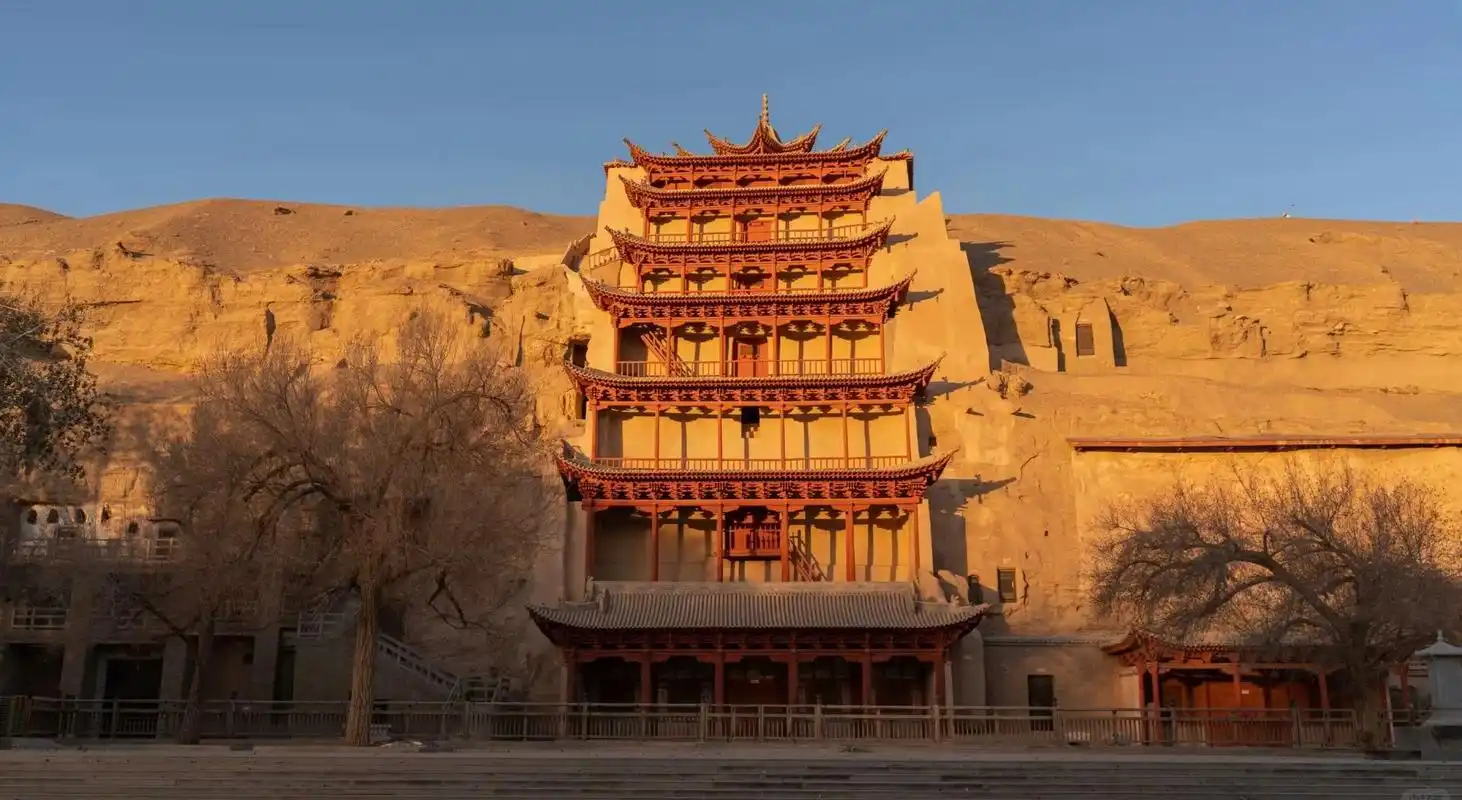
At the edge of one of the world’s harshest deserts lies one of humanity’s greatest cultural treasures.
Surrounded by windswept dunes and endless sands, a cliff face in northwestern China contains hundreds of caves filled with paintings, sculptures, and manuscripts.
For over a thousand years, travelers, monks, merchants, and pilgrims passed through this remote region.
Many left behind something precious:
A prayer.
A painting.
A story.
A piece of history.
Today, we know this extraordinary place as the Mogao Caves.
Located near the oasis city of Dunhuang in Gansu Province, the site is often called the “Cave of a Thousand Buddhas.”
Yet this title barely hints at its significance.
The Mogao Caves are not simply a collection of religious shrines.
They are a visual record of human civilization.
A museum carved into rock.
A crossroads where East and West met.
And home to one of the most astonishing archaeological discoveries in modern history.
For curious travelers seeking to understand China’s role in global history, few destinations are more important.

Where the Desert Meets Civilization
To understand the Mogao Caves, we must first understand Dunhuang.
For centuries, Dunhuang occupied one of the most strategic locations on the Silk Road.
Travelers moving between China, Central Asia, the Middle East, and Europe often passed through this oasis.
The surrounding environment was unforgiving.
To the west stretched vast deserts.
To the north lay rugged terrain and shifting sands.
Water was scarce.
Survival depended upon the oasis.
As a result, Dunhuang became a vital resting point where caravans exchanged goods, information, languages, religions, and ideas.
The city was not merely a stop along a trade route.
It was one of the world’s earliest centers of globalization.

The Birth of the Mogao Caves
According to tradition, the story began in the year 366 AD.
A Buddhist monk traveling through the region reportedly experienced a vision.
He saw thousands of radiant Buddhas shining upon a cliff.
Inspired by this experience, he began excavating a cave for meditation and worship.
Others followed.
Generation after generation continued the work.
New caves were carved.
Walls were painted.
Statues were sculpted.
Patrons ranging from emperors to merchants contributed resources.
Over the centuries, a vast complex gradually emerged.
By the height of its development, the site contained hundreds of decorated caves.
Each reflected the artistic and spiritual aspirations of its era.

More Than a Religious Site
At first glance, visitors may assume the Mogao Caves are purely Buddhist monuments.
In reality, they are much more.
The caves preserve evidence of:
- Religion
- Trade
- Politics
- Daily life
- International exchange
- Artistic innovation
The artwork records changing fashions, architectural styles, musical instruments, and social customs.
In many cases, historians have learned as much about ancient society from these paintings as from written documents.
The caves serve as an enormous visual archive.
Every wall tells a story.

The Cave of a Thousand Buddhas
The nickname “Cave of a Thousand Buddhas” comes from the countless Buddhist images found throughout the site.
Many cave walls are covered with rows of painted Buddhas.
Some appear as tiny decorative figures.
Others dominate entire chambers.
The repetition creates a sense of infinity.
Visitors often describe the experience as overwhelming.
Every surface seems alive with color, symbolism, and spiritual meaning.
The sheer scale of artistic effort is difficult to comprehend.
Thousands of artists worked here across many centuries.
Together, they created one of the largest collections of religious art in the world.
The Magnificent Murals
Perhaps the most famous feature of the Mogao Caves is their mural paintings.
Stretching across tens of thousands of square meters, these works represent one of humanity’s greatest artistic achievements.
The murals depict:
- Buddhist teachings
- Mythological stories
- Historical events
- Court life
- Foreign visitors
- Trade caravans
Their colors remain remarkably vivid despite the passage of time.
Blues, reds, greens, and golds continue to illuminate the cave walls.
For art historians, the collection is invaluable.
It documents more than a thousand years of artistic evolution.
Few places on Earth offer such a continuous visual record.
A Window Into the Silk Road
One reason the Mogao Caves fascinate scholars is their international character.
The Silk Road connected diverse civilizations.
Merchants arriving in Dunhuang came from regions that today include:
- China
- India
- Iran
- Afghanistan
- Central Asia
- Mongolia
Their influence appears throughout the artwork.
Visitors can observe artistic techniques, clothing styles, and cultural motifs originating from many different societies.
The caves demonstrate that ancient civilizations were far more interconnected than many people realize.
Long before the modern age, ideas traveled across continents.
The Discovery That Shocked the World
Among all the stories associated with Dunhuang, none is more extraordinary than the discovery of the Library Cave.
In 1900, a Taoist caretaker named Wang Yuanlu made a remarkable discovery.
Behind a sealed wall, he uncovered a hidden chamber.
The small room contained tens of thousands of manuscripts, paintings, documents, and textiles.
The collection had remained untouched for centuries.
Today, the chamber is known as Cave 17, or the Library Cave.
Its contents transformed the study of Asian history.
Scholars suddenly gained access to an unparalleled archive of medieval documents.
The discovery has been compared to finding a lost library from another age.
What Was Found Inside?
The manuscripts covered an astonishing range of subjects.
They included:
- Buddhist scriptures
- Government records
- Contracts
- Letters
- Maps
- Literature
- Religious texts from multiple traditions
Some documents were written in Chinese.
Others appeared in languages such as Tibetan, Sanskrit, and several Central Asian scripts.
The collection revealed the incredible diversity of Silk Road society.
Historians suddenly possessed firsthand evidence of life more than a thousand years ago.
The importance of the discovery cannot be overstated.
The Mystery of the Sealed Cave
Why was the Library Cave sealed?
No one knows with certainty.
Several theories exist.
Some scholars believe the documents were stored for protection during periods of instability.
Others suggest the chamber functioned as a sacred archive.
Another possibility is that changing political or religious conditions made preservation necessary.
Whatever the reason, the decision ultimately saved thousands of manuscripts.
Without the sealed chamber, many might have been lost forever.
The mystery remains one of the most fascinating puzzles in archaeological history.
The Giant Buddha Statues
The Mogao Caves are not limited to paintings.
Many chambers contain enormous sculptures.
Among the most impressive are giant Buddha statues rising several stories high.
Carved and constructed within confined spaces, these figures inspire awe.
Visitors often stand silently before them.
The statues communicate both spiritual devotion and artistic ambition.
Creating works of such scale in remote desert caves required extraordinary skill and determination.
Preserving a Fragile Masterpiece
The very qualities that make the Mogao Caves valuable also make them vulnerable.
Murals are sensitive to:
- Humidity
- Temperature changes
- Human breath
- Dust
- Light exposure
Conservation experts face immense challenges.
Protecting the artwork requires sophisticated technology and careful management.
Visitor numbers are often controlled.
Many caves remain closed to preserve their contents.
The goal is simple but demanding:
Ensure that future generations can experience these treasures.
UNESCO World Heritage Status
In 1987, the Mogao Caves received UNESCO World Heritage recognition.
The designation acknowledged the site’s extraordinary cultural significance.
UNESCO described the caves as a unique achievement of human creativity.
The recognition also helped attract international support for preservation efforts.
Today, the Mogao Caves are widely regarded as one of the world’s most important archaeological and artistic sites.
Why Historians Call Dunhuang the “Louvre of the East”
The comparison may sound ambitious.
Yet many scholars consider it justified.
Like the Louvre in Paris, the Mogao Caves contain an immense concentration of artistic masterpieces.
Unlike traditional museums, however, the works remain in their original setting.
The caves themselves are part of the experience.
Visitors do not simply view artifacts.
They enter the environments for which the art was created.
This authenticity makes Dunhuang unique.
Why Modern Travelers Are Captivated
Many foreign visitors arrive expecting an ancient religious site.
They leave having encountered something much larger.
The Mogao Caves reveal:
- The global nature of ancient history
- The spread of ideas across continents
- The power of art to preserve memory
- The diversity of human civilization
The site challenges stereotypes about the past.
It demonstrates that cultural exchange has always shaped the world.
For travelers interested in history, few destinations offer such profound insights.
Best Time to Visit
Spring (April–May)
Pleasant temperatures and relatively low visitor numbers.
Summer (June–August)
Peak tourist season, though the surrounding desert scenery is spectacular.
Autumn (September–October)
Often considered the ideal period for exploration.
Comfortable weather and clear skies enhance the experience.
Winter (November–March)
Quiet and atmospheric, with far fewer tourists.
Why the Mogao Caves Matter Today
The Mogao Caves remind us that civilizations are connected.
For centuries, people from different cultures met in Dunhuang.
They exchanged ideas, beliefs, technologies, and artistic traditions.
The caves preserve evidence of those encounters.
In an era often defined by division, they offer a powerful lesson.
Human progress has always depended upon communication and exchange.
The Silk Road was not merely a trade network.
It was a bridge between worlds.
Conclusion: The Desert’s Greatest Secret
Hidden beside the sands of northwestern China stands one of humanity’s greatest achievements.
The Mogao Caves contain more than beautiful paintings and ancient statues.
They preserve the memory of entire civilizations.
They tell stories of travelers crossing deserts, monks seeking enlightenment, merchants carrying goods, and artists creating beauty that would survive for centuries.
For over a thousand years, these caves have watched history unfold.
Today, they continue to inspire everyone fortunate enough to visit.
In a world filled with famous landmarks, the Mogao Caves remain something rare:
A place where history, art, faith, and human curiosity converge.
A place that proves some of humanity’s greatest treasures are hidden in the most unexpected places.
And perhaps that is the true magic of Dunhuang.
At the edge of the desert, where civilizations once met, the past still speaks.