




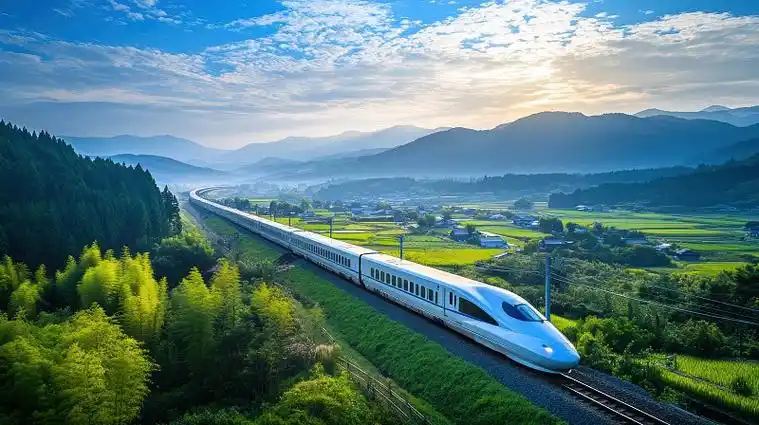
High-speed rail has changed the way people travel, but the experience can feel very different depending on where you are.
In China, high-speed trains connect huge cities across enormous distances with remarkable speed and scale. In Europe, high-speed trains often connect countries, cultures, and historic cities in a way that feels deeply tied to the travel experience itself.
So which is better for travelers: China’s high-speed rail or Europe’s?
The answer depends on what kind of trip you want.
China Has the Bigger Network
China has built the world’s largest high-speed rail system in just a few decades.
For travelers, this means you can move between major cities such as Beijing, Shanghai, Guangzhou, Shenzhen, Chengdu, Xi’an, Hangzhou, Wuhan, and many others without taking a flight.
The scale is hard to compare with anywhere else. China’s network is designed as a national transportation backbone, not just a few premium routes between major cities.
Europe also has impressive high-speed rail, especially in countries such as France, Spain, Italy, and Germany. According to Eurostat, the EU had 8,556 km of high-speed lines in 2023. However, Europe’s network is more fragmented because it crosses many national systems, operators, languages, and ticketing rules.
China Feels More Standardized
One of the biggest advantages of China’s high-speed rail is consistency.
Stations may be huge, but the system usually feels standardized. Ticketing, security checks, platforms, train types, and boarding procedures follow a fairly predictable pattern across the country.
Once you understand how to take one high-speed train in China, it becomes much easier to take another.
China Railway’s official 12306 platform also centralizes train searches and ticketing, including English-language access for foreign travelers.
Europe feels more varied.
That can be charming, but also confusing. A traveler may need to deal with different operators, ticket platforms, reservation rules, and rail passes depending on the route.
Taking a train from Paris to Lyon is simple. But planning a multi-country route across Germany, France, Italy, Austria, or Spain can require more work.
Europe Wins on Romance and Scenery
China’s high-speed rail is efficient and modern, but Europe often wins on atmosphere.
European trains frequently connect historic city centers. You can leave Paris, arrive in Amsterdam, continue to Cologne, then travel to Milan or Barcelona, often passing through landscapes that feel like part of the journey.
For tourists, this is a major advantage.
Europe’s rail travel feels connected to old towns, cafés, museums, mountains, and cross-border culture.
China’s high-speed rail is more about scale and speed. The stations are often large, modern, and efficient, but some are located farther from historic city centers.
China Is Often Better for Long-Distance Domestic Travel
If your goal is to travel across one large country quickly, China is extremely strong.
Routes such as Beijing–Shanghai, Guangzhou–Wuhan, Chengdu–Xi’an, and Shanghai–Hangzhou show how high-speed rail has reshaped domestic travel.
For medium-distance trips, trains often compete directly with flights because they avoid airport-style travel time, long security queues, and delays.
For many travelers in China, high-speed rail is the easiest way to move between major cities.
Europe Is Better for Multi-Country Travel
Europe’s biggest advantage is cross-border travel.
You can wake up in one country and arrive in another before lunch.
This makes European rail travel especially attractive for tourists who want to visit several countries in one trip.
France, Germany, Spain, Italy, Switzerland, Belgium, and the Netherlands all offer strong rail experiences in different ways.
However, Europe’s cross-border system still has challenges. The European Court of Auditors has previously criticized Europe’s high-speed rail development as fragmented, slow to coordinate, and difficult to complete as a truly integrated network.
Ticket Prices Can Feel Very Different
China’s high-speed rail fares are usually predictable and relatively affordable compared with flights or long-distance car travel.
Prices vary by distance and seat class, but the system feels straightforward.
Europe can be more complicated.
Some routes are affordable if booked early, especially with budget operators or advance tickets. But last-minute fares can be expensive, and international journeys may require more planning.
For travelers who value simplicity, China often feels easier.
For travelers who enjoy searching for deals, passes, and scenic routes, Europe offers more flexibility.
Comfort and Onboard Experience
Both China and Europe offer comfortable high-speed train experiences.
Chinese high-speed trains are usually clean, modern, and smooth. Seats are generally spacious, and trains run frequently on major routes.
European trains can feel more varied. Some are very comfortable and elegant, while others depend heavily on country, operator, and train age.
China feels more uniform.
Europe feels more diverse.
That difference reflects the systems themselves: China built much of its high-speed rail network in a relatively short period, while Europe developed its network gradually across many countries.
Punctuality and Reliability
China’s high-speed rail is generally known for strong punctuality and operational discipline.
Europe varies much more by country and operator. Some systems are highly reliable, while others struggle with delays, congestion, or aging infrastructure.
Germany, for example, has faced long-running punctuality challenges. Deutsche Bahn set a target of reaching 80% long-distance punctuality by 2035 after only slightly above 60% of long-distance trains were punctual in 2025.
That does not mean European rail is poor. It means the experience depends heavily on where you travel.
Which Is Better?
China is better if you want:
- Fast domestic travel
- Large-scale connectivity
- Predictable ticketing
- Modern stations and trains
- Efficient city-to-city movement
Europe is better if you want:
- Cross-border travel
- Historic city-center arrivals
- Scenic routes
- Cultural variety
- A more romantic rail journey
In simple terms, China’s high-speed rail feels like infrastructure at massive scale. Europe’s high-speed rail feels like travel across history, geography, and culture.
Final Thoughts
China and Europe both offer impressive high-speed rail systems, but they are built around different travel experiences.
China’s system is faster to understand, larger in scale, and extremely useful for moving across a huge country. Europe’s system is more fragmented, but it offers a unique charm by connecting different countries, languages, and landscapes.
For efficiency, China may win.
For atmosphere, Europe may win.
For travelers, the best answer is simple: try both.