

The Forbidden City in Beijing, this royal palace standing on the land of China, is like a bright pearl, shining with the brilliance of the thousand – year – old Chinese civilization. It is a witness of history, bearing the rise and fall of the Ming and Qing dynasties; it is a inheritor of culture, gathering the wisdom and creativity of the Chinese nation; it is a masterpiece of architecture, showing the exquisite craftsmanship and extraordinary imagination of ancient craftsmen.
I. Historical Evolution
- The Beginning of Construction: The construction of the Forbidden City in Beijing began in 1406, during the Yongle period of the Ming Dynasty, modeled after the Imperial Palace in Nanjing. After Emperor Chengzu of the Ming Dynasty, Zhu Di, seized the throne through the Jingnan Campaign, in order to strengthen his rule, he decided to move the capital to Beijing. He issued an edict to send people to mine precious timbers and stones all over the country. Precious nanmu wood mostly grew in the mountains, and the common people took risks to enter the mountains to cut wood, paying a huge price in life. There is a saying passed down from later generations that “a thousand people enter the mountain, but only five hundred come out”. The huge Danbi stone behind the Baohe Hall was mined in Fangshan, southwest of Beijing. Tens of thousands of laborers drew water from the wells and poured it into an ice – road in the cold winter, and it took 28 days to transport it to the palace. In addition, the gold – bricks fired in Suzhou and the tribute bricks from Linqing, Shandong were also successively transported to Beijing. After 11 years of preparatory work, in 1417, the Forbidden City in Beijing officially started construction and was completed in 1420.
- The Ming Dynasty Period: After the completion of the Forbidden City, it has gone through many vicissitudes. In 1421, the front three halls were burned down by a fire, and they were not rebuilt until 1440. After that, in 1557 and 1597, there were successive fires in the Forbidden City, and many palaces were burned down. Through many reconstructions and repairs, the Forbidden City experienced the rise and fall in the Ming Dynasty, and also witnessed the governance and court life of the emperors of the Ming Dynasty.
- The Qing Dynasty Period: After the Qing Dynasty entered the pass, it basically adopted the architectural style of the Forbidden City in the Ming Dynasty. However, some renovations and expansions were also carried out, such as changing the names of some palaces. The three main halls were renamed from Huangji Hall, Zhongji Hall, and Jianji Hall to Taihe Hall, Zhonghe Hall, and Baohe Hall. The Qing emperors also held various grand ceremonies and sacrifices in the Forbidden City. The Forbidden City was still the political and cultural center of the country.
- The Republic of China Period: After the Revolution of 1911 broke out, Pu Yi abdicated in 1912. In 1914, the Ministry of Internal Affairs of the Beiyang Government used the front – court palaces of the Forbidden City to establish the “Antique Exhibition Hall”. In 1924, the Regency Cabinet revised the “Preferential Treatment Conditions for the Qing Dynasty”, and expelled Pu Yi from the palace. Subsequently, a Commission for Handling Qing Dynasty Relics was organized to inventory the items in the Qing Palace. On October 10, 1925, the Palace Museum was officially established. The Forbidden City, from an old – time royal palace, was transformed into a museum open to the public, starting a new chapter in its history.
- The Modern Period: After the founding of the People’s Republic of China in 1949, the Forbidden City has been properly protected and managed. The state has invested a large amount of funds in the renovation of ancient buildings and the cleaning of cultural relics, and put forward the renovation and protection policy of “focusing on maintenance, key renovation, overall planning, and gradual implementation”. In 1961, the Forbidden City was listed as one of the first batch of national key cultural relics protection units. In 1987, it was listed on the World Heritage List. In 2007, it was rated as a national 5A – level tourist scenic spot. Now it has become an important window for displaying the excellent traditional Chinese culture.
II. The Beauty of Architecture
- Overall Layout: The Forbidden City was strictly built in accordance with the imperial – city construction principle of “front court, rear market, left ancestral temple, right shrine” in Zhou Li (The Rites of Zhou). It is located in the center of the central axis of Beijing, 961 meters long from north to south and 753 meters wide from east to west. It is surrounded by a 10 – meter – high city wall on all sides, and there is a 52 – meter – wide moat outside the city, forming a solid defense system. There are four city gates in the Forbidden City, the Meridian Gate in the south, the Shenwu Gate in the north, the Donghua Gate in the east, and the Xihua Gate in the west. There is a watchtower at each of the four corners of the city wall, and its structure is complex. There is a folk saying of “nine beams, eighteen pillars, and seventy – two ridges”.
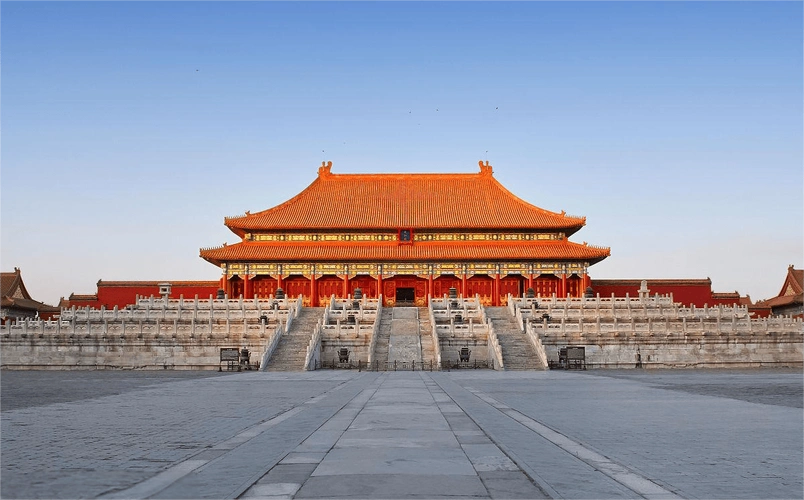
- Outer – court Buildings: The center of the outer court is the Taihe Hall, Zhonghe Hall, and Baohe Hall, collectively referred to as the three main halls, where the country held grand ceremonies. The Taihe Hall, also known as the Hall of Supreme Harmony, is the building with the highest rank and the largest scale in the Forbidden City. Its roof adopts the double – eave hip – roof style, and there are 10 mythical animals decorated on the eaves corners, which is unique in Chinese ancient architecture. There is the emperor’s throne in the hall, and the floor is paved with gold bricks. The decoration is gorgeous, highlighting the supremacy of imperial power. The Zhonghe Hall is the place where the emperor rested and received the homage of the attendants before holding a grand ceremony in the Taihe Hall. The roof is of the pyramidal – roof style, and the shape is exquisite. The Baohe Hall is the place where the emperor held the palace examination and hosted banquets for the princes and nobles. The roof is of the gable – hip roof style, with a grand momentum.
- Inner – court Buildings: The center of the inner court is the Qianqing Palace, Jiaotai Hall, and Kunning Palace, collectively referred to as the three rear palaces, which are the main palaces where the emperor and the empress lived. The Qianqing Palace was the place where the emperor handled daily government affairs and lived. Many emperors of the Ming Dynasty lived and governed here. The Kunning Palace was the bedroom of the empress in the Ming Dynasty. In the Qing Dynasty, it was transformed according to the customs of the Manchu people and became a place for Shamanist sacrifices. The Jiaotai Hall is located between the Qianqing Palace and the Kunning Palace, implying the harmony of heaven and earth. It is mainly used to store the emperor’s imperial seals. On both sides of the three rear palaces are the six eastern palaces and the six western palaces, which are the living places of the concubines. The architectural styles of each palace are different, and they echo each other, reflecting the rigorous layout of the royal palaces.
- Architectural Details: The roof forms of the buildings in the Forbidden City are rich and colorful, with more than 10 types, such as hip – roof, gable – hip roof, pyramidal – roof, etc. Different roof forms reflect different ranks and functions. The roofs are covered with various colored glazed tiles. The main halls are mainly yellow, symbolizing the dignity of imperial power. Green is used for the buildings in the living areas of the princes. Other colored glazes are mostly used in the gardens or glazed walls. In addition, the brackets, doors, windows, beams and columns of the palaces are all exquisitely carved and painted, with rich themes and exquisite craftsmanship, showing the superb skills of ancient craftsmen.
III. Cultural Connotations
- Royal Culture: The Forbidden City is the place where the royal family of the Ming and Qing dynasties lived and governed, containing rich royal culture. There is a strict hierarchical system here. From the scale and layout of the palaces to the costumes and etiquettes of the people, there are clear regulations, reflecting the supremacy of imperial power and the strictness of the feudal hierarchy. The emperor held various grand ceremonies such as enthronement, wedding and celebration here, demonstrating the majesty and prosperity of the country. Many court etiquettes and regulations inherit the long – standing etiquette culture of the Chinese nation.
- Religious Culture: The religious cultural relics collected in the Forbidden City include four categories: Han – Chinese Buddhism, Tibetan Buddhism, Taoism, and Shamanism. There are many Buddhist halls in the palace, such as Zhongzheng Hall and Yuhua Hall, where a large number of Buddha statues, Thang -kas and other Buddhist cultural relics are enshrined. This reflects the respect of the royal family for Buddhism in the Ming and Qing dynasties, especially the important position of Tibetan Buddhism in the palace. Taoist cultural relics are stored in halls such as the Qin’an Hall and the Xuanqiong Baodian. Shamanist cultural relics are stored in the west – warm pavilion of the Kunning Palace. These religious cultural relics are integrated with the architecture, reflecting the diversity of religious culture in the Forbidden City.
- Artistic Culture: The Palace Museum houses more than 1.86 million pieces/sets of collections, covering various categories such as calligraphy and paintings, ceramics, bronzes, jades, and enamelware. Among them, there are art treasures like Riverside Scene at Qingming Festival. These cultural relics are the crystallization of the artistic creativity of the Chinese nation, showing the development context and superb level of ancient Chinese art. The architecture of the Forbidden City itself is also a masterpiece of art. Its architectural forms and decorative arts have extremely high aesthetic value and represent the peak of ancient Chinese architectural art.
- Confucian Culture: The layout and naming of the Forbidden City also embody Confucian culture. For example, the layout of the front – court and rear – bedroom reflects the Confucian ethical and moral concepts. The Qianqing Palace represents heaven, and the Kunning Palace represents earth, symbolizing the universe. The six eastern palaces and six western palaces on both sides of the three rear palaces reflect the harmony of yin and yang. The naming of palaces such as Taihe, Zhonghe, and Baohe contains Confucian ideas such as the doctrine of the mean and harmony, reflecting the profound manifestation of Confucian culture in the construction of royal palaces.
IV. Historical Value and Modern Significance
- Historical Value: The Forbidden City is the culmination of ancient Chinese palace architecture. It is the only existing example and the highest model in the development history of ancient Chinese palace cities. It comprehensively embodies traditional Chinese philosophy, architecture, and aesthetics, and has extremely high historical value. It is an important physical example of the historical evolution of the Ming and Qing dynasties. Through the architecture, cultural relics, and archives of the Forbidden City, we can deeply understand all aspects of the politics, economy, culture, and society of the Ming and Qing dynasties. It is an important treasure – house for studying ancient Chinese history.
- Modern Significance: In modern society, the Forbidden City still plays an important role. As a world – cultural heritage and a famous tourist scenic spot, it attracts tourists from all over the world, becoming an important window for displaying excellent traditional Chinese culture, enabling more people to understand China’s long history and splendid culture. At the same time, the Palace Museum is also constantly innovating. Through holding various exhibitions, cultural activities, and developing cultural and creative products, it makes the ancient Forbidden – City culture glow with new vitality, promoting the creative transformation and innovative development of excellent traditional Chinese culture.

The Forbidden City in Beijing, this royal palace carrying the thousand – year – old Chinese civilization, with its long history, exquisite architecture, and rich cultural connotations, has become the pride and symbol of the Chinese nation. It is a living historical book, telling the past glory and vicissitudes; it is an eternal monument, standing in the long river of history, witnessing the great rejuvenation of the Chinese nation.