


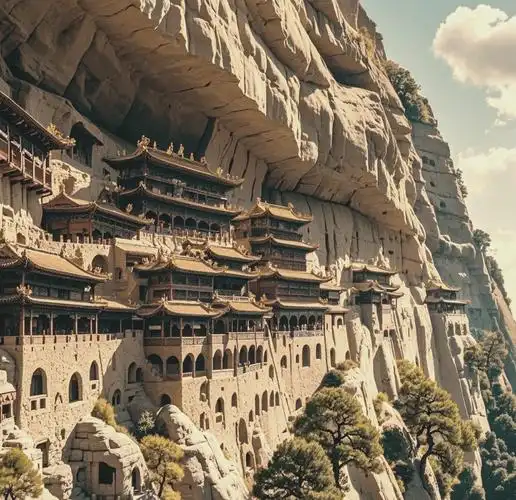
Introduction: The Temple That Defies Gravity
Imagine standing at the base of a sheer cliff in northern China.
Hundreds of feet above your head, a wooden temple appears to cling impossibly to the rock face.
Narrow walkways hang over empty space.
Ancient halls seem suspended in midair.
From a distance, the structure looks less like a building and more like a miracle.
Your first thought is almost always the same:
“How is that even possible?”
For more than 1,500 years, travelers have asked this question.
The answer remains one of the most fascinating stories in Chinese architectural history.
Known as the Hanging Temple, or Xuankong Temple, this extraordinary structure has survived wars, earthquakes, dynastic changes, and centuries of harsh weather.
Yet it still hangs from the cliff as if challenging gravity itself.
For many foreign visitors, it is one of the most astonishing places in China—and perhaps one of the most remarkable buildings ever created by human hands.
A Temple Unlike Any Other
Across the world, temples are usually built on mountain tops, riverbanks, forests, or city centers.
The Hanging Temple is different.
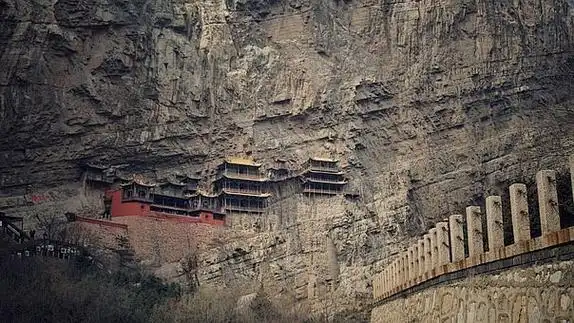
It is literally attached to a vertical cliff.
Located near Mount Heng in Shanxi Province, the temple sits approximately 75 meters (246 feet) above the valley floor.
From below, it appears dangerously fragile.
Wooden beams support interconnected halls.
Bridges connect different sections.
Balconies overlook steep drops.
Yet despite its appearance, the structure has remained standing for more than fifteen centuries.
Its survival represents one of the greatest engineering achievements of the ancient world.
Why Build a Temple on a Cliff?
This is perhaps the most intriguing question.
Why would anyone choose such a difficult location?
Ancient builders had several reasons.
Protection From Flooding
The valley below was historically prone to flooding.
Building higher on the cliff protected the temple from rising waters.
Preservation
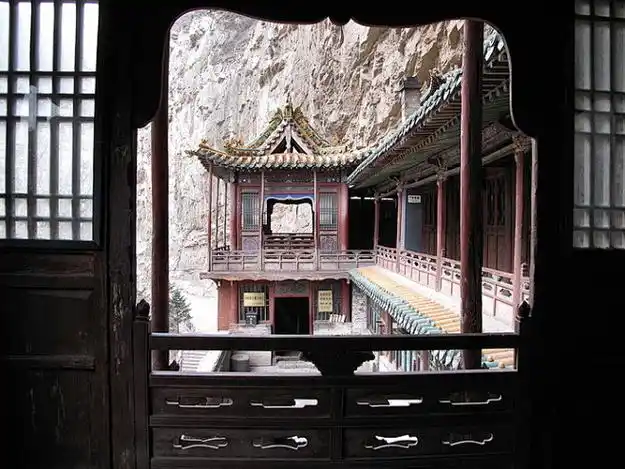
The cliff overhang shields much of the structure from rain, snow, and direct sunlight.
This natural protection helped preserve the wooden architecture.
Spiritual Symbolism
Mountains occupy a sacred place in Chinese religious traditions.
Building closer to the sky represented a symbolic connection between humanity and the divine.
Isolation
Religious practitioners often sought quiet environments for meditation and spiritual reflection.
The cliff provided both security and solitude.
The location was not chosen despite its challenges.
It was chosen because of them.
The Origins of the Hanging Temple
Historical records suggest construction began around the late 5th century during the Northern Wei Dynasty.
At that time, China was politically divided and culturally diverse.
Religious ideas from across Asia were spreading throughout the region.
A monk named Liao Ran is traditionally credited with initiating the project.
According to legend, he sought a place where spiritual practice could flourish away from worldly distractions.
The dramatic cliff offered exactly that.
Over the centuries, successive dynasties expanded and restored the temple.
What visitors see today reflects contributions from multiple periods of Chinese history.
Each generation helped preserve and strengthen the structure.
The Engineering Mystery
At first glance, many visitors focus on the visible wooden pillars beneath the temple.
These supports appear to hold up the entire building.
Surprisingly, they are not the primary structural system.
The real secret lies inside the mountain itself.
Ancient builders inserted large wooden beams deep into holes carved directly into the cliff face.
These beams function as anchors.
The weight of the structure is distributed through this hidden framework rather than relying solely on the external pillars.
This ingenious design allows the temple to remain remarkably stable.
Modern engineers continue to admire the sophistication of the system.
Considering the technology available 1,500 years ago, the achievement is extraordinary.
Walking Through the Sky
Visiting the Hanging Temple is not merely sightseeing.
It is an experience.
As visitors ascend toward the entrance, the scale of the cliff becomes increasingly apparent.
Narrow staircases lead upward.
Wooden walkways cling to the mountainside.
The valley stretches far below.
Once inside, the temple feels surprisingly intimate.
The rooms are compact.
The corridors are narrow.
Every step reminds visitors that they are suspended high above the ground.
For some, the experience is exhilarating.
For others, slightly terrifying.
Either way, it is unforgettable.
The World’s Only Temple of Three Religions
One of the most remarkable aspects of the Hanging Temple is its religious inclusiveness.
Most temples are dedicated to a single tradition.
The Hanging Temple combines three of China’s most influential belief systems:
- Buddhism
- Taoism
- Confucianism
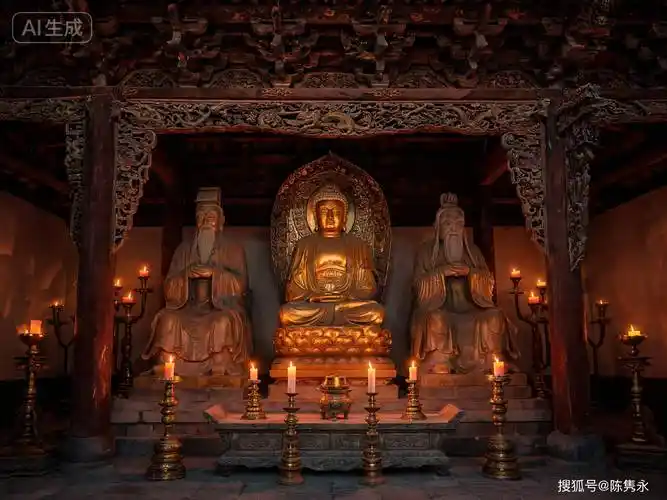
Within the temple, statues representing all three traditions stand side by side.
This arrangement reflects an important aspect of Chinese culture.
Rather than viewing these philosophies as mutually exclusive, many Chinese communities historically integrated elements from each.
The Hanging Temple serves as a physical symbol of this coexistence.
Few religious sites anywhere in the world embody such a unique synthesis.
Buddhism: The Path to Enlightenment
Buddhist influences arrived in China from India through the Silk Road.
Within the Hanging Temple, Buddhist statues represent compassion, wisdom, and spiritual awakening.
Monks once practiced meditation in these halls while surrounded by mountain silence.
The elevated location reinforced the Buddhist ideal of transcending worldly attachments.
The temple’s environment naturally encouraged contemplation.
Even modern visitors often remark upon its peaceful atmosphere.
Taoism: Harmony With Nature
Taoism emphasizes balance, simplicity, and harmony with the natural world.
Few locations illustrate these principles more effectively than the Hanging Temple.
Rather than dominating the landscape, the structure adapts to it.
The building follows the contours of the cliff.
Architecture and nature become inseparable.
This integration reflects core Taoist values.
The mountain is not merely a backdrop.
It is part of the temple itself.
Confucianism: Order and Virtue
Confucianism focuses on ethical behavior, social responsibility, and personal cultivation.
Its presence within the temple demonstrates how deeply Confucian ideas shaped Chinese society.
The coexistence of Confucian, Buddhist, and Taoist figures reflects a broader Chinese worldview in which multiple traditions contribute to moral and spiritual life.
For historians, this makes the Hanging Temple culturally significant beyond its architectural achievements.
Surviving 1,500 Years of History
The temple has witnessed an extraordinary span of history.
It existed before:
- The Viking Age
- The Norman Conquest
- The Renaissance
- The Industrial Revolution
- The invention of the airplane
Empires rose and fell.
Dynasties changed.
Wars reshaped nations.
Yet the Hanging Temple endured.
Its survival speaks not only to engineering skill but also to generations of caretakers who understood its importance.
Without continuous maintenance, such a structure could not have survived.
The Most Photogenic Temple in China?
China contains thousands of temples.
Many are larger.
Many are older.
Many contain greater artistic treasures.
Yet few are as visually dramatic as the Hanging Temple.
Photographers love the contrast between:
- Vertical cliffs
- Ancient wooden architecture
- Open sky
- Mountain landscapes
The temple changes character throughout the day.
Morning light creates a sense of serenity.
Afternoon shadows emphasize its precarious position.
At sunset, the structure glows against the surrounding rock.
Every angle reveals something new.
The Symbol of Human Ingenuity
Beyond religion and tourism, the Hanging Temple represents something universal.
It demonstrates humanity’s ability to overcome seemingly impossible challenges.
Ancient builders faced enormous obstacles:
- Limited tools
- Difficult terrain
- Dangerous working conditions
Yet they transformed a cliff into one of the world’s most extraordinary architectural achievements.
The temple reminds us that innovation did not begin in the modern era.
Human creativity has always found ways to turn impossible ideas into reality.
Best Time to Visit
Spring (April–May)
Comfortable temperatures and clear skies create excellent conditions for photography.
Summer (June–August)
Green mountain scenery provides beautiful contrasts with the cliffside architecture.
Autumn (September–October)
Often considered the ideal season.
Cool weather and vibrant colors enhance the surrounding landscape.
Winter (November–March)
Snow occasionally transforms the temple into a breathtaking scene resembling a traditional Chinese painting.
Why Foreign Travelers Are Fascinated by the Hanging Temple
Many international visitors arrive expecting another historic temple.
They leave having witnessed something far more extraordinary.
The Hanging Temple challenges assumptions.
It combines:
- Engineering
- Religion
- History
- Art
- Adventure
Unlike many heritage sites, it creates an immediate emotional reaction.
Visitors do not need extensive historical knowledge to appreciate it.
One glance is enough.
The sheer improbability of the structure speaks for itself.
Conclusion: A Building That Shouldn’t Exist
Some places impress because of their size.
Others because of their beauty.
The Hanging Temple impresses because it seems impossible.
For 1,500 years, it has remained suspended between earth and sky.
It has become a symbol of ingenuity, faith, and perseverance.
Whether viewed as an engineering marvel, a religious sanctuary, or an architectural masterpiece, it occupies a unique place in human history.
For curious travelers seeking the most extraordinary experiences China has to offer, the Hanging Temple is not simply worth visiting.
It is unforgettable.
Because long after you leave, one question continues to linger in your mind:
How did they build that?