


Introduction: The China That Doesn’t Look Like China
Ask most foreigners to imagine China, and they will probably picture:
- The Great Wall
- Snow-covered mountains
- Ancient temples
- Giant cities filled with skyscrapers
- Pandas and bamboo forests
Very few would imagine tropical rainforests.
Even fewer would imagine wild elephants wandering through forests, golden Buddhist temples, banana plantations, and a culture that feels closer to Thailand or Laos than Beijing.
Yet all of these things exist in China.
Welcome to Xishuangbanna.
Located in the far south of Yunnan Province, near the borders of Laos and Myanmar, Xishuangbanna is one of the most surprising destinations in the country.
For many visitors, it completely transforms their understanding of China.
This is not the China of imperial palaces and northern dynasties.
This is a China of tropical forests, ethnic diversity, Buddhist traditions, and extraordinary biodiversity.
It is one of the most fascinating—and least understood—corners of the country.

A Different World at the Edge of China
Geographically, Xishuangbanna occupies a unique position.
The region sits within the Mekong River basin, one of Asia’s most important ecological and cultural zones.
The climate is tropical.
Temperatures remain warm throughout much of the year.
Heavy seasonal rains support dense forests and rich ecosystems.
As a result, the landscape looks dramatically different from the China many international travelers expect.
Visitors encounter:
- Palm trees
- Rubber plantations
- Bamboo forests
- Tropical flowers
- Rainforests
- River valleys
The environment often feels more Southeast Asian than traditionally Chinese.
This distinctive character is one of the region’s greatest attractions.

The Meaning of Xishuangbanna
The name Xishuangbanna comes from the Dai language.
It roughly translates to “Twelve Rice-Growing Districts.”
This reflects the agricultural heritage of the region.
For centuries, fertile river valleys supported rice cultivation and helped sustain local communities.
Agriculture remains an important part of daily life.
Terraced fields, fruit orchards, and tropical crops continue to shape the landscape.
The name itself reminds visitors that this region possesses a history and identity distinct from much of the rest of China.

Home of the Dai People
One of Xishuangbanna’s most remarkable features is its cultural diversity.
The region is home to numerous ethnic groups, but the Dai people are particularly influential.
Their traditions shape much of the area’s identity.
The Dai are known for:
- Elegant architecture
- Buddhist beliefs
- Rich festivals
- Traditional dance
- Distinctive cuisine
Visitors often notice similarities between Dai culture and the cultures of neighboring Southeast Asian countries.
This is not surprising.
For centuries, communities across this region maintained close cultural connections regardless of modern national borders.
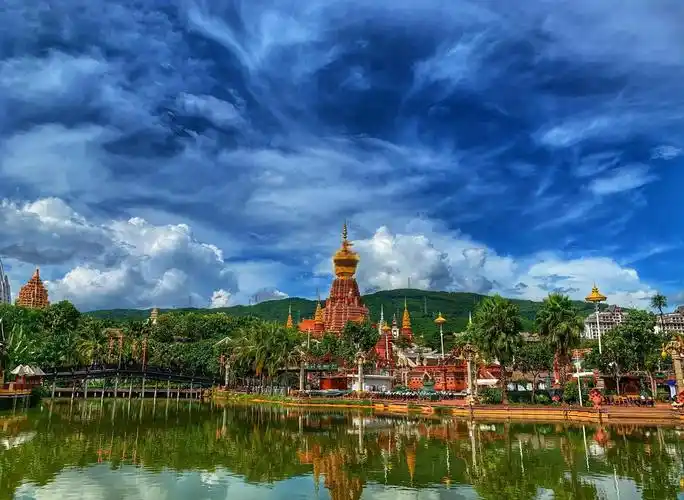
The Golden Temples of Southern China
Many travelers are surprised to discover Buddhist temples that resemble those of Thailand rather than the temples typically associated with China.
Throughout Xishuangbanna, golden stupas and ornate temple complexes rise above villages and forests.
Their architecture features:
- Multi-tiered roofs
- Intricate carvings
- Bright colors
- Golden decorations
These temples remain active centers of religious life.
Monks continue to study, teach, and participate in community activities.
For visitors, they offer insight into a lesser-known dimension of Chinese cultural diversity.
The Famous Water Splashing Festival
Perhaps no event better captures the spirit of Xishuangbanna than the Water Splashing Festival.
For the Dai people, this celebration marks the traditional New Year.
Water symbolizes purification, blessings, and good fortune.
During the festival, streets transform into scenes of joyful chaos.
People splash water on friends, family members, and strangers alike.
What begins as a symbolic gesture quickly becomes a massive celebration.
Music fills the air.
Traditional dances take place.
Communities gather to welcome a new year of prosperity and happiness.
For many visitors, participating in the festival becomes an unforgettable experience.
China’s Tropical Rainforests
One of the most astonishing facts about Xishuangbanna is that it contains some of China’s most important tropical rainforests.
These forests represent only a small percentage of the country’s land area, yet they support an enormous share of its biodiversity.
Walking through the rainforest feels completely different from exploring other parts of China.
Visitors encounter:
- Towering trees
- Hanging vines
- Exotic plants
- Dense vegetation
- Unusual insects
- Diverse birdlife
The forests create an atmosphere of exploration and discovery.
Every trail seems to lead into another hidden world.
The Land of Wild Elephants
Perhaps the most famous residents of Xishuangbanna are its elephants.
Many people are surprised to learn that China still has wild Asian elephants.
The majority live in this region.
These magnificent animals represent one of the country’s most important conservation priorities.
In recent years, elephant movements have attracted international attention.
Some herds traveled significant distances through rural communities, generating global headlines.
For conservationists, their survival offers hope.
For visitors, the presence of elephants adds another layer of wonder to the region.
A Biodiversity Hotspot
Xishuangbanna is often described as a biological treasure house.
Despite covering a relatively small area, it contains an extraordinary variety of life.
Scientists have recorded:
- Thousands of plant species
- Hundreds of bird species
- Rare mammals
- Amphibians
- Reptiles
- Butterflies
Many species are found nowhere else in China.
This biodiversity makes the region immensely important from both scientific and conservation perspectives.
The Mekong River: Lifeline of Southeast Asia
One of the world’s great rivers flows through Xishuangbanna.
Known in China as the Lancang River, it later becomes the Mekong River as it travels south through Southeast Asia.
For centuries, the river has supported:
- Trade
- Agriculture
- Transportation
- Human settlement
Its waters connect multiple countries and cultures.
Standing beside the river, visitors gain a sense of how geography has shaped the history of an entire region.
The river is not merely a natural feature.
It is the backbone of a civilization.
Tropical Fruits and Unique Cuisine
Food lovers quickly discover that Xishuangbanna offers flavors rarely encountered elsewhere in China.
The tropical climate supports a remarkable variety of fruits, including:
- Mangoes
- Pineapples
- Bananas
- Jackfruit
- Papayas
Local cuisine combines influences from Dai traditions and neighboring Southeast Asian cultures.
Common ingredients include:
- Fresh herbs
- Lemongrass
- Chili peppers
- Sticky rice
- Tropical fruits
The result is a culinary experience unlike that of northern or eastern China.
Many visitors consider the food one of the highlights of their trip.
Why Backpackers and Nature Lovers Are Drawn Here
Unlike some of China’s more famous tourist destinations, Xishuangbanna offers a slower pace of travel.
People come for:
- Nature
- Culture
- Wildlife
- Photography
- Relaxation
The region encourages exploration rather than rushing between attractions.
Travelers often spend days wandering through villages, forests, and markets.
The experience feels immersive.
Rather than simply observing local culture, visitors become part of it.
Why Foreign Travelers Are So Surprised
One of the most common reactions among international visitors is disbelief.
Many arrive with a very narrow image of China.
Xishuangbanna challenges those assumptions immediately.
Visitors discover:
- Tropical ecosystems
- Southeast Asian influences
- Religious diversity
- Ethnic traditions
- Wild elephants
The region reveals the extraordinary diversity that exists within China’s borders.
It demonstrates that China is not a single cultural or geographic experience.
It is many worlds combined into one nation.
Best Time to Visit
November to April
Generally considered the best period.
The weather is warm and relatively dry.
April
Particularly popular because of the Water Splashing Festival.
May to October
Rainy season.
The forests become exceptionally lush and vibrant, though occasional storms can affect travel plans.
The Future of Conservation
Like many tropical regions around the world, Xishuangbanna faces environmental challenges.
Population growth, development, and changing land use create pressures on ecosystems.
Conservation efforts focus on:
- Protecting rainforests
- Preserving wildlife corridors
- Supporting elephant populations
- Promoting sustainable tourism
Balancing economic development with environmental protection remains one of the region’s most important priorities.
The outcome will shape the future of this unique landscape.
Why Xishuangbanna Matters
Xishuangbanna is more than a tourist destination.
It is a reminder of the incredible diversity that exists within China.
The region demonstrates that national identity can encompass many cultures, languages, traditions, and environments.
Its forests preserve biodiversity.
Its temples preserve spirituality.
Its communities preserve centuries-old traditions.
Together, these elements create a destination unlike any other in the country.
Conclusion: Discovering a Hidden Side of China
The greatest travel experiences often occur when reality exceeds expectations.
Xishuangbanna offers exactly that.
Its rainforests challenge assumptions.
Its elephants inspire wonder.
Its temples reveal cultural diversity.
Its people demonstrate the richness of local traditions.
For travelers seeking a deeper understanding of China, few places are more rewarding.
Because Xishuangbanna reveals a simple truth:
China is far more diverse, complex, and surprising than most people imagine.
And in the tropical forests of the far south, that truth becomes impossible to ignore.
For many visitors, discovering Xishuangbanna feels like discovering an entirely different country.
Yet it is China.
And that is what makes it so extraordinary.