


Introduction: China’s Forgotten Silk Road
Most people have heard of the Silk Road.
The legendary network of trade routes connected China with Central Asia, the Middle East, and Europe.
But few foreigners know that China had another great trade route.
One that crossed snow-covered mountains.
One that climbed dangerous cliffs.
One where a single mistake could mean death.
For over a thousand years, merchants risked everything to travel this route.
They carried a product so important that millions of people depended on it.
That product was tea.
The route became known as the:
Ancient Tea Horse Road.
While the Silk Road carried silk, spices, and luxury goods, the Tea Horse Road connected two very different worlds:
- The tea-growing regions of southwestern China
- The high-altitude plateau of Tibet
It helped shape cultures, economies, and entire civilizations.
Yet today, many people have never heard of it.
What Was the Tea Horse Road?
The Tea Horse Road was not a single road.
Instead, it was a vast network of mountain trails connecting:
Yunnan
and
Sichuan
with Tibet and beyond.
At its peak, the route stretched thousands of kilometers.
Merchants, caravans, monks, and travelers used it for centuries.
Some historians describe it as one of the most difficult trade routes in human history.
Why Tibet Needed Tea
At first glance, the trade seems strange.
Why would Tibet import enormous amounts of tea?
The answer lies in geography.
Large parts of Tibet sit at elevations exceeding 4,000 meters.
The harsh climate limits agriculture.
Traditional Tibetan diets relied heavily on:
- Yak meat
- Dairy products
- Barley
Tea became extremely important because it:
- Added flavor
- Provided nutrients
- Improved digestion
Over time, tea became a daily necessity.
Even today, butter tea remains one of the most iconic drinks in Tibetan culture.
Why China Needed Horses
The other side of the trade was equally important.
Chinese dynasties needed strong horses.
Especially for:
- Military campaigns
- Border defense
- Transportation
The Tibetan Plateau produced hardy horses capable of surviving difficult conditions.
For Chinese governments, obtaining these animals was strategically important.
Thus began a mutually beneficial exchange:
Tea for horses.
The World’s Most Dangerous Trade Route
Transporting tea across the Himalayas was extraordinarily difficult.
Merchants faced:
- Avalanches
- Landslides
- Floods
- Bandits
- Extreme weather
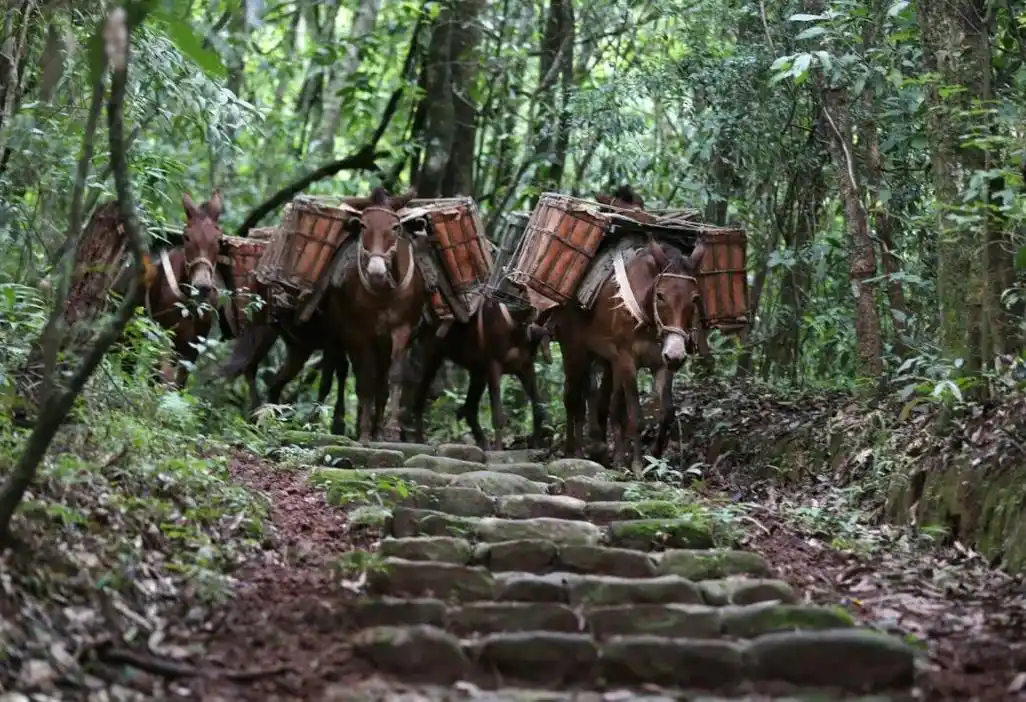
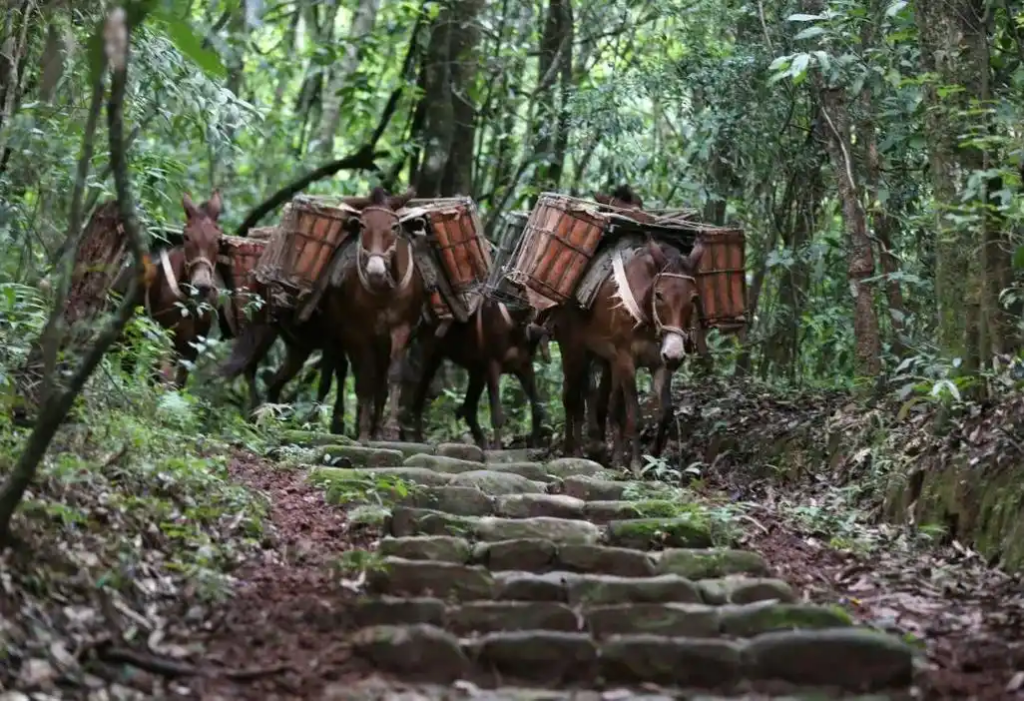
Many sections passed through narrow mountain paths carved into cliffs.
A single misstep could send people and animals plunging into deep valleys.
Travelers often spent months completing journeys.
The route demanded courage, endurance, and experience.
The Men Who Carried Mountains of Tea
One of the most remarkable aspects of the Tea Horse Road was the human labor involved.
Before modern transportation, tea was often carried by porters.
Some individuals transported loads weighing more than their own body weight.
The tea was compressed into dense bricks.
Workers strapped these bricks to their backs and climbed steep mountain trails.
Their journeys became legendary.
Why Tea Was Compressed Into Bricks
Tea leaves are fragile.
Loose leaves would have been difficult to transport through mountains.
The solution was simple:
Compress tea into solid bricks.
These tea bricks offered several advantages:
- Easier transportation
- Better durability
- Longer storage life
In some regions, tea bricks even functioned as a form of currency.
People could literally pay for goods using tea.
The Birthplace of Pu-erh Tea
One of the Tea Horse Road’s most famous exports was:
Pu-erh tea
originating in southern Yunnan.
Unlike many teas, Pu-erh continues to mature over time.
Some aged varieties become highly valuable.
Today, collectors may pay thousands of dollars for rare examples.
The Tea Horse Road played a crucial role in spreading this tea across Asia.
The Mountain City That Became a Trading Hub
One important stop along the route was:
Shangri-La
Known historically as Zhongdian, the town became a meeting point for traders from different cultures.
Here, people exchanged:
- Goods
- Languages
- Religions
- Ideas
The region became a crossroads of civilizations.
More Than Just Commerce
The Tea Horse Road carried much more than tea and horses.
It also transported:
- Buddhism
- Art
- Architecture
- Technology
- Cultural traditions
Monks traveled the route.
Pilgrims used it.
Families migrated along it.
The road became a channel for cultural exchange across the mountains.
The Spread of Tibetan Buddhism
Many Buddhist influences moved along the Tea Horse Road.
Monasteries emerged throughout the region.
Religious texts traveled between communities.
The route helped strengthen connections between Tibetan and Chinese Buddhist traditions.
Its cultural impact extended far beyond trade.
The Tea Horse Road vs. The Silk Road
Foreign visitors often compare the Tea Horse Road to the Silk Road.
Both connected distant regions.
Both facilitated trade.
Both transformed civilizations.
Yet there were important differences.
The Silk Road crossed deserts.
The Tea Horse Road crossed mountains.
The Silk Road linked continents.
The Tea Horse Road linked cultures separated by some of Earth’s most difficult terrain.
Many travelers argue that the Tea Horse Road was physically even more challenging.
Why So Few People Know About It
The Silk Road became famous because it connected Europe and Asia.
The Tea Horse Road remained largely within Asia.
As a result, it received less attention from Western historians.
Yet its influence on southwestern China and Tibet was enormous.
Without it, the history of the region would look very different.
What Remains Today?
Although modern highways have replaced much of the old route, traces remain.
Visitors can still find:
- Ancient stone paths
- Caravan towns
- Historic bridges
- Traditional villages
Some sections have become popular with hikers interested in history and culture.
Walking these routes offers a glimpse into a world that existed long before cars and trains.
Why Travelers Are Rediscovering It
In recent years, interest in the Tea Horse Road has grown.
Modern travelers increasingly seek experiences beyond famous tourist attractions.
The Tea Horse Road offers:
- Spectacular landscapes
- Rich history
- Cultural diversity
- Authentic local traditions
For many visitors, it represents a hidden side of China.
The Legacy of Tea
Perhaps the most remarkable thing about the Tea Horse Road is that its legacy remains visible today.
Tea continues to play an important role throughout China and Tibet.
The cultural connections created by centuries of trade still exist.
Even modern tea enthusiasts unknowingly benefit from traditions shaped by this ancient route.
Why It Matters Today
The Tea Horse Road reminds us that globalization is not a modern invention.
Long before airplanes and the internet, people crossed mountains to exchange goods and ideas.
They built relationships across vast distances.
They connected different cultures through trade.
In many ways, the Tea Horse Road was an early form of globalization.
Conclusion: The Road That Changed a Region
The Ancient Tea Horse Road may not be as famous as the Silk Road, but its story is equally fascinating.
For centuries, traders risked their lives transporting tea and horses across some of the world’s most difficult terrain.
Their journeys connected China and Tibet.
They spread religions, cultures, and technologies.
They transformed entire regions.
Today, the old caravans are gone.
The tea porters have disappeared.
Yet the legacy of the Tea Horse Road survives in every cup of tea, every mountain monastery, and every community that once depended on this extraordinary route.
It was more than a trade route.
It was a bridge between worlds.