
Introduction: The Discovery That Shocked China
What if everything you thought you knew about ancient China was incomplete?
For generations, historians believed that Chinese civilization began and developed primarily along the Yellow River in northern China.
Ancient dynasties such as the Shang and Zhou were considered the central story of early Chinese civilization.
Then archaeologists made a discovery that changed everything.
Hidden beneath the soil of China’s southwestern Sichuan Province lay the remains of a civilization unlike any previously known.
Its people created:
- Enormous bronze masks
- Giant human statues
- Mysterious golden objects
- Strange religious artifacts
The discoveries looked so unusual that some observers jokingly compared them to alien creations.
Yet they were undeniably human.
Today, this archaeological site is known as:
Sanxingdui Museum
And it remains one of the greatest mysteries in Chinese history.
Why Sanxingdui Fascinates the World
Ancient civilizations usually leave clues that connect them to neighboring cultures.
Egyptian artifacts look Egyptian.
Roman artifacts look Roman.
Greek artifacts look Greek.
Sanxingdui is different.
When archaeologists first uncovered its treasures, many experts were stunned.
The artifacts looked unlike anything previously discovered in ancient China.
Some bronze masks had:
- Giant protruding eyes
- Enormous ears
- Exaggerated facial features
Others appeared almost surreal.
For many people seeing them for the first time, the reaction is immediate:
“What is that?”
That sense of mystery is exactly why Sanxingdui has fascinated millions worldwide.
The Accidental Discovery
The story began unexpectedly.
In 1929, a farmer in Sichuan reportedly discovered a cache of ancient jade artifacts while digging a ditch.
At the time, nobody realized the importance of the find.
The objects attracted attention, but the true scale of the site remained unknown.
For decades, the mystery lingered.
Then came a breakthrough.
The Discovery of the Sacrificial Pits
In 1986, workers made an astonishing discovery.
Two large sacrificial pits were uncovered.
Inside were thousands of artifacts.
Archaeologists found:
- Gold objects
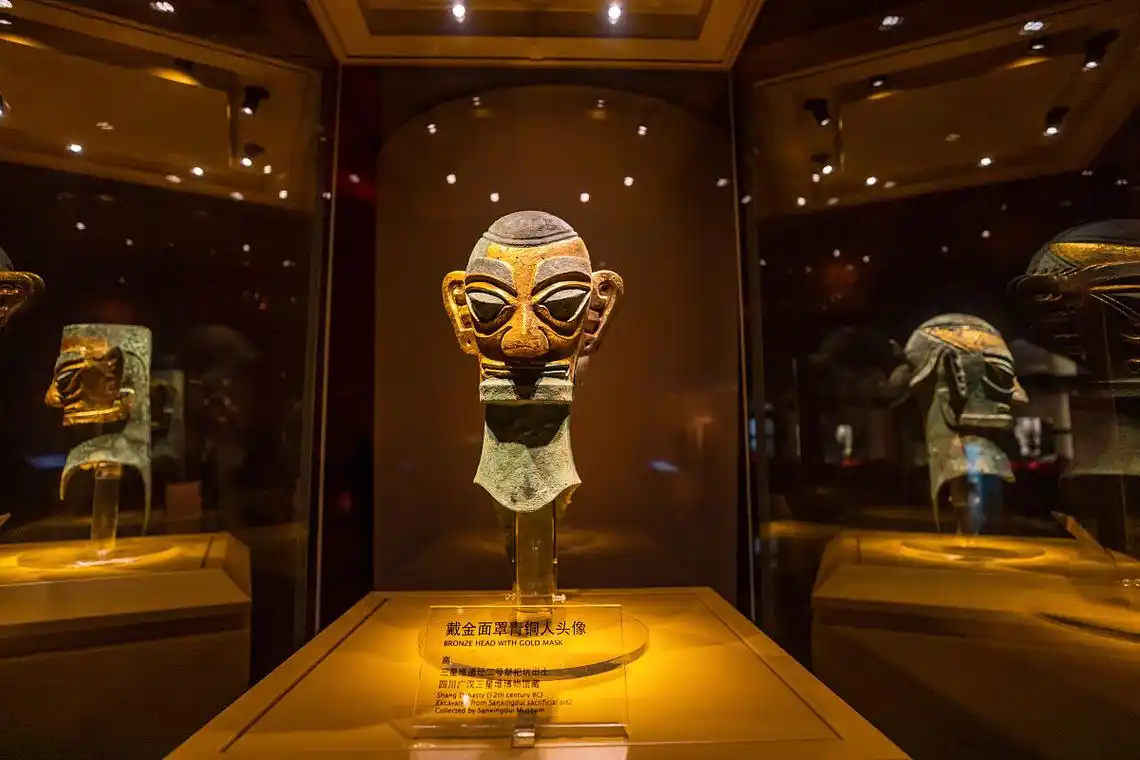
- Bronze masks
- Jade carvings
- Ivory
- Religious sculptures
The discovery shocked the archaeological world.
Nothing comparable had ever been found in China.
A Civilization Older Than Many Expected
Most Sanxingdui artifacts date back approximately 3,000 to 3,500 years.
That means they existed during roughly the same period as the late Shang Dynasty.
However, Sanxingdui culture appeared remarkably different from northern Chinese civilizations.
This raised a major question:
How many ancient civilizations existed in China?
The answer was apparently more complicated than previously believed.
The Kingdom of Shu
Most scholars associate Sanxingdui with the ancient Kingdom of Shu.
Shu was a powerful regional civilization that occupied parts of modern Sichuan.
For centuries, historical records mentioned Shu.
But many details seemed legendary.
Some historians wondered whether the stories were exaggerated.
Sanxingdui changed that.
The discoveries demonstrated that a highly sophisticated civilization had indeed flourished in the region.
The Giant Bronze Masks
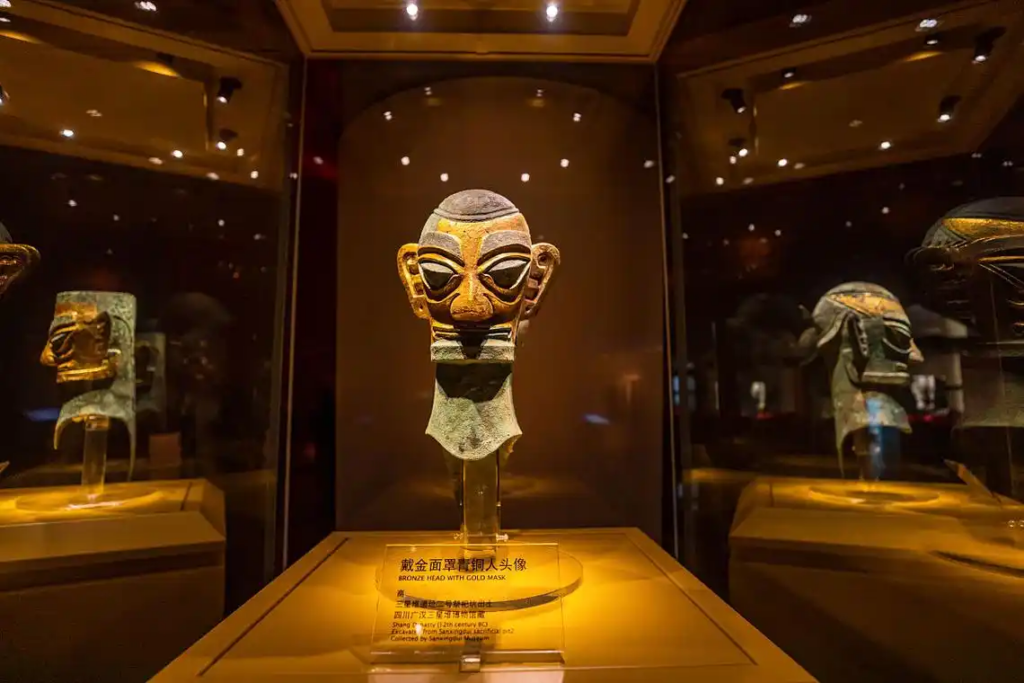
The most famous Sanxingdui artifacts are undoubtedly the bronze masks.
Some are so large that they seem almost impossible to have been created three thousand years ago.
Their features include:
- Huge eyes
- Sharp noses
- Large ears
Unlike traditional Chinese art known from other regions, these faces appear almost otherworldly.
No one knows exactly whom they represent.
Possible explanations include:
- Kings
- Priests
- Ancestors
- Deities
The debate continues today.
The Eyes That See Everything
Perhaps the most striking feature of many masks is the eyes.
Some extend dramatically outward.
Why?
Several theories exist.
Some researchers suggest they represent a legendary ruler known for extraordinary vision.
Others believe they symbolize spiritual insight.
No definitive answer has been found.
The eyes remain one of Sanxingdui’s greatest mysteries.
The Giant Bronze Human Statue
One artifact stunned archaeologists more than almost any other.
A bronze human figure standing over 2.6 meters (8.5 feet) tall.
At the time of its discovery, it was among the largest ancient bronze human statues ever found anywhere in the world.
The figure appears to be standing ceremonially.
But who does it represent?
A king?
A priest?
A god?
No one knows.
The Gold Mask Mystery
In recent years, new excavations have uncovered remarkable gold artifacts.
Among them are fragments of elaborate gold masks.
Gold held special significance within Sanxingdui culture.
Yet archaeologists still struggle to understand its exact role.
Was it associated with political authority?
Religious ceremonies?
Royal power?
The evidence remains incomplete.
Why Did They Burn Their Treasures?
One of the strangest discoveries involves the sacrificial pits themselves.
Many artifacts appear deliberately damaged.
Some were:
- Broken
- Burned
- Buried
This raises a fascinating question.
Why would a civilization destroy valuable objects?
Several possibilities have been proposed:
Religious Rituals
The objects may have been offerings to gods or ancestors.
Political Upheaval
The civilization may have experienced major social changes.
Natural Disaster
A catastrophe may have forced the population to abandon the site.
No theory fully explains the evidence.
The Missing City
Another mystery concerns the city itself.
The artifacts demonstrate extraordinary sophistication.
Yet archaeologists have struggled to identify the full urban center that produced them.
A civilization capable of creating such treasures should have left substantial settlements.
Some have been found.
But many questions remain unanswered.
Where exactly did the people live?
How large was their population?
What happened to them?
Did the Civilization Disappear?
One of the biggest mysteries is the apparent disappearance of Sanxingdui culture.
Around 3,000 years ago, activity at the site seems to have declined.
What happened?
Several theories exist.
Flooding
Some researchers suggest major floods altered local rivers.
Migration
The population may have relocated elsewhere.
Political Transformation
The civilization may have evolved into a different cultural center.
Evidence points in several directions but provides no final answer.
The Discovery of Jinsha
In 2001, archaeologists made another major discovery in Sichuan:
Jinsha Site Museum
Many scholars believe Jinsha may represent a successor culture connected to Sanxingdui.
The artifacts share similarities.
This suggests that the civilization may not have vanished entirely.
Instead, it may have transformed and relocated.
The Ancient Aliens Theory
Because Sanxingdui artifacts look so unusual, some internet users have proposed extraordinary explanations.
Claims include:
- Ancient aliens
- Lost super-civilizations
- Visitors from another world
There is no credible evidence supporting these theories.
Archaeologists overwhelmingly agree that Sanxingdui was created by human beings.
However, the artifacts are so visually striking that such speculation continues to attract attention online.
Why Sanxingdui Changed Chinese History
Before Sanxingdui, many people viewed early Chinese civilization through a relatively simple narrative centered on the Yellow River.
Sanxingdui revealed something more complex.
Ancient China contained multiple regional civilizations developing simultaneously.
The country was never culturally uniform.
Instead, it was a mosaic of diverse societies.
This realization transformed the study of Chinese history.
Why Foreign Visitors Are So Fascinated
Sanxingdui combines several elements that people love:
- Ancient mysteries
- Lost civilizations
- Archaeological discoveries
- Strange artifacts
- Unanswered questions
It feels almost like the Chinese equivalent of:
- Atlantis
- Stonehenge
- Easter Island
Yet unlike those sites, major discoveries are still being made today.
The New Discoveries Keep Coming
Excavations at Sanxingdui continue.
Recent archaeological work has uncovered thousands of additional artifacts.
Each new discovery raises fresh questions.
The story is far from finished.
In many ways, we may still be at the beginning of understanding this remarkable civilization.
What Sanxingdui Reveals About Human History
Perhaps the most important lesson is humility.
History is never complete.
Every generation assumes it understands the past.
Then a discovery like Sanxingdui appears and changes everything.
Entire civilizations can remain hidden for thousands of years.
Important chapters of human history can still be waiting underground.
Conclusion: China’s Greatest Archaeological Mystery
Three thousand years ago, a sophisticated civilization flourished in what is now Sichuan Province.
Its artists created extraordinary bronzes.
Its people built a complex society.
Then, for reasons still debated, it disappeared from history.
For centuries, the civilization remained forgotten.
Today, Sanxingdui stands as one of the most important archaeological discoveries ever made in Asia.
Its giant masks, mysterious rituals, and unanswered questions continue to captivate historians, archaeologists, and curious travelers alike.
And perhaps that is the greatest mystery of all:
How many more lost chapters of human history are still waiting to be discovered beneath our feet?