

Introduction: The City That Shouldn’t Have Existed
Imagine a city where:
- Police rarely entered.
- Government officials had almost no control.
- Streets were so narrow that sunlight barely reached the ground.
- Tens of thousands of people lived inside just a few city blocks.
- Dentists, factories, schools, restaurants, and apartments were stacked on top of one another like a giant concrete maze.
It sounds like something from a dystopian science-fiction movie.
Yet it was real.
For decades, in the heart of Hong Kong, there existed a place unlike any other on Earth:
Kowloon Walled City
A settlement so crowded, so mysterious, and so unique that many people still struggle to believe it actually existed.
Often described as:
“The most densely populated place in human history,”
Kowloon Walled City became a symbol of both urban chaos and human resilience.
Its story is one of empire, war, crime, survival, and extraordinary community.
A Fortress Before It Became a City
The story begins long before skyscrapers dominated Hong Kong.
Originally, Kowloon Walled City was not a slum.
It was a military fortress.
Built during the Qing Dynasty, the walled settlement served as an important defensive outpost protecting China’s southern coast.
The fortress contained:
- Soldiers
- Government officials
- Administrative offices
Massive stone walls surrounded the compound.
These walls gave the area its name:
The Walled City.
At the time, nobody could have imagined what it would eventually become.
How a Political Loophole Created a Monster
The origins of Kowloon Walled City’s strange status lie in colonial history.
After the British gained control of Hong Kong, a complicated legal situation emerged.
Although Britain controlled most of Hong Kong, the Walled City technically remained under Chinese authority.
This created a bizarre political anomaly.
The enclave existed physically inside British Hong Kong but was not fully governed by either side.
For decades, neither government exercised complete control.
The result was a legal gray zone unlike anything else in the world.
World War II Changed Everything
During the Japanese occupation of Hong Kong in World War II, much of the original fortress was dismantled.
After the war ended, the area remained largely neglected.
Then came a massive wave of migration.
Thousands of refugees fled political instability and poverty in mainland China.
Many needed somewhere to live.
The Walled City offered a solution.
Because government oversight was weak, people could settle there with relatively little interference.
Population growth exploded.
The Birth of a Vertical City
As more residents arrived, space became scarce.
The settlement could not expand outward.
It was surrounded by urban Hong Kong.
The only direction left was upward.
Residents began constructing buildings on top of existing structures.
Then more floors were added.
Then even more.
Often, construction occurred without formal approval or professional planning.
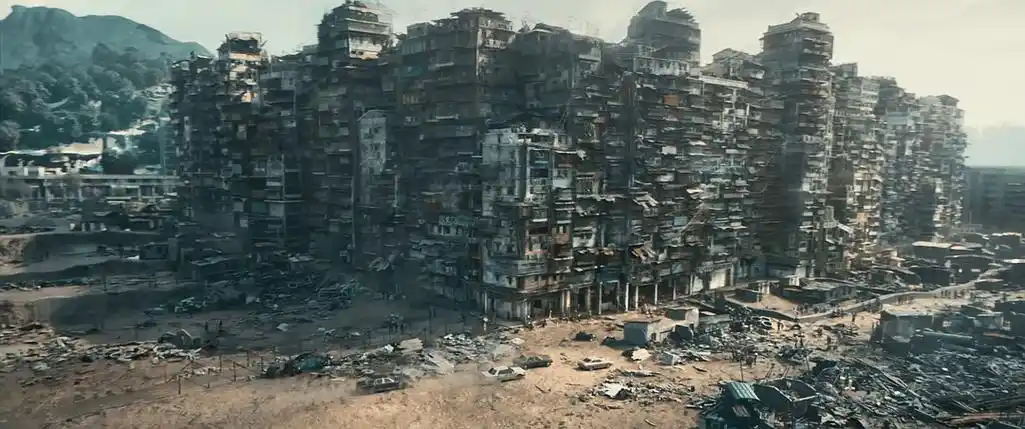
Over time, an enormous concrete labyrinth emerged.
The Most Crowded Place on Earth
By the 1980s, Kowloon Walled City covered only about 6.4 acres (2.6 hectares).
Yet approximately 35,000 to 50,000 people lived there.
To put this into perspective:
The population density was estimated at over 1.2 million people per square kilometer.
No modern city has ever approached such density.
Apartments were tiny.
Families often lived in spaces smaller than a typical hotel room.
Every available area was used.
A City Without Sunlight
One of the most shocking features of the Walled City was its architecture.
Buildings stood so close together that sunlight rarely reached the lower levels.
Many alleys measured only a few feet wide.
Residents often navigated:
- Dark corridors
- Narrow passageways
- Staircases connecting multiple structures
The city developed an almost underground atmosphere despite being above ground.
Visitors frequently described it as surreal.
Life Inside the Maze
Despite its reputation, Kowloon Walled City was not simply a criminal hideout.
It was a functioning community.
Inside the city were:
- Grocery stores
- Restaurants
- Schools
- Factories
- Medical clinics
- Religious temples
Residents built an entire society within the maze.
Many people spent most of their lives without leaving the neighborhood.
The Triad Connection
No discussion of Kowloon Walled City can ignore organized crime.
During certain periods, criminal organizations known as Triads operated within the settlement.
Activities reportedly included:
- Illegal gambling
- Drug use
- Prostitution
The city’s unusual legal status made enforcement difficult.
This contributed significantly to its notorious reputation.
However, popular culture often exaggerates the extent of criminal control.
For many ordinary residents, daily life revolved around work, family, and community rather than crime.
The Unlicensed Dentists
One of the strangest industries inside the Walled City was dentistry.
Because regulations were loosely enforced, numerous unlicensed dentists established practices there.
Patients came from outside the settlement because treatment was inexpensive.
At one point, hundreds of dental clinics reportedly operated within the city.
This became one of Kowloon Walled City’s most unusual characteristics.
Factories Inside Apartments
Manufacturing flourished within the maze.
Small workshops produced:
- Food products
- Plastic items
- Textiles
- Metal goods
Many businesses operated directly inside residential buildings.
Workers might live upstairs and work downstairs.
The distinction between home and workplace often disappeared.
Children Growing Up in a Concrete Labyrinth
Perhaps the most remarkable aspect of the Walled City was the children.
Thousands grew up there.
They attended school.
Played with friends.
Went shopping with parents.
To outsiders, the environment seemed unbearable.
To many children, it simply felt normal.
Former residents often recall a strong sense of neighborhood identity despite the crowded conditions.
Rooftops Became Parks
Because open space was nearly nonexistent, rooftops became gathering places.
Residents used rooftops for:
- Socializing
- Relaxation
- Exercise
- Children’s play
Above the darkness of the alleys existed a surprisingly vibrant rooftop world.
Some former residents describe the rooftops as the city’s unofficial parks.
The Reality Behind the Myths
Movies, documentaries, and video games have often portrayed Kowloon Walled City as a lawless nightmare.
The truth was more complicated.
Yes, crime existed.
Yes, living conditions were harsh.
But many residents also describe:
- Strong community bonds
- Friendly neighbors
- Mutual support
For those who lived there, the Walled City was home.
Why Architects Are Fascinated by It
Today, architects and urban planners study Kowloon Walled City extensively.
Why?
Because it represents an extreme example of organic urban development.
Unlike modern cities designed by planners, the Walled City evolved almost entirely through the decisions of residents themselves.
The result was chaotic.
Yet it was also surprisingly efficient.
Every inch of space served a purpose.
The Decision to Demolish It
By the 1980s, authorities concluded that conditions had become unsustainable.
Concerns included:
- Fire safety
- Sanitation
- Structural stability
The governments of Britain and China eventually agreed to clear the settlement.
Residents received compensation and relocation assistance.
Demolition began in the early 1990s.
After decades of existence, the Walled City disappeared.
What Exists Today?
Today, the site has been transformed into:
Kowloon Walled City Park
A peaceful public park.
Visitors can walk through landscaped gardens and historical exhibits.
Few traces of the old city remain.
Yet its memory continues to fascinate people worldwide.
Why the Internet Can’t Stop Talking About It
Decades after its destruction, Kowloon Walled City remains one of the most discussed urban environments in history.
It frequently appears in:
- YouTube documentaries
- Reddit discussions
- Architecture forums
- Video games
- Academic research
People are fascinated because the city seems impossible.
Yet it was real.
A Cyberpunk City Before Cyberpunk Existed
Many observers note that Kowloon Walled City looked remarkably similar to the fictional cities later seen in cyberpunk films and games.
The dense architecture.
The tangled wiring.
The narrow alleys.
The layered construction.
All contributed to an atmosphere that felt futuristic despite being entirely real.
It has influenced countless creators around the world.
What Kowloon Walled City Reveals About Human Nature
Perhaps the most important lesson is not about crime or overcrowding.
It is about adaptability.
Faced with limited space and minimal resources, residents created:
- Homes
- Businesses
- Communities
Life found a way to continue.
The city demonstrated humanity’s extraordinary ability to adapt to extreme circumstances.
Conclusion: The City That History Almost Forgot
Kowloon Walled City should not have existed.
It emerged from a political loophole.
It grew without planning.
It operated beyond normal systems of governance.
And yet, for decades, tens of thousands of people called it home.
To some, it was a slum.
To others, it was a community.
To historians, it remains one of the most extraordinary urban experiments ever witnessed.
Today, the concrete maze is gone.
But its legend lives on.
And whenever people search for the strangest, most crowded, and most fascinating city in history, one name inevitably appears:
Kowloon Walled City.