
Walk through the streets of Macau, and you might momentarily forget you’re in China.
Pastel-colored colonial buildings line the squares. Street signs are written in both Chinese and Portuguese. Catholic churches stand just minutes away from traditional Chinese temples, while Portuguese restaurants serve dishes alongside Cantonese eateries.
So why does a Chinese city feel so Portuguese?
The answer lies in more than four centuries of shared history. Macau is one of the few places in the world where Eastern and Western cultures have blended so naturally, creating an identity unlike anywhere else.
A Portuguese Settlement for More Than 400 Years
Portuguese traders first arrived on China’s southern coast in the 16th century. In 1557, they established a permanent settlement in Macau with the approval of the Ming government, using it as an important trading port between China, Japan, India, and Europe.
For centuries, Macau became a gateway between East and West. Goods, ideas, religions, languages, and cuisines flowed through its harbor, making the city one of Asia’s earliest international trading centers.
Unlike many colonial cities, Macau developed as a place where Chinese and Portuguese communities lived side by side. While each preserved its own traditions, they also influenced one another in countless ways.
Macau Returned to China in 1999
On December 20, 1999, Portugal officially handed Macau back to China.
Today, Macau is a Special Administrative Region (SAR), operating under the “One Country, Two Systems” principle. This arrangement allows Macau to maintain its own legal system, currency, customs, and many administrative practices while remaining part of China.
Rather than erasing its past, Macau has chosen to preserve its multicultural heritage. Portuguese architecture, public squares, churches, and historical districts have been carefully restored and protected.
As a result, visitors can still experience centuries of Portuguese influence throughout the city.
Why Are Street Signs Written in Portuguese?
One of the first things visitors notice is that almost every street sign appears in two languages: Chinese and Portuguese.
Portuguese remains one of Macau’s official languages alongside Chinese, even though relatively few residents speak it as their first language today.
The bilingual signs reflect Macau’s legal and historical traditions rather than everyday conversation. They also make the city especially interesting for travelers, who can spot names such as Largo do Senado and Rua da Felicidade displayed beside their Chinese equivalents.
Portuguese Architecture Is Everywhere
Macau’s architecture is perhaps the most visible reminder of its past.
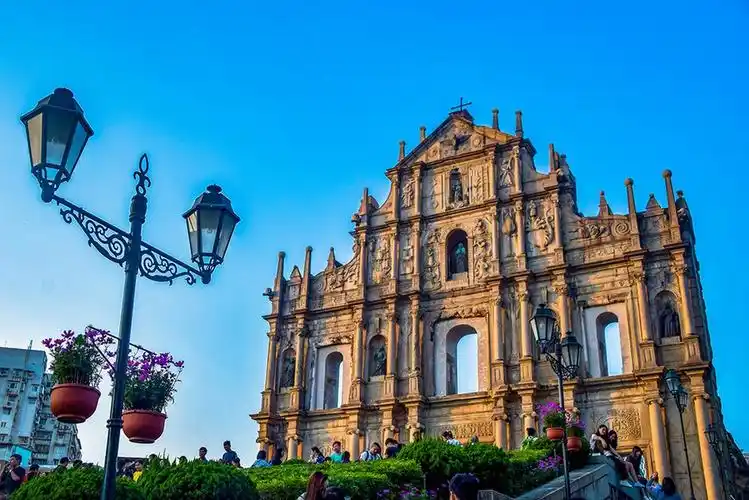
As you explore the historic center, you’ll encounter elegant European-style buildings with colorful façades, arched windows, wrought-iron balconies, and stone-paved squares.
Some of the city’s best-known architectural landmarks include:
- The Ruins of St. Paul’s
- Senado Square
- St. Dominic’s Church
- Holy House of Mercy
- Leal Senado Building
- Guia Fortress
These buildings stand alongside traditional Chinese temples, creating a cityscape found nowhere else in China.
In 2005, the Historic Centre of Macau was recognized as a UNESCO World Heritage Site for its outstanding cultural value.
A Unique Blend of Religions
Macau’s multicultural history is also reflected in its religious diversity.
Within a short walk, visitors can explore:
- Catholic churches
- Chinese Buddhist temples
- Taoist shrines
- A-Ma Temple, dedicated to the sea goddess Mazu
Rather than competing, these religious traditions have coexisted peacefully for centuries, reflecting Macau’s role as a crossroads of civilizations.
Macanese Cuisine: A Fusion Like No Other
Perhaps nowhere is Macau’s cultural blend more delicious than in its food.
Macanese cuisine combines Chinese ingredients with Portuguese cooking techniques and flavors introduced through Portugal’s former trading network, including influences from India, Africa, Malaysia, and Brazil.
Popular dishes include:
- Portuguese egg tarts
- African Chicken
- Minchi
- Portuguese seafood rice
- Serradura (sawdust pudding)
This rich culinary heritage has made Macau one of Asia’s most exciting food destinations.
Portuguese Festivals and Traditions
Although Macau is part of China, many Portuguese customs remain visible throughout the year.
Visitors may encounter:
- Portuguese cultural festivals
- Catholic processions
- Traditional Portuguese music performances
- Lusophone food festivals
- European-style Christmas celebrations
At the same time, Chinese festivals such as Lunar New Year, the Mid-Autumn Festival, and the Dragon Boat Festival are celebrated with equal enthusiasm.
This combination of traditions gives Macau a cultural calendar unlike any other city in Asia.
East Meets West in Everyday Life
Macau isn’t simply a place where Chinese and Portuguese cultures exist side by side—they have become deeply intertwined.
You’ll see this in everyday life:
- Portuguese tiles decorating Chinese buildings
- Cantonese conversations outside European churches
- Dim sum restaurants next to Portuguese bakeries
- Traditional Chinese medicine shops across from Western cafés
- Colonial architecture surrounding bustling Chinese markets
The result is a city that feels both familiar and surprisingly different.
Is Macau Still Worth Visiting If You Don’t Gamble?
Absolutely.
Many visitors now come to Macau primarily for its history, food, architecture, and culture rather than its casinos.
Because the city is compact, it’s easy to spend a day exploring UNESCO landmarks, sampling Macanese cuisine, strolling through Taipa Village, and enjoying the relaxed atmosphere without ever entering a gaming resort.
For travelers interested in culture, Macau offers one of the most distinctive experiences in Asia.
Final Thoughts
Macau’s Portuguese character isn’t a tourist attraction created for visitors—it’s the result of more than 400 years of shared history.
From bilingual street signs and colonial architecture to fusion cuisine and religious diversity, the city’s identity reflects centuries of cultural exchange between China and Portugal.
That unique heritage is what makes Macau so special. It’s not simply a destination where East meets West—it’s a place where the two have grown together, creating a culture found nowhere else in the world.