

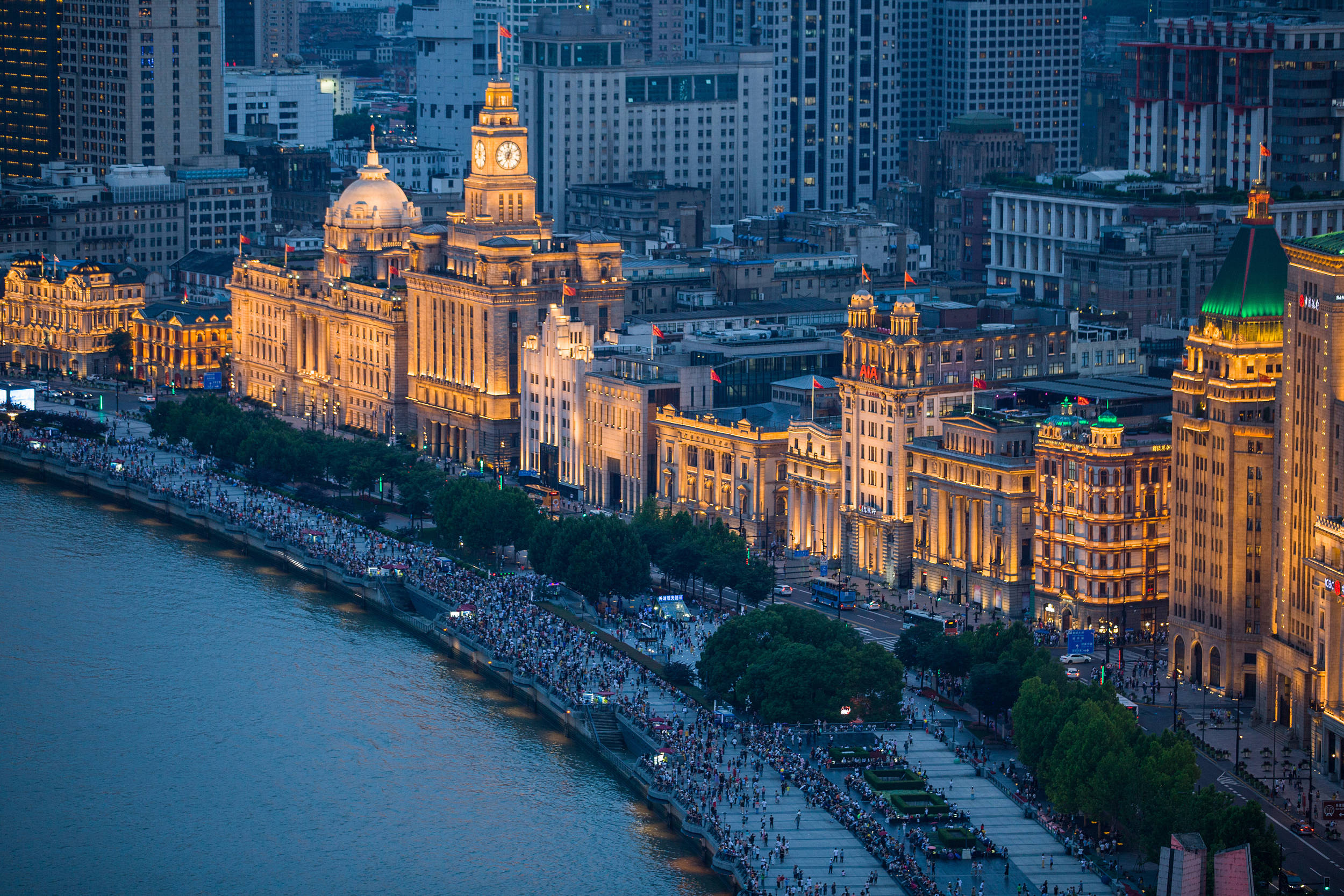
The Bund is undoubtedly the most dazzling business card of Shanghai. Like a brilliant ribbon, it is inlaid along the bank of the Huangpu River, carrying the history and glory of this city, and showcasing its unique charm and style.
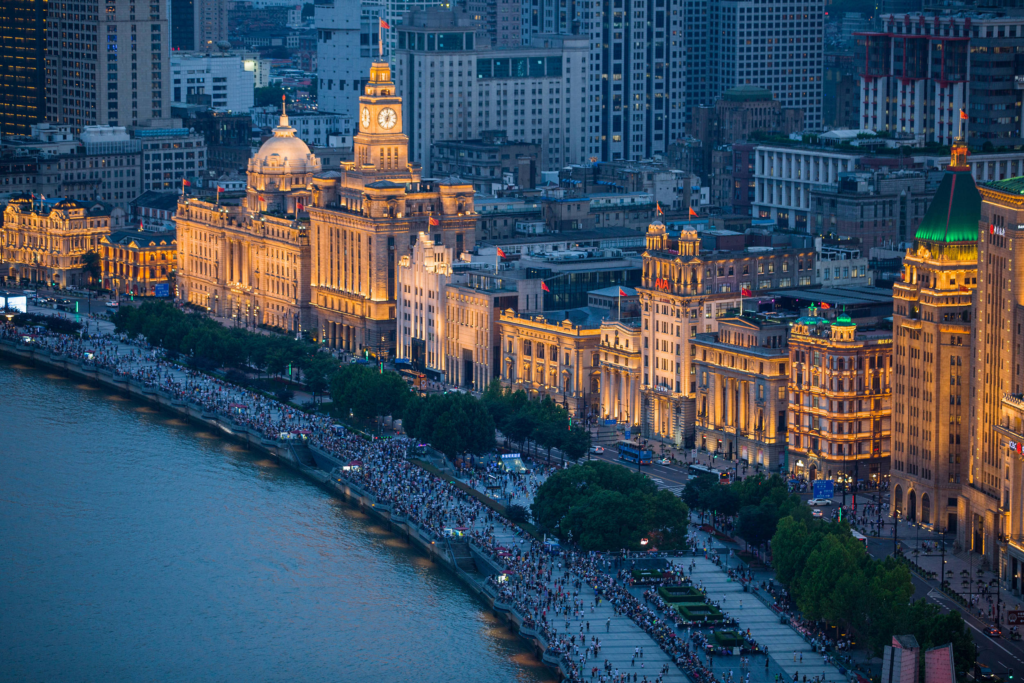
Historical Evolution
The Bund is located on Zhongshan Dongyi Road, Huangpu District, Shanghai, stretching about 1.5 kilometers from Jinling East Road in the south to Waibaidu Bridge in the north. Originally, it was a natural beach. During the Jiajing period of the Ming Dynasty, local fishermen named it “Huangpu Beach” because of its location along the Huangpu River.
In 1843, Shanghai was opened as a commercial port. In 1845, 830 mu of land west of the Bund was designated as the British Concession. Subsequently, foreign banks, commercial firms, clubs, etc. were established here one after another, and the Bund gradually became the financial center of the whole country and even the Far East. As time passed, buildings of various styles were erected, forming the world – famous “Exhibition of International Architecture”.
In 1943 (the 32nd year of the Republic of China), the century – long history of the Bund as a concession ended. In 1996, the buildings on the Bund were listed as the fourth batch of national key cultural relics protection units, becoming a precious gem in the history of modern Chinese architecture.
Charming Scenery
During the day, the Bund exudes an atmosphere of a blend of retro and freshness. Strolling along the riverside walkway, the river breeze caresses your face, bringing a touch of coolness. On the left are the solemn and elegant century – old buildings. Having withstood the test of time, they still stand tall and upright. Every brick and stone tells stories of the past. On the right is the cluster of skyscrapers in Lujiazui. Tall buildings such as the Oriental Pearl Tower and the Shanghai Tower stand in great numbers, demonstrating the prosperity and vitality of a modern metropolis. The old and new buildings contrast with each other here, forming a unique urban picture.
When night falls, the Bund ushers in its most glorious moment. At around 18:00, the lights turn on punctually. Under the illumination of the warm yellow lights, the old buildings appear more primitive and solemn. The shadow levels of the cornices and columns are distinct, as if you have traveled back in time to the prosperous old days. On the opposite side, the skyscrapers in Lujiazui are surrounded by colorful neon lights, shining brightly, and they shine in contrast with the old buildings on the Bund. On the river, cruise ships sail slowly, and the sparkling water surface reflects the lights on both sides, creating a dreamy and beautiful scene.
Stories behind the Famous Buildings
- The Customs House (No. 13, Zhongshan Dongyi Road): It is the “time – keeper” of the Bund, and its 80 – meter – high clock tower is very eye – catching. Its bell rings “The East Is Red” every 15 minutes. The melodious bell seems to be an echo of history, witnessing the century – old changes of the Bund. This building was constructed in 1927, designed by the British firm Palmer & Turner. The architectural style combines Greek and modern elements, and the exterior is solemn and elegant, making it one of the iconic buildings on the Bund.
- The Peace Hotel (No. 20, Zhongshan Dongyi Road): It is highly recognizable by its green copper roof and is a classic filming location for the TV drama “Blossoms Shanghai”. The Peace Hotel was originally built in 1929 and was formerly known as the Cathay Hotel, invested and constructed by the Sassoon Group. The architectural style is Chicago School Gothic. Its interior is decorated luxuriously. The crystal chandeliers in the lobby are dazzling, fully demonstrating the luxury and style of old Shanghai. It was once one of the most luxurious hotels in Shanghai and even the Far East, receiving many domestic and foreign politicians and celebrities.
- The Hongkong and Shanghai Banking Corporation Building (No. 12, Zhongshan Dongyi Road): It was once hailed as “the most luxurious building from the Suez Canal to the Bering Strait in the Far East” and is now the headquarters of the Shanghai Pudong Development Bank. The building was completed in 1923, designed by the British firm Palmer & Turner. It is the highest masterpiece of Western classical architecture in modern China. The glass ceiling in its hall is warm and grand, and the mosaic murals are exquisite, showing extreme luxury. At that time, the construction cost was as high as 10 million taels of silver, accounting for more than half of the total construction cost of all buildings on the Bund at that time. It is the building on the Bund with the largest land area, the widest frontage, and the largest volume.
- The British Consulate (No. 33, Zhongshan Dongyi Road): This is the earliest existing building on the Bund, full of a strong British style. Its British – style lawn and ancient trees create a unique atmosphere, and it occasionally holds exhibitions. The building was first built in 1849 and has gone through many renovations and expansions. It has witnessed the early history of Shanghai’s opening as a commercial port and is an important physical material for studying the modern history and diplomatic history of Shanghai.
The Bund, a place carrying a century – old history and culture, attracts countless tourists with its unique charm. Whether you are tracing the footsteps of history, enjoying the beautiful scenery, or experiencing the charm of architecture, the Bund can bring an unforgettable experience. It is the soul of Shanghai and an eternal urban legend.