

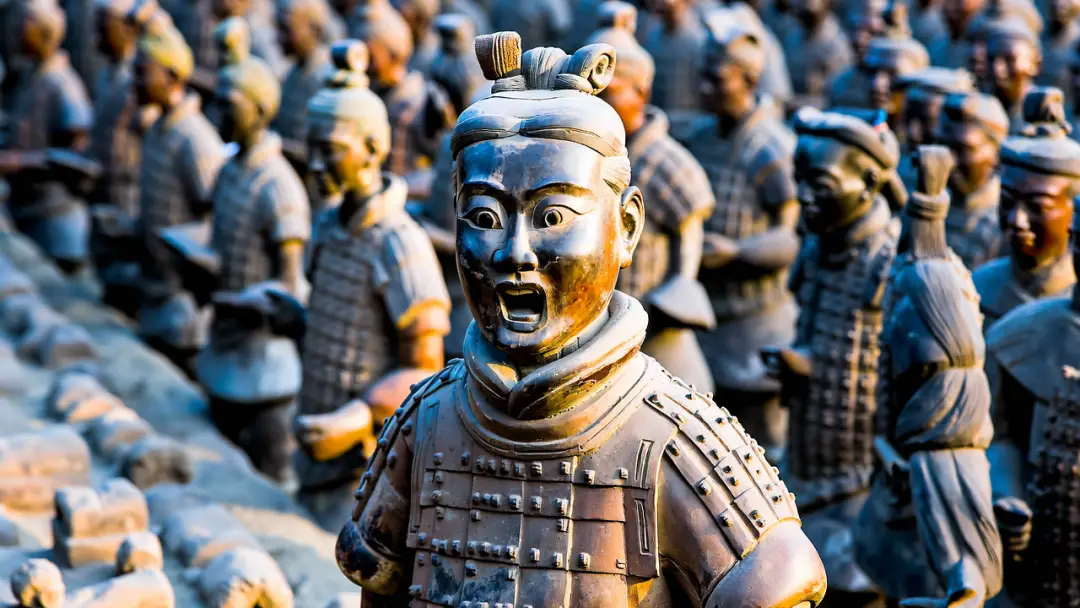
The Terracotta Warriors and Horses of Emperor Qinshihuang’s Mausoleum, the “underground legion” that has slept for more than two thousand years, has shocked the world with its majestic momentum, exquisite craftsmanship and rich connotations since its discovery in 1974, and is known as the “Eighth Wonder of the World”. It is not only a treasure of ancient Chinese sculpture art, but also an important treasure – house for studying the history, culture and military of the Qin Dynasty. It bears the profound historical memory and brilliant cultural achievements of the Chinese nation.
I. Historical Origin of the Terracotta Warriors and Horses
The Terracotta Warriors and Horses of Emperor Qinshihuang’s Mausoleum are the funerary pits of Emperor Qinshihuang’s Mausoleum, located at the northern foot of Lishan Mountain, 1.5 kilometers east of Lintong District, Xi’an City, Shaanxi Province. Qinshihuang, the first monarch to be called “Emperor” in Chinese history, began to build his own mausoleum after unifying the six states. According to historical records, the construction of Emperor Qinshihuang’s Mausoleum took 38 years, and the number of people participating in the construction reached 700,000. The scale is so grand and the burial is so rich that it is rare in the world. As a part of the mausoleum, the Terracotta Warriors and Horses were made according to the real – life appearance of the Qin army, which is the funerary objects for Qinshihuang to continue to rule the world after his death, reflecting the view of “treating the dead as the living” in the Qin Dynasty.
From the historical background, the Qin Dynasty was the first unified dynasty in Chinese history. Qinshihuang, relying on the powerful Qin army, successively destroyed the six states, ending the long – term split and war – torn situation since the Spring and Autumn and Warring States periods, and established the first centralized state in Chinese history. The Terracotta Warriors and Horses are the epitome of the powerful military force of the Qin Dynasty. They witnessed the great achievements of Qinshihuang in unifying China, and also reflected the highly centralized political system and strong national mobilization ability in the Qin Dynasty.
In terms of archaeological discovery, in March 1974, farmers in Lintong, Shaanxi, accidentally found broken terracotta figurines while digging a well, which kicked off the prelude to the archaeological excavation of the Terracotta Warriors and Horses. Subsequently, archaeologists successively discovered Pit 1, Pit 2 and Pit 3. Pit 1 is a rectangular military formation, 230 meters long from east to west and 62 meters wide from north to south, with an area of 14,260 square meters. There are about 6,000 terracotta warriors and horses, which is a large – scale military formation with infantry as the main force and some chariots mixed in. Pit 2 is roughly in the shape of a right – angled triangle, consisting of four parts, including an infantry archer square, a cavalry array, an array mainly composed of chariots, etc., which is a multi – arm mixed military formation. Pit 3 is smaller in scale, in the shape of a “concave”, and is the command center of the Terracotta Warriors and Horses.
Over the past half – century, the archaeological excavation and research on the Terracotta Warriors and Horses have never stopped. Through continuous archaeological work, a large number of terracotta figurines, terracotta horses and weapons have been unearthed, and the overall layout characteristics of Emperor Qinshihuang’s Mausoleum, which is centered on the earth – covered mound and forms an inner and outer city pattern around it with a large number of funerary pits, and the planning and design concepts that simulate the urban pattern, political system, court life, social culture, military system, etc. of the Qin Empire have been gradually clarified.

II. Cultural Connotations of the Terracotta Warriors and Horses
(I) Artistic and Cultural Values
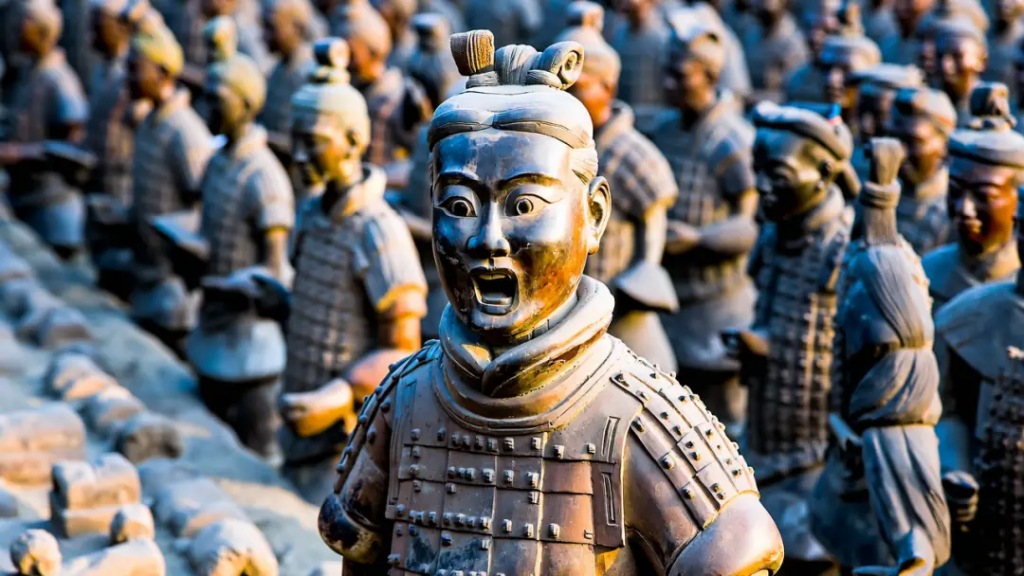
The Terracotta Warriors and Horses are the pinnacle of ancient Chinese sculpture art. Among the nearly 8,000 terracotta figurines, no two faces are exactly the same. The expression, hairstyle and armor details of each terracotta figurine are different, lifelike, showing a very high – level realistic level. Some of them look determined, as if full of the determination to fight; some have deep eyes, as if thinking about strategic tactics; some have a young face, possibly young soldiers who have just joined the army. These terracotta figurines are not only exquisitely carved in facial expressions, but also very particular about clothing and equipment. The clothing and equipment of terracotta figurines of different ranks and arms are obviously different, providing precious physical materials for the study of the clothing culture of the Qin Dynasty.
From an overall perspective, the military formation of the Terracotta Warriors and Horses is majestic and neatly arranged, as if reproducing the heroic posture of the Qin army in those days, which was powerful and overwhelming. Individually, every hair and armor piece of each terracotta figurine is exquisitely carved, reflecting the perfect combination of grandeur and finesse. Compared with the sculptures of ancient Greece and Rome, the Terracotta Warriors and Horses pay more attention to verve and momentum. They are unique symbols of Eastern art, representing the highest achievements of ancient Chinese sculpture art and holding an important position in the history of world sculpture.
(II) Social and Cultural Values
The Terracotta Warriors and Horses reflect the rich social and cultural connotations of the Qin Dynasty. Firstly, it embodies the hierarchical system of the Qin Dynasty. From the crowns, clothing and armors of the terracotta figurines, it can be seen that there are different ranks in the Qin army, such as senior military officials, middle – level military officials and ordinary soldiers. Senior military officials wear headdresses with pheasant tails and colored fish – scale armors, showing their noble status and high military command power. Middle – level military officials wear single – board long crowns and double – layer long robes, responsible for the implementation of specific tactics. Ordinary soldiers wear relatively simple armors or cloth clothes, undertaking different combat tasks. This hierarchical system is the embodiment of the centralized – power politics of the Qin Dynasty in the military.

Secondly, the Terracotta Warriors and Horses also reflect the social and economic situation of the Qin Dynasty. The production of such a large – scale Terracotta Warriors and Horses requires a huge amount of manpower, material resources and financial resources, which is inseparable from the strong economic strength of the Qin Dynasty. Judging from the production process of the Terracotta Warriors and Horses, various methods such as molding and hand – sculpting were used, and large – scale production was possible, indicating that the pottery – making industry in the Qin Dynasty had reached a very high level. At the same time, a large number of bronze weapons unearthed from the Terracotta Warriors and Horses have exquisite production techniques, also reflecting the developed bronze – casting technology of the Qin Dynasty.
In addition, the Terracotta Warriors and Horses also embody the cultural exchanges and integrations of the Qin Dynasty. Although there is still some controversy about whether foreign cultures had an impact on the production process of the Terracotta Warriors and Horses, it is undeniable that the Qin Dynasty, as a unified dynasty, had an open and inclusive culture. During the process of unifying the six states, the Qin Dynasty absorbed the cultural essences of various states, and this cultural integration may also be reflected in the production and design of the Terracotta Warriors and Horses.
III. Military Value of the Terracotta Warriors and Horses
(I) Military Establishment
The Terracotta Warriors and Horses are a three – dimensional testimony to the military establishment of the Qin Dynasty, completely preserving the organizational structure of the Qin army. At the micro – level, the identities of the terracotta figurines are highly differentiated. Archaeologists have identified at least 11 different identities of military officials and soldiers, including crossbowmen, infantry, cavalry, charioteers and other different arms. This professional division of labor was of great significance in the cold – weapon era. For example, the independent formation of crossbowmen confirmed the professional division of labor idea in “The Book of Lord Shang · Defense of the Troops” that “strong men form one army, strong women form one army, and the old and weak form one army”.
At the meso – level, the three main pits of the Terracotta Warriors and Horses form a complete combat system. Pit 1 is the main military formation, arranged in the pattern of “vanguard in the front, rear guard in the back, and wing guards on the left and right”, which is highly consistent with the record in “The Art of War of Sun Bin · Eight Arrays” that “use the formation in three parts, each formation has a vanguard, and each vanguard has a rear”. Pit 2 is a mixed military formation, composed of four relatively independent units, which is a true portrayal of the combined operations of “chariots, infantry and cavalry” of the Qin army. Pit 3 is the command center, responsible for the command and dispatch of the entire military formation.
At the macro – level, the establishment logic of the Terracotta Warriors and Horses forms a perfect mutual confirmation with documents such as “Military Rank Laws in the Bamboo Slips of Shuihudi Qin Dynasty” and “The Book of Lord Shang · Inside the State”. The Qin army took the “wu” (five people) as the basic unit, the “shi” (ten people) as the basic – level establishment, and the “tun” (one hundred people) as the combat unit. This “five – five – based system” is clearly visible in the column arrangement of Pit 1. Moreover, there are no traces of private troops of the nobility among the Terracotta Warriors and Horses. The clothing and equipment specifications of all terracotta figurines are uniform, which is closely related to the “military – merit – based title – conferring” system of the Qin Dynasty, reflecting the flat military management system of the Qin army, enabling the Qin army to “obey orders and prohibitions, and act in unity”.
(II) Equipment System
The more than ten thousand bronze weapons, wooden chariot remains and various protective equipment unearthed from the pits of the Terracotta Warriors and Horses constitute China’s earliest “Military Equipment Museum”. In terms of offensive weapons, the bronze sword is a highlight. The length of these long swords generally exceeds 90 centimeters. After being buried underground for more than 2,200 years, they are still sharp. There is a 10 – micron – thick chromium salt oxide layer on the surface of the sword. This “chromium salt oxidation” technology was not invented by Germany until 1937. The length, weight and alloy ratio of the same type of sword are almost exactly the same, demonstrating the high – level standardized production capacity of the Qin Dynasty. The design of the crossbow also reflects a high level of technical wisdom. The sighting hill on the crossbow is engraved with scales, equivalent to an ancient “mechanical sight”. The effective range of the Qin crossbow can reach 300 meters, and its penetration power can pierce through ancient leather armors.
In terms of protective equipment, the armors on the terracotta figurines are “living specimens” for studying the protective equipment of the Qin Dynasty. The fish – scale armor of senior military officials is composed of 224 armor pieces, which is both flexible and strong. The strip – shaped armor of ordinary soldiers is convenient for mass production. The armors of different arms are obviously different. For example, the armor of cavalrymen is shorter, which is convenient for riding horses; the armor of crossbowmen has a long front part and a short rear part, which is convenient for raising the arms to draw the crossbow; the armor of chariot drivers is the thickest to protect their safety.
In addition, the Terracotta Warriors and Horses also reveal the strong logistical support ability of the Qin army. The wooden chariot remains unearthed from Pit 1 have wheel diameters, the number of spokes and axle designs that ensure driving stability and reduce friction loss. The harnesses of the chariots are all made of bronze or leather, and the horses are also equipped with saddles, showing the perfection of the Qin army in logistical equipment.
IV. Protection and Inheritance of the Terracotta Warriors and Horses
In 1987, Emperor Qinshihuang’s Mausoleum and the pits of the Terracotta Warriors and Horses were inscribed on the World Heritage List by UNESCO, becoming the common cultural wealth of all mankind. Since then, the Chinese government has attached great importance to the protection and research of the Terracotta Warriors and Horses. The Museum of Emperor Qinshihuang’s Mausoleum was established, specifically responsible for the archaeological excavation, cultural relic protection, display and utilization of the Terracotta Warriors and Horses.
In terms of cultural – relic protection, scientific researchers face many challenges, such as the protection of the painted colors of the terracotta figurines and the restoration of cultural relics. When the Terracotta Warriors and Horses were unearthed, they were originally painted. However, due to long – term burial underground, when they were exposed to the air after excavation, the pigments would quickly dehydrate, warp and peel off. To solve this problem, Chinese and foreign scientists have carried out research and cooperation for many years, and have continuously made efforts in the analysis and protection technology of painted colors. By using industrial – grade scanners to collect surface information of cultural relics, establishing three – dimensional information databases, and using virtual – splicing technology, etc., they help restore the original appearance of the Terracotta Warriors and Horses, and lay the foundation for subsequent protection, restoration design, digital display and other work.
In terms of display and utilization, relying on the latest archaeological discoveries and cultural – relic protection achievements, the Museum of Emperor Qinshihuang’s Mausoleum promotes the combination of new technologies such as image digital virtual technology and augmented reality technology with traditional methods such as exhibition display and site display. It has successively planned a series of exhibitions, building a platform for demonstrating the outstanding characteristics of Chinese civilization. At the same time, the museum has also carried out brand – education projects such as “Excellent Historical Culture Entering Campus” and “Mobile Classroom of Emperor Qinshihuang’s Mausoleum” around the integration of the museum into the national education system, enabling more people to understand the Terracotta Warriors and Horses and the culture of the Qin Dynasty. In addition, a series of cultural and creative products represented by “Terracotta Warriors” and “Bronze Chariots and Horses” are also very popular. Through cross – border cooperation with cultural and creative enterprises, thousands of cultural and creative products have been developed, realizing the organic combination of traditional culture and modern technology, and the organic combination of artistic value and market demand.
V. The World Significance of the Terracotta Warriors and Horses
As an outstanding representative of Chinese civilization, the Terracotta Warriors and Horses have had a wide – range of influences worldwide and have become a golden name – card for the display of Chinese culture. Since going abroad for exhibition in Japan in 1976, the cultural relics of Emperor Qinshihuang’s Mausoleum have been exhibited in nearly 200 cities in 49 countries and regions for 277 times, with more than 20 million people visiting the exhibitions. Every “tour” has set off waves of upsurges of Chinese culture.
It not only enables the world to understand China’s glorious ancient history and splendid culture, but also promotes cultural exchanges and mutual learning between China and foreign countries. Compared with the art treasures of other world civilizations such as the sculptures of ancient Greece and Rome, the Terracotta Warriors and Horses have unique charm and value. They show the profound heritage and unique aesthetics of Eastern culture to the world, enhance the cultural confidence of the Chinese nation, and also enable the world to better understand the diversity and richness of human civilization.
In conclusion, the Terracotta Warriors and Horses of Emperor Qinshihuang’s Mausoleum are the pride of the Chinese nation and a bright pearl in the treasure – house of world civilization. With their unique historical, cultural and military values, they carry the past of the Chinese nation, influence the present, and will continue to tell Chinese stories to the world and convey the wisdom and strength of Chinese civilization in the years to come.