


Among the culinary landscape of Beijing, Beijing Instant – Boiled Mutton holds a pivotal position with its unique flavor and profound cultural heritage. This delicacy is not only a feast for the taste buds but also a vivid textbook of history and culture, carrying the memories and emotions of this ancient city.
I. Tracing the Origin: A Gastronomic Migration from the Grasslands to the Capital
The history of Beijing Instant – Boiled Mutton is long – standing, with its roots stretching back to the vast Mongolian grasslands. In ancient times, the Mongols, as a nomadic people on horseback, moved with the water and grass, and mutton naturally became their main food source. Due to their living environment and nomadic nature, they invented a simple cooking method: slicing mutton into thin pieces and quickly boiling them in hot water. This method could not only cook the mutton rapidly but also preserve its tender taste to the greatest extent, which was the prototype of Instant – Boiled Mutton.
With the establishment of the Yuan Dynasty, the Mongols entered the Central Plains, and this unique way of eating mutton was introduced to Beijing. Initially, however, the ingredients and seasonings for Instant – Boiled Mutton were relatively simple, mainly consisting of mutton and salt. But as time went by, Instant – Boiled Mutton gradually took root in Beijing and integrated with the local food culture, starting its evolutionary journey.
II. Development: The Integration of the Imperial Court and the Folk in the Ming and Qing Dynasties
During the Ming and Qing dynasties, Instant – Boiled Mutton entered an important stage of development. After the Ming Dynasty established its capital in Beijing, the imperial cuisine culture thrived. Instant – Boiled Mutton was favored by the imperial nobles for its unique flavor. Imperial chefs improved Instant – Boiled Mutton based on the original version. They selected more tender parts of mutton, and the requirements for knife skills became more meticulous. The sliced mutton was as thin as paper and melted in the mouth. At the same time, the seasonings became more diverse. Besides salt, chives flower, fermented bean curd, etc., were added, making the taste of Instant – Boiled Mutton richer and more mellow.
With the imperial court’s preference, Instant – Boiled Mutton gradually spread from the palace to the folk. Folk chefs further enriched the ingredients and ways of eating according to the tastes and eating habits of the common people. Local characteristic ingredients in Beijing, such as Chinese cabbage and vermicelli, were incorporated, forming a combination of meat and vegetables for boiling. This not only increased the richness of the taste but also made Instant – Boiled Mutton more nutritionally balanced. Since then, Instant – Boiled Mutton has become a common delicacy on the streets and alleys of Beijing, loved by people from all walks of life.
III. Cultural Connotations: A Symbol of Reunion and Tolerance
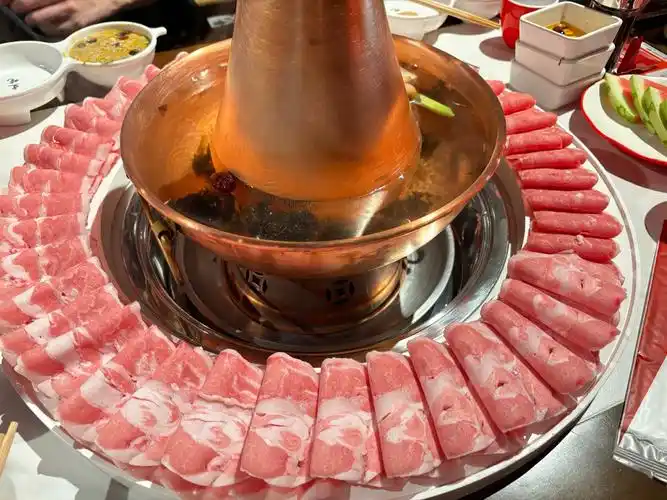
Beijing Instant – Boiled Mutton is not just a delicious dish; it also contains rich cultural connotations and has become an important symbol of Beijing culture. At the family level, Instant – Boiled Mutton is a symbol of family reunion. In the cold winter, the whole family gathers around the copper pot, watching the charcoal fire burning brightly and the water in the copper pot boiling gurgling. Everyone puts the tender mutton slices into the pot to boil in turn, then dips them in their favorite seasonings and chats while eating, enjoying a happy and harmonious atmosphere. This scene not only warms the body but also shortens the distance between family members, transmitting strong family affection.
Socially, Instant – Boiled Mutton reflects the tolerant spirit of Beijing. As an ancient capital with a long history, Beijing has attracted people from all over the country to live and communicate here. During the development of Instant – Boiled Mutton, it has continuously absorbed the food characteristics and cultural elements of various regions. Whether it is the variety of seasonings or the combination of ingredients for boiling, it integrates the styles of different regions. It is like a big cultural melting pot, embracing and assimilating various cultures, demonstrating the open and diverse cultural characteristics of Beijing.
IV. Stories Behind: The Inseparable Bond between Celebrities and Instant – Boiled Mutton
Throughout the history of Beijing Instant – Boiled Mutton, there are many fascinating stories between celebrities and it. It is said that Emperor Qianlong had a special fondness for Instant – Boiled Mutton. At the Thousand – 叟 Banquet he held, Instant – Boiled Mutton was an essential delicacy. It is reported that in order to meet the taste needs of numerous elderly people, imperial chefs carefully prepared a large amount of tender mutton and prepared a variety of seasonings. At the Thousand – 叟 Banquet, the elderly people sat around, tasting the delicious Instant – Boiled Mutton, creating a spectacular scene. This tradition also increased the popularity of Instant – Boiled Mutton among the people, making it a palace – style food in the eyes of the common folk.
In modern times, many literati and poets also favored Instant – Boiled Mutton. Mr. Lao She was one of them. He mentioned Instant – Boiled Mutton many times in his works, depicting it as an important element of Beijing life. In his writing, Instant – Boiled Mutton was not just a kind of food but a symbol of Beijing culture, carrying the local customs and life charm of old Beijing.
V. Unique Charm: The Perfect Combination of Ingredients, Utensils, and Techniques
The unique charm of Beijing Instant – Boiled Mutton stems from its ultimate pursuit of ingredients, utensils, and techniques. In terms of ingredients, the selection of mutton is crucial. Authentic Beijing Instant – Boiled Mutton usually uses Inner Mongolia sheep, especially those from Xilingol League and Hulunbuir Grassland. The sheep here grow up eating natural pastures, resulting in tender meat with less muttony smell. Moreover, fresh mutton is preferred for Instant – Boiled Mutton, and it is slaughtered and consumed on the same day to ensure its freshness and taste.
The copper pot is the iconic utensil of Beijing Instant – Boiled Mutton. There is charcoal fire burning in the middle of the copper pot, and there is a soup pool around for boiling meat. The charcoal fire can quickly bring the water to a boil and maintain a constant water temperature in the pot, allowing the mutton to be cooked in a short time. At the same time, the heat from the charcoal fire endows Instant – Boiled Mutton with a unique flavor. The copper pot’s material has good thermal conductivity, which can evenly transfer heat, ensuring that each piece of mutton is heated evenly and has a consistent taste.
The technique of boiling mutton is also particular. Slicing mutton is a technical job that requires the chef to have exquisite knife skills. A good chef can slice mutton evenly in thickness and size, and each piece can be quickly cooked in the pot. Moreover, the boiling time of mutton is also important. Generally, the mutton slices are boiled in the pot for three to five times until they change color, and then they can be fished out. The mutton boiled in this way is tender and juicy, with the best taste.
VI. Inheritance and Innovation: Development and Challenges in the New Era
In modern society, Beijing Instant – Boiled Mutton faces the dual tasks of inheritance and innovation. On the one hand, many old – established Instant – Boiled Mutton restaurants still adhere to traditional production techniques and business concepts, committed to passing on the authentic Beijing Instant – Boiled Mutton. These old stores not only retain the classic copper pots and charcoal fires, tender mutton, and traditional seasonings but also pay attention to creating an old – Beijing dining atmosphere, allowing customers to feel the strong historical and cultural flavor while tasting the food.
On the other hand, to adapt to the tastes and lifestyles of modern consumers, some Instant – Boiled Mutton restaurants are constantly innovating. For example, in terms of ingredients, in addition to traditional mutton, various special boiled items such as seafood and mushrooms are also introduced to meet the needs of different customers. In terms of seasonings, more novel flavors such as spicy and tomato are also developed to attract young consumers. In addition, some Instant – Boiled Mutton restaurants have adopted modern business models, combining online and offline methods to expand their brand influence, enabling more people to understand and love Beijing Instant – Boiled Mutton.
However, Beijing Instant – Boiled Mutton also faces some challenges in the process of inheritance and innovation. With the acceleration of urbanization, traditional charcoal – fired copper pot Instant – Boiled Mutton is restricted by environmental protection and other aspects. Some stores have to switch to modern heating equipment such as induction cookers, which, to a certain extent, affects the traditional flavor of Instant – Boiled Mutton. At the same time, some unregulated Instant – Boiled Mutton restaurants in the market also affect the brand image. How to ensure the quality and characteristics of Instant – Boiled Mutton has become an important issue for practitioners.
As a treasure of Beijing’s food culture, Beijing Instant – Boiled Mutton carries hundreds of years of historical inheritance and rich cultural connotations. It came from the grasslands and blossomed in the capital city, conquering generations of diners with its unique charm. In the new era, it is our responsibility to protect and inherit this traditional food, let it develop continuously through innovation, and continue to write its legendary story, enabling more people to experience the unique charm of Beijing culture.