
Introduction: The Buildings That Look Like Alien Spaceships
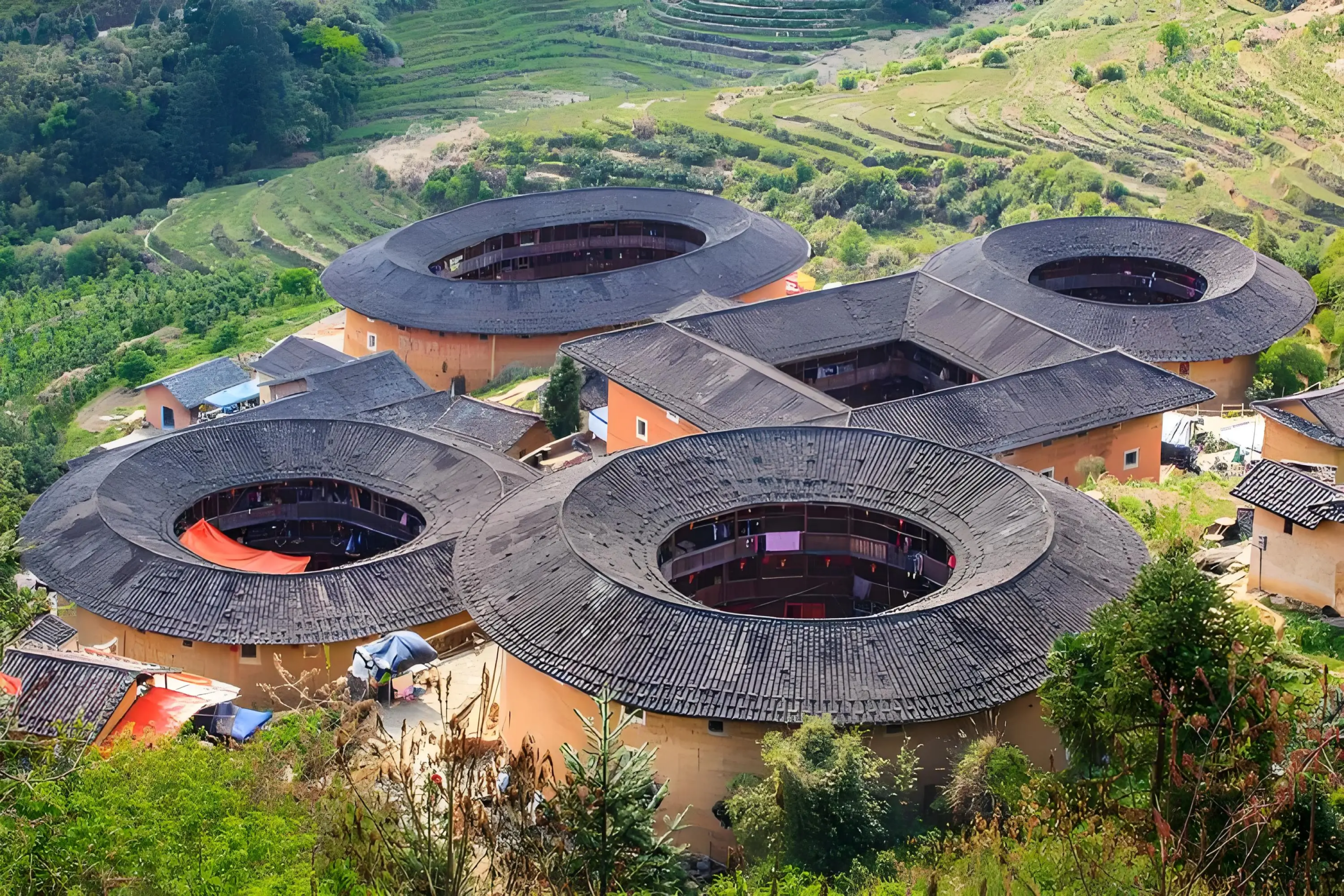
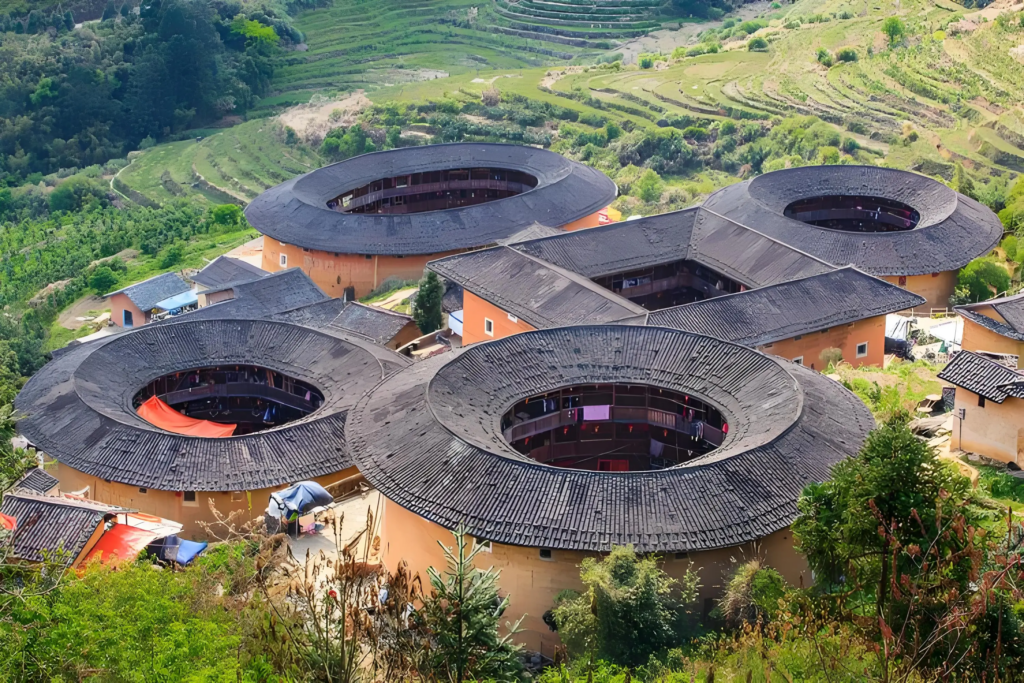
Imagine flying over the mountains of southeastern China.
Below you, hidden among forests, rivers, and terraced hills, appear enormous circular structures unlike anything you have ever seen.
From the air, they resemble:
- Giant fortresses
- Ancient arenas
- Alien spaceships
- Massive military compounds
Their thick earthen walls form perfect circles, squares, and rectangles.
At first glance, many visitors assume they were built for war.
Others think they are temples.
Some even mistake them for modern architectural experiments.
The truth is far more fascinating.
These remarkable structures are called Tulou, meaning “earthen buildings.”
Located primarily in Fujian Province, they represent one of the most unusual forms of residential architecture ever created.
For centuries, entire families—sometimes hundreds of people—lived together inside these giant earth castles.
Today, they stand as living monuments to one of China’s most resilient and ingenious communities.

What Exactly Is a Tulou?
A Tulou is a large communal building traditionally constructed by the Hakka people and other local communities in southeastern China.
The word itself combines two Chinese characters:
- Tu (earth)
- Lou (building)
While the name sounds simple, the structures themselves are anything but.
Some Tulou are:
- Circular
- Square
- Rectangular
- Oval-shaped
Many contain:
- Up to 400 rooms
- Multiple floors
- Internal courtyards
- Wells
- Storage facilities
- Family shrines
A single Tulou could house an entire clan for generations.
In many ways, they functioned as self-contained villages enclosed within one building.

The Story of the Hakka People
To understand Tulou, we must first understand the people who built them.
The Hakka are one of China’s most fascinating cultural groups.
Their name roughly translates to “guest families.”
Historically, they migrated southward over many centuries due to warfare, political upheaval, and social changes in northern China.
These migrations were often difficult.
Arriving in unfamiliar regions, Hakka communities faced challenges ranging from scarce resources to conflicts with local groups.
As a result, they developed a culture emphasizing:
- Unity
- Cooperation
- Self-reliance
- Family loyalty
Tulou architecture emerged directly from these values.
The buildings were not merely homes.
They were symbols of collective survival.
Why Build a Giant Fortress?
One of the first questions foreign visitors ask is:
“Why are the walls so thick?”
The answer lies in security.
During periods of instability, rural communities faced threats from:
- Bandits
- Raiders
- Local conflicts
- Natural disasters
Instead of building separate houses, entire clans constructed a single fortified structure.
Many Tulou feature:
- Walls up to two meters thick
- Few windows on lower levels
- Heavy wooden gates
- Elevated watch positions
In times of danger, residents could close the entrance and defend the entire community from within.
The result was part fortress, part apartment complex, and part village.
Engineering With Earth
Perhaps the most astonishing aspect of Tulou architecture is the construction material.
Many of these buildings are made primarily from:
- Earth
- Sand
- Clay
- Stone
- Bamboo
- Wood
The walls were created using a technique known as rammed earth construction.
Layer upon layer of earth was compressed into dense, solid forms.
Over time, the walls became remarkably strong.
Some have survived:
- Typhoons
- Earthquakes
- Floods
- Centuries of weather exposure
Even modern engineers continue to study these structures.
Their durability demonstrates a sophisticated understanding of sustainable building techniques long before the invention of modern concrete.
The Circular Design: More Than Architecture
The most famous Tulou are circular.
This design was not chosen purely for aesthetics.
The circular layout offered several practical advantages.
Defensive Strength
A circle eliminates vulnerable corners.
Attackers had fewer weak points to exploit.
Efficient Space
Every family received similar access to the central courtyard.
Structural Stability
Circular walls distribute stress more evenly.
Social Equality
No household occupied a privileged corner or position.
Everyone shared the same communal environment.
The architecture reflected the Hakka belief that the welfare of the group mattered more than individual status.
A Village Inside One Building
Entering a Tulou can feel like stepping into another world.
From outside, the structure appears imposing and defensive.
Inside, however, it opens into a vibrant communal space.
At the center lies a large courtyard.
Surrounding it are rows of wooden rooms rising several stories high.
Life followed a remarkably organized pattern.
Typically:
- Ground floor = kitchens and storage
- Second floor = food reserves
- Upper floors = living quarters
Families occupied vertical sections of the building.
Each household received rooms on every level.
This arrangement ensured fairness and maintained harmony among residents.
The Heart of Community Life
Unlike modern apartment buildings, Tulou were designed to foster interaction.
Residents shared:
- Festivals
- Ceremonies
- Weddings
- Funerals
- Harvest celebrations
Children grew up together.
Neighbors knew one another intimately.
Elders passed traditions down through generations.
At the center of many Tulou stood an ancestral hall.
This space served both religious and social functions.
It reminded residents that they belonged to a larger family history stretching back centuries.
UNESCO Recognition
In 2008, Fujian Tulou were designated as a UNESCO World Heritage Site.
UNESCO praised them as:
“A unique architectural tradition reflecting communal living and adaptation to local environments.”
The designation recognized not only the buildings themselves but also the culture they represent.
Few places in the world preserve such a complete example of collective architecture.
The Tulou stand as evidence that communities can create remarkable solutions using local materials and shared effort.
The Most Famous Tulou
Chengqi Lou
Often called the “King of Tulou.”
This enormous circular structure contains hundreds of rooms and multiple concentric rings.
Visitors are often astonished by its scale.
Zhencheng Lou
Known for its combination of Chinese and Western architectural influences.
Built during a period of increasing international contact, it reflects a fascinating cultural blend.
Hegui Lou
Constructed on marshland, it demonstrates remarkable engineering ingenuity.
Despite the challenging ground conditions, it has remained stable for generations.
Daily Life in Modern Tulou
Contrary to popular belief, some Tulou are still inhabited today.
Modern residents balance tradition and contemporary life.
Inside ancient walls, you may find:
- Smartphones
- Wi-Fi routers
- Motorcycles
- Television sets
The contrast is striking.
Centuries-old architecture coexists with modern technology.
For visitors, this creates a unique opportunity to observe living heritage rather than static museum exhibits.
Why Hollywood and Architects Love Tulou
The visual impact of Tulou has attracted international attention.
Architects admire their:
- Sustainability
- Community-centered design
- Climate adaptation
- Efficient use of resources
Filmmakers and photographers are drawn to their unusual appearance.
Their geometric forms seem both ancient and futuristic.
In an age of increasing urban isolation, many observers see Tulou as offering valuable lessons about community living.
The Best Time to Visit
Spring
Green hills and blooming landscapes surround the villages.
Summer
Lush vegetation creates beautiful photographic opportunities.
Autumn
Clear weather and harvest activities provide cultural richness.
Winter
Fewer tourists and peaceful atmospheres allow deeper exploration.
What Tulou Teach Us About Human Society
Perhaps the greatest significance of Tulou extends beyond architecture.
These buildings reveal an alternative way of organizing human life.
They were designed around cooperation rather than isolation.
Community rather than individualism.
Shared responsibility rather than separation.
For centuries, they provided:
- Security
- Identity
- Stability
- Social cohesion
In a world increasingly dominated by anonymous urban living, Tulou offer a fascinating reminder that architecture can shape how people relate to one another.
Why Every Curious Traveler Should Visit Fujian Tulou
Many travelers come to China expecting:
- The Great Wall
- Shanghai skyscrapers
- Ancient imperial palaces
Few expect to encounter giant earthen castles hidden among mountains.
Yet for many visitors, Tulou become one of the most memorable experiences of their journey.
They are visually stunning.
Historically significant.
Architecturally unique.
And culturally profound.
No photograph fully captures the sensation of standing within walls that have sheltered generations of families for centuries.
Conclusion: The Castles Built by Community
The Fujian Tulou are among the most extraordinary residential structures ever built.
They challenge conventional ideas about architecture, community, and family life.
Constructed from earth, shaped by necessity, and sustained through cooperation, they demonstrate how ordinary people can create something truly remarkable.
To visit a Tulou is not simply to see an unusual building.
It is to step into a living chapter of Chinese history.
A chapter written not by emperors or armies, but by families working together to build a better future.
And perhaps that is what makes these giant earth castles so unforgettable.
They are monuments not to power, but to community.