

Introduction: A Chinese City That Refuses to Rush
When foreigners imagine modern China, they often picture:
- Shanghai’s skyscrapers
- Shenzhen’s technology companies
- Beijing’s political power
They imagine crowded subways, long working hours, and relentless competition.
And in many cases, they are right.
China’s major cities are often associated with speed.
But there is one famous exception.
A city where people sit in tea houses for hours.
A city where playing mahjong is practically a cultural institution.
A city where residents are known throughout China for enjoying life.
Welcome to Chengdu.
Located in southwestern China, Chengdu is the capital of:
Sichuan
and one of the country’s most fascinating cities.
With a history stretching back more than two thousand years and a population larger than many countries, Chengdu has somehow managed to maintain a reputation for being relaxed, comfortable, and deeply human.
Many Chinese people have a saying:
“Work hard in other cities. Enjoy life in Chengdu.”
While simplified, it captures the city’s unique spirit.
A City Older Than Most People Realize
Unlike many modern cities that grew rapidly in recent decades, Chengdu has been continuously inhabited for more than 2,300 years.
Historical records show that the city was already an important center long before the Roman Empire reached its peak.
Over centuries, Chengdu became:
- A political center
- A commercial hub
- A cultural capital
Its strategic location within the fertile Sichuan Basin allowed it to flourish while many other cities rose and fell.
Remarkably, Chengdu has remained important throughout nearly every period of Chinese history.
The Land of Abundance
For centuries, Sichuan was known as:
“The Land of Abundance”
This nickname originated largely because of Chengdu and the surrounding region.
The area benefited enormously from:
Dujiangyan Irrigation System
an engineering project built more than 2,200 years ago that still functions today.
The irrigation network transformed the region into one of China’s most productive agricultural areas.
Food was plentiful.
Economic stability followed.
And over time, residents developed a reputation for enjoying life’s pleasures rather than constantly struggling for survival.
Why Chengdu Feels Different
Ask Chinese travelers what makes Chengdu unique, and many give a similar answer:
The atmosphere.
Unlike many major cities where people seem perpetually busy, Chengdu often feels surprisingly calm.
Visitors frequently notice:
- Slower walking speeds
- Longer meals
- More social interaction
- Less visible stress
Of course, Chengdu is still a modern metropolis.
People work hard.
Businesses compete.
Deadlines exist.
But the overall rhythm of life often feels gentler.
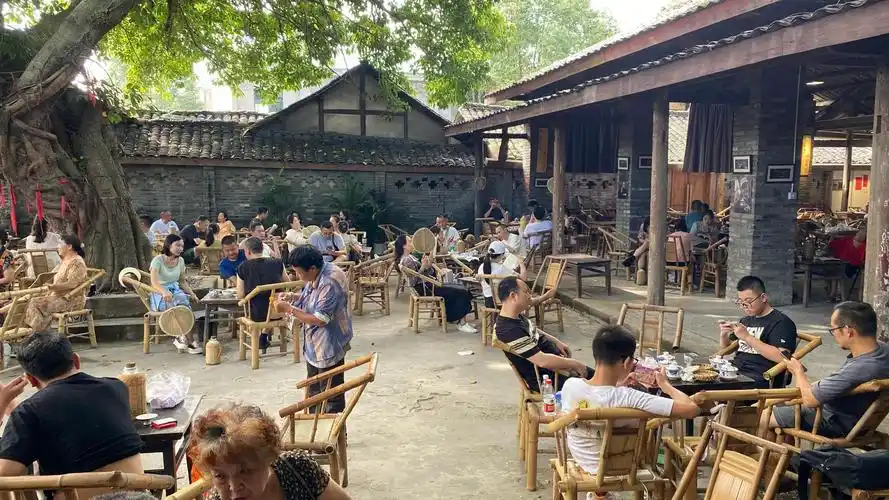
The City of Tea Houses
Nothing symbolizes Chengdu more than its tea culture.
Across the city, tea houses serve as social centers.
People gather to:
- Chat with friends
- Read newspapers
- Play cards
- Discuss business
- Simply relax
In some establishments, customers may spend an entire afternoon over a single pot of tea.
To outsiders, this can seem unusual.
In Chengdu, it is perfectly normal.
Tea houses function almost like living rooms shared by the entire city.
People’s Park: Chengdu in One Location
If someone wanted to understand Chengdu culture in a single afternoon, there is one obvious destination:
People’s Park
Here visitors can observe local life unfolding in real time.
Retirees gather for conversation.
Friends play mahjong.
Families stroll through the gardens.
Tea drinkers relax under the trees.
The atmosphere feels remarkably authentic.
Rather than being a tourist attraction designed for visitors, it remains a place genuinely used by local residents.
Mahjong: More Than a Game
Few activities are more closely associated with Chengdu than mahjong.
Across the city, the sound of mahjong tiles clicking together is instantly recognizable.
The game appears everywhere:
- Tea houses
- Parks
- Community centers
- Family gatherings
For many residents, mahjong is not merely entertainment.
It is a form of social connection.
A way to maintain friendships and strengthen community ties.
The Capital of Comfort Food
Of course, no discussion of Chengdu is complete without mentioning food.
The city is widely regarded as one of China’s culinary capitals.
Its most famous dishes include:
- Mapo Tofu
- Dan Dan Noodles
- Kung Pao Chicken
- Hot Pot
Yet what makes Chengdu’s food culture special is not only flavor.
It is the role food plays in daily life.
Meals are often lengthy social events rather than quick necessities.
People gather around shared dishes, exchanging stories while enjoying some of China’s most celebrated cuisine.
Why the Food Is So Addictive
The secret lies partly in:
Mala (麻辣)
the famous combination of:
- Numbing Sichuan peppercorn
- Spicy chili peppers
This unique flavor profile has become internationally famous.
Many visitors discover that Sichuan food offers something entirely different from the Chinese cuisine they know at home.
The Home of the Giant Panda
Chengdu also serves as the global capital of panda conservation.
Nearby is:
Chengdu Research Base of Giant Panda Breeding
one of the world’s most famous wildlife conservation centers.
Millions of visitors come specifically to see China’s most beloved animal.
The panda has become inseparable from Chengdu’s identity.
For many foreign tourists, it provides their first introduction to the city.
A City That Loves Leisure
One of Chengdu’s most famous characteristics is its attitude toward leisure.
Throughout Chinese history, many cities became known for:
- Commerce
- Industry
- Politics
Chengdu became known for enjoying life.
Locals often value:
- Good food
- Good conversation
- Time with friends
- Personal comfort
This philosophy has shaped the city’s culture for generations.
Why Young Chinese Are Moving to Chengdu
In recent years, Chengdu has become increasingly attractive to younger professionals.
Several factors contribute.
Lower Living Costs
Compared with cities such as Beijing and Shanghai, Chengdu is often more affordable.
Better Work-Life Balance
Many residents feel the city offers a healthier lifestyle.
Strong Economy
The city has developed into an important center for:
- Technology
- Manufacturing
- Finance
- Creative industries
As a result, Chengdu combines economic opportunity with a relatively relaxed atmosphere.
The Nightlife Nobody Expects
Foreign visitors are often surprised by Chengdu after dark.
The city has a vibrant nightlife scene featuring:
- Restaurants
- Bars
- Live music venues
- Night markets
Unlike some global cities where nightlife feels rushed or exclusive, Chengdu’s evening culture often remains casual and social.
People gather to enjoy themselves rather than impress others.
The Ancient and the Modern
One reason Chengdu fascinates travelers is the coexistence of old and new.
Within a single day, visitors can experience:
- Ancient temples
- Traditional tea houses
- Modern shopping districts
- High-speed rail stations
The contrasts feel seamless rather than contradictory.
The city embraces modern development without entirely abandoning its historical identity.
Why Foreigners Fall in Love With Chengdu
Many international visitors arrive expecting to spend only a few days.
Then they stay longer.
The reasons vary.
Some come for pandas.
Others come for food.
Many become captivated by the atmosphere.
Chengdu offers something increasingly rare in modern urban life:
The feeling that there is time.
Time to eat.
Time to talk.
Time to enjoy the moment.
More Than a Tourist Destination
For many Chinese people, Chengdu represents an alternative vision of success.
A reminder that life is not solely about productivity.
That happiness can be found in simple pleasures.
That a city can be modern without becoming exhausting.
This philosophy explains why Chengdu consistently ranks among China’s most desirable places to live.
Conclusion: China’s Master Class in Enjoying Life
Chengdu is often described as the most relaxed major city in China.
While the phrase may sound like a stereotype, there is truth behind it.
For centuries, the city has cultivated a culture centered on:
- Community
- Food
- Leisure
- Balance
Its tea houses remain full.
Its restaurants remain busy.
Its parks remain lively.
And its residents continue to demonstrate that even in a rapidly changing world, there is value in slowing down.
In a country famous for speed and transformation, Chengdu stands as a reminder that sometimes the good life is not about moving faster.
It is about knowing when to pause, pour another cup of tea, and enjoy where you are.