



Introduction: The Exam That Determined Your Entire Life
Imagine preparing for a single examination.
Not for a few months.
Not for a year.
But for decades.
Imagine knowing that passing this test could transform your family forever.
You could rise from poverty to become one of the most powerful officials in the empire.
Fail, and years of sacrifice might amount to nothing.
No second chances.
No alternative career paths.
No shortcuts.
For more than a thousand years, millions of Chinese men lived exactly this reality.
Their fate depended on one thing:
The Imperial Examination System.
Known in Chinese as the Keju, it was arguably the most important examination system in human history.
Long before modern universities, standardized testing, and civil service exams, China developed a merit-based recruitment system that helped govern one of the world’s largest empires.
At its peak, the Keju influenced every aspect of Chinese society:
- Education
- Politics
- Social mobility
- Family life
- Literature
- Culture
It even inspired civil service systems in Europe and beyond.
To understand traditional China, one must first understand the exam.
The Problem Ancient China Needed to Solve
Every large empire faces the same challenge:
How do you choose officials?
In many ancient societies, power depended on:
- Noble birth
- Family connections
- Wealth
- Military influence
China experimented with these approaches as well.
However, rulers eventually recognized a problem.
If government positions are inherited, talented people may never receive opportunities.
And incompetent people may gain power simply because of their family background.
The solution was revolutionary.
Instead of choosing officials based primarily on birth, choose them based on knowledge.
Thus emerged the Imperial Examination System.
The Birth of the Keju
The examination system began developing during the Sui Dynasty and expanded dramatically under the Tang Dynasty.
However, it reached its mature form during later dynasties such as:
- Song
- Ming
- Qing
Over time, the examinations became the primary path into government service.
For ambitious families, success in the exams represented the ultimate goal.
Why Becoming an Official Was So Important
Government officials occupied one of the highest positions in traditional Chinese society.
Successful candidates gained:
- Prestige
- Wealth
- Influence
- Social status
- Career security
More importantly, success brought honor to an entire family.
A poor farming family could suddenly become respected members of local society.
The examination system created one of the earliest large-scale meritocratic institutions in world history.
At least in theory, talent could overcome birth.
The Influence of Confucianism
The examination system was deeply connected to the teachings of Confucius.
Confucian philosophy emphasized:
- Education
- Moral behavior
- Good governance
- Respect for learning
As a result, exam candidates spent years studying Confucian classics.
Knowledge alone was not enough.
Candidates were expected to demonstrate moral understanding and intellectual discipline.
The ideal official was both educated and ethical.
What Did Students Study?
The curriculum focused heavily on classical texts.
Candidates memorized and analyzed works such as:
The Analects
Teachings attributed to Confucius.
The Mencius
A foundational Confucian text.
The Great Learning
A guide to self-cultivation and governance.
The Doctrine of the Mean
A philosophical work emphasizing balance and moderation.
Students often memorized thousands upon thousands of characters.
This required extraordinary dedication.
The Long Road to Success
Preparation usually began in childhood.
Boys from ambitious families spent years studying.
Their daily routine often involved:
- Reading
- Memorization
- Writing
- Recitation
- Classical analysis
Many students devoted their entire youth to examination preparation.
For some, the process continued into middle age.
Stories exist of candidates taking examinations well into their sixties and seventies.
The Multi-Level Examination System
The Keju was not a single test.
It consisted of multiple levels.
Each stage became increasingly difficult.
Local Examinations
Candidates first competed at the local level.
Success allowed advancement to higher stages.
Provincial Examinations
These attracted thousands of participants.
Only a small percentage passed.
Metropolitan Examinations
Held in the imperial capital.
Competition became even more intense.
Palace Examination
The final stage took place under imperial supervision.
The emperor himself often played a role in determining rankings.
Success here could launch an extraordinary career.
The World’s Toughest Exam?
Many historians consider the Imperial Examination System among the most difficult testing systems ever created.
Why?
Because candidates faced:
- Massive amounts of material
- Extremely low pass rates
- Intense competition
- Years of preparation
In some periods, fewer than 1% of candidates reached the highest levels.
Imagine spending decades preparing for a test with such odds.
Yet millions tried.
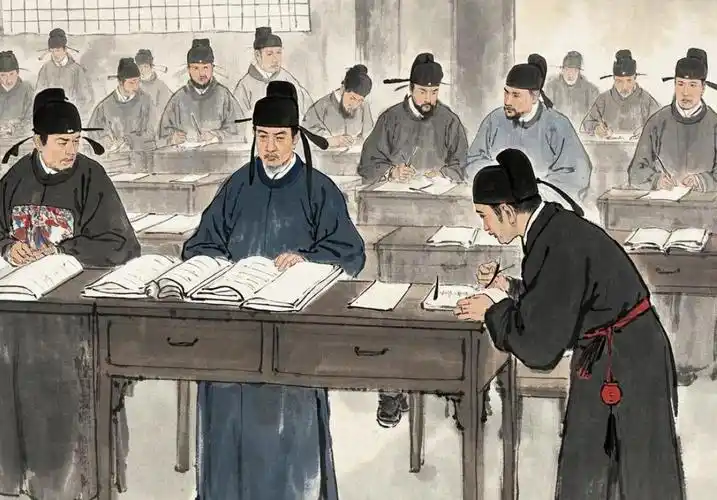
Life Inside the Examination Cells
Perhaps the most remarkable aspect of the system was the examination environment itself.
Candidates were confined to tiny examination cells.
These spaces were barely larger than modern bathroom stalls.
Inside, candidates spent days writing essays.
The cell contained simple wooden boards that served as:
- Desk
- Seat
- Bed
Conditions could be uncomfortable.
Weather was often extreme.
Yet candidates persevered because the rewards were immense.
Preventing Cheating
Cheating was a serious concern.
Authorities developed sophisticated anti-cheating measures.
Candidates underwent inspections before entering examination compounds.
Officials searched for:
- Hidden notes
- Unauthorized texts
- Concealed writing materials
Despite these efforts, cheating scandals occasionally occurred.
Human nature, it seems, has changed little over the centuries.
The Famous Eight-Legged Essay
One of the most controversial features of later examinations was the “Eight-Legged Essay.”
This writing format required strict structure and organization.
Supporters argued it demonstrated intellectual discipline.
Critics claimed it encouraged memorization rather than creativity.
The debate sounds surprisingly modern.
Even today, educators continue discussing similar questions.
Should examinations reward knowledge, creativity, or both?
Success Changed Entire Families
Passing the examinations often transformed family fortunes.
A successful scholar might become:
- Magistrate
- Administrator
- Advisor
- Minister
His relatives gained prestige.
Future generations benefited.
Entire villages celebrated successful candidates.
In many ways, examination success became a form of social mobility.
The Scholar as Cultural Hero
Traditional Chinese society greatly admired scholars.
Unlike cultures that primarily celebrated warriors, China often elevated educated officials.
The ideal gentleman was:
- Intelligent
- Ethical
- Educated
- Cultured
This respect for learning remains visible in Chinese society today.
The Dark Side of the System
Despite its achievements, the examination system had flaws.
Extreme Pressure
Candidates often endured immense stress.
Limited Curriculum
Heavy emphasis on classical texts sometimes restricted intellectual diversity.
Gender Exclusion
Women were generally excluded from participation.
Social Inequality
Although merit mattered, wealthy families often had better educational opportunities.
The system was innovative but not perfect.
Why the System Lasted So Long
The Imperial Examination System survived for more than 1,300 years.
Few institutions in human history have lasted so long.
Its endurance reflects several strengths:
- Administrative efficiency
- Cultural legitimacy
- Political stability
- Public respect for education
The exams became deeply embedded in Chinese civilization.
How the Keju Influenced the World
Many people assume modern civil service examinations originated in Europe.
In reality, China’s examination system influenced government reforms elsewhere.
During the nineteenth century, observers studied the Chinese model.
Its principles helped inspire aspects of modern civil service recruitment in several countries.
China’s innovation had global consequences.
The End of an Era
By the late nineteenth century, China faced unprecedented challenges.
The world was changing rapidly.
Many reformers argued that the examination system no longer met modern needs.
In 1905, the Qing government officially abolished the Imperial Examination System.
An institution that had shaped China for more than a millennium came to an end.
Its influence, however, did not disappear.
The Legacy in Modern China
Although the Keju no longer exists, its spirit survives.
Modern China places enormous value on education.
The country’s famous university entrance examination, the Gaokao, is often compared to the Imperial Examination System.
Both reflect a belief that academic achievement can transform lives.
The connection is not direct, but the cultural legacy is unmistakable.
Why Foreigners Find the System Fascinating
For international readers, the Keju challenges assumptions about premodern societies.
Many expect ancient governments to rely solely on aristocracy and inheritance.
China’s examination system reveals something different.
A large-scale attempt to recruit officials based on learning and merit.
The idea was revolutionary.
And remarkably influential.
Conclusion: The Exam That Built an Empire
For more than thirteen centuries, China’s Imperial Examination System shaped the lives of millions.
It created scholars.
Officials.
Administrators.
Thinkers.
It rewarded discipline, learning, and perseverance.
It transformed families and influenced governments.
Although imperfect, it represented one of humanity’s earliest and most ambitious experiments in meritocracy.
Today, examination halls have disappeared.
The tiny testing cells stand empty.
But the legacy remains.
Because long before modern universities and civil service tests, China built an educational system that changed history.
And for generations of ambitious students, one exam truly had the power to change everything.