



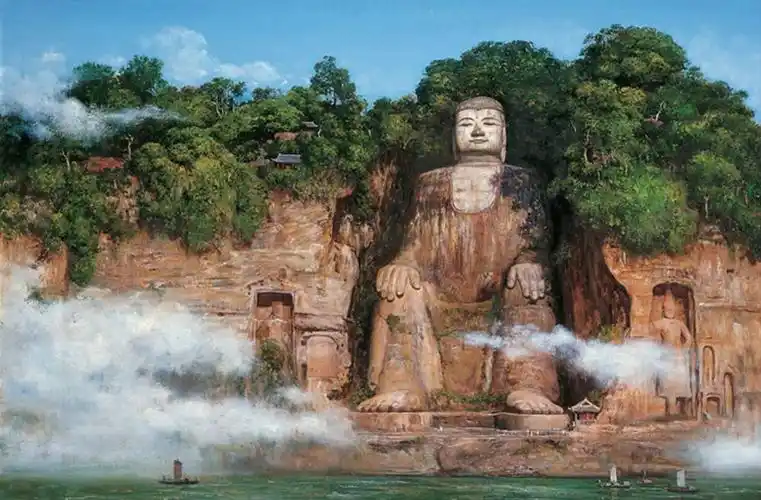
On the convergence of the Minjiang River, Qingyi River and Dadu River in southern Sichuan Basin, perched on the steep cliff of Lingyun Mountain, sits a colossal Maitreya Buddha carved into the mountain. This is the world-famous Leshan Giant Buddha. Integrated perfectly with natural landforms, Buddhist beliefs, people’s livelihood sentiments and top-tier ancient engineering technologies, it stands as an unparalleled miracle across time. Renowned worldwide for its grandeur, the Leshan Giant Buddha is far more than a religious statue. It is a living historical book carved on stone, a tangible symbol of the prosperous Tang Dynasty, a practical interpretation of the ancient Chinese philosophy of harmony between humanity and nature, and an eternal cultural totem representing the Chinese nation’s reverence for nature, compassion for all living beings, and perseverance in craftsmanship. In 1996, Leshan Giant Buddha, together with Mount Emei, was inscribed on the UNESCO World Heritage List as a mixed cultural and natural heritage site, embodying the multi-dimensional context of Chinese civilization covering religion, architecture, sculpture, water conservancy and folk customs of the Tang Dynasty.
The birth of Leshan Giant Buddha originated from floods and a heartfelt wish to protect the people, rather than imperial extravagance or noble vanity. During the prosperous Kaiyuan period of the Tang Dynasty, though Bashu region enjoyed prosperous business and frequent shipping, the confluence of the three rivers suffered from turbulent currents and violent whirlpools. Frequent shipwrecks and floods brought endless disasters to local people. Witnessing the sufferings of the folks, Master Haitong, a virtuous monk of Lingyun Temple, made a grand vow to carve a giant Buddha to suppress the floods and bless the people.
The massive project started in 713 AD (the first year of the Kaiyuan reign of the Tang Dynasty) and lasted for 90 years, spanning three generations of craftsmen and four imperial reigns. Without modern machinery or precision surveying tools, all carving and polishing work relied entirely on manual labor. To raise funds for the Buddha project, Master Haitong traveled extensively to raise donations. When corrupt officials attempted to embezzle the funds, he gouged out his own eyes to defend the public money, demonstrating his unwavering determination and compassion. He passed away when the Buddha was only carved up to the shoulders. Later, Zhang Qiu Jianqiong, a military governor, donated his salary to continue the project, and Wei Gao, another governor, finally completed the grand project in 803 AD (the 19th year of the Zhenyuan reign).
Known as “the mountain is the Buddha, and the Buddha is the mountain”, Leshan Giant Buddha is entirely chiseled from the natural cliff of Lingyun Mountain, integrated seamlessly with the mountain body. As the largest stone-carved Maitreya sitting Buddha in the world, it stands 71 meters tall with precise and magnificent proportions: its head is 14.7 meters high with 1,021 neat hair buns, shoulder width reaches 24 meters, ear length 7 meters, and its broad feet can accommodate hundreds of people. Carved from red sandstone which is fragile and prone to weathering, the Buddha has remained intact and solemn for over 1,300 years, thanks to the sophisticated invisible drainage system designed by ancient craftsmen.
A three-dimensional fully automatic drainage system is hidden in the Buddha’s body, blending perfectly with the artistic design without any abrupt traces. The hollow hair buns on the head serve as diversion channels to drain rainwater rapidly. Hidden vertical drainage tunnels behind the ears discharge accumulated water and prevent erosion. The natural folds of the kasaya form guide grooves to channel rainwater downwards, and concealed drainage holes on the chest and waist constitute a comprehensive water drainage network. This advanced ancient engineering design effectively avoids rain erosion and water accumulation, enabling the Buddha to withstand thousands of years of wind, rain and floods, fully demonstrating the extraordinary wisdom of Tang Dynasty craftsmen.
Beyond its engineering marvels, Leshan Giant Buddha represents the pinnacle of Tang Dynasty stone carving art, establishing the aesthetic paradigm of Oriental giant Buddhist statues. Breaking free from the rigid stylization of early religious sculptures, it embodies the prosperous, tolerant and graceful aesthetic of the Tang Dynasty. The Buddha’s head slightly droops, with gentle and compassionate eyes overlooking the mortal world, presenting a harmonious integration of divine solemnity and human warmth. Every detail, from the smooth facial contours, delicate eye carving, neat hair buns to the flowing kasaya folds, reflects superb craftsmanship and vivid artistic expression. The accompanying guardian generals and warriors carved on the surrounding cliffs form a rigid-flexible contrast with the main Buddha, enriching the layered artistic conception.
The profound cultural connotation of Leshan Giant Buddha lies in its integration of nature, religion, people’s livelihood and spiritual civilization. It perfectly interprets the traditional Chinese philosophy of harmony between humanity and nature by conforming to the mountain’s original terrain rather than transforming nature forcibly. Rooted in the compassion of saving all living beings, it carries the ancient people’s yearning for peace and reverence for life, different from imperial Buddhist statues built for meritorious blessings. It also witnesses the inclusive and open cultural pattern of the prosperous Tang Dynasty, realizing the localized integration of foreign Buddhist culture and traditional Chinese culture. Moreover, it has been integrated into the folk customs of Leshan for thousands of years, becoming the spiritual totem of Bashu region and embodying the Chinese nation’s perseverance and benevolence.
To protect this precious cultural heritage, official and folk maintenance projects have been carried out sixteen times since the Northern Song Dynasty. In view of the weathering, water seepage and vegetation erosion of the red sandstone carrier, modern professional protection adopts the principle of “restoring the old as the old” with minimal intervention. Advanced digital technologies such as 3D scanning, big data monitoring and AI early warning have built a full-dimensional intelligent protection system, realizing scientific inheritance and sustainable protection of the millennium heritage.
After more than 1,300 years of vicissitudes, Leshan Giant Buddha stands towering as always. As an irreplaceable physical specimen of the Tang Dynasty, it provides crucial materials for the study of ancient Chinese history, art, engineering and religion. As a world-class business card of Oriental stone carving art, it promotes Sino-foreign cultural exchanges and spreads the aesthetic charm of Chinese civilization. More importantly, it condenses the spiritual core of compassion, perseverance, ingenuity and responsibility, nourishing contemporary cultural inheritance and spiritual development. Empowering cultural tourism integration, it enables the millennium civilization to break through historical books and integrate into modern life.
Standing by the three rivers and looking up at the millennium Buddha, we witness the integration of mountain, Buddha and river. This stone-carved monument of Tang civilization carries the supreme ingenuity, compassion and extraordinary wisdom of the ancients, as well as the continuous context and spiritual heritage of Chinese civilization. Built for the people and dedicated to calming floods a thousand years ago, it guards the land and blesses the people. Today, it still stands silently through vicissitudes, telling the world the long history and endless vitality of Chinese civilization. The symbiosis of mountain and Buddha perpetuates the cultural context, and this epic of civilization spanning thirteen centuries will shine forever in the long river of time.