



In the central hinterland of the vast land of China, on both banks of the Yi River in the southern suburbs of Luoyang, there is a cultural wonder that shocks the world – the Longmen Grottoes. It is like a historical book engraved on the stone wall. After thousands of years of baptism, with its grand scale, exquisite craftsmanship and profound cultural connotations, it tells the glory and vicissitudes of ancient China, and has become a dazzling pearl in the treasure house of human civilization.
I. Geographical Location and Natural Environment of the Longmen Grottoes
The Longmen Grottoes are located on Longmen Mountain and Xiangshan on both banks of the Yi River in Luolong District, Luoyang City, Henan Province. The Yi River flows northward from the south, dividing Longmen Mountain into two parts, forming a confrontation between the east and west mountains. From a distance, it looks like a natural gateway, so it was anciently called “Yique”. Here, mountains and waters are adjacent, and the scenery is beautiful. Since ancient times, it has been a place where literati and poets linger. The gurgling water of the Yi River not only provided convenient transportation conditions for the excavation of the grottoes, but also added a vivid beauty to this ancient land. The surrounding mountains are rich in vegetation, and the scenery varies in different seasons. In spring, it is a riot of color; in summer, the trees provide dense shade; in autumn, the mountains are covered with red leaves; in winter, everything is wrapped in white. They set off the solemn and mysterious grottoes, forming a picturesque natural and cultural landscape.
II. Historical Evolution of the Longmen Grottoes
- The Origin of Excavation in the Northern Wei DynastyThe excavation of the Longmen Grottoes began in the Northern Wei Dynasty. After Emperor Xiaowen of the Northern Wei Dynasty moved the capital to Luoyang, he vigorously promoted the sinicization policy, and Buddhism also flourished in the Central Plains. In order to promote Buddhism and pray for the country, the royal family and nobles began to excavate grottoes on a large scale on Longmen Mountain. The grotto statue style of this period was influenced by both Indian Gandhara art and traditional Central Plains art, presenting a unique style. The Buddha statues have a thin face, a slender body, and their clothing is mostly in the style of loose robes and broad belts, reflecting the aesthetic characteristics and cultural integration of the Northern Wei Dynasty. For example, Guyang Cave is the earliest and most content – rich cave in the Longmen Grottoes. There are many exquisite Buddha statues and numerous inscriptions in the cave, and it is known as the “crown of the Longmen Grottoes”. Among them, the “Twenty Calligraphic Works of Longmen” are outstanding representatives of the Weibei calligraphy. Their fonts are vigorous, simple, dignified and generous, with extremely high artistic value.
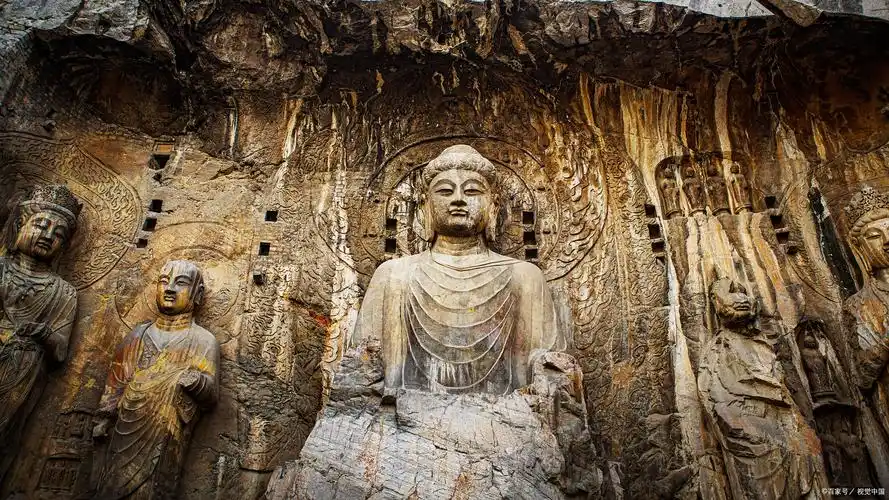
- The Prosperous Development in the Sui and Tang DynastiesDuring the Sui and Tang dynasties, the country was unified, the economy was prosperous, and Buddhism was extremely popular. The excavation of the Longmen Grottoes reached its peak during this period. The grotto statues in the Tang Dynasty, on the basis of inheriting the style of the Northern Wei Dynasty, paid more attention to realism and secularization. The Buddha statues have a plump and rounded face, a kind and gentle expression, and gorgeous and exquisite clothing, showing the magnificent atmosphere of the prosperous Tang Dynasty. Fengxian Temple is an outstanding representative of the grotto art in the Tang Dynasty. The main Buddha, Vairocana Buddha, is 17.14 meters high, with a head height of 4 meters and an ear length of 1.9 meters. The facial lines of the Buddha are soft, and the corners of the mouth are slightly raised, showing a peaceful, kind and majestic expression, as if overlooking all things in the world, giving people a strong spiritual shock. According to records, the face of the Vairocana Buddha was carved based on Wu Zetian, which not only reflects the close connection between Buddhism and politics at that time, but also reflects the secularization tendency of Buddhist statues in the Tang Dynasty from the side.
- Continuation and Decline after the Song DynastyAfter the Song Dynasty, due to the transfer of political and economic centers and the changes in the development of Buddhism, the large – scale excavation of the Longmen Grottoes gradually stopped, but there were still some small – scale continuous excavations and renovations. However, with the passage of time, the destruction of wars and the influence of natural erosion, the Longmen Grottoes gradually declined in the long history. Many Buddha statues in the caves were damaged, the murals fell off, and the overall appearance of the grottoes was seriously damaged. Nevertheless, the historical and cultural value carried by the Longmen Grottoes is still indelible. It still stands quietly on the banks of the Yi River, waiting for future generations to discover, protect and inherit.
III. Artistic Features of the Longmen Grottoes
- Carving TechniquesThe carving techniques of the Longmen Grottoes are second to none. The craftsmen used exquisite knife skills to carve hard stones into lifelike Buddha statues and various beautiful patterns. During the carving process, according to different materials and objects to be expressed, they adopted a variety of techniques such as round carving, relief carving and line carving. Round – carved Buddha statues have a strong three – dimensional sense and are vivid, as if they can step down from the stone wall; relief carvings show rich picture content through distinct layers of carving; line carvings outline the expressions of characters and the details of clothing with delicate lines, making the whole work more vivid. For example, in the carving of the clothing patterns of some Buddha statues, the craftsmen showed the texture of the clothing and the dynamic of it fluttering in the wind through smooth and rhythmic lines, making people sigh with admiration for their superb skills.
- Statue StylesThe statue styles of the Longmen Grottoes are rich and diverse, and the statues of different periods have distinct characteristics of the times. The statue style in the Northern Wei Dynasty is thin and elegant, reflecting the aesthetic taste of “thin – boned and clear – featured”; the statues in the Tang Dynasty are plump and rounded, showing the graceful and luxurious style of the Tang Dynasty. In addition to the main statues such as Buddhas and Bodhisattvas, there are also many images of disciples, guardians and apsaras in the grottoes. The disciples’ statues look pious, the guardians’ statues are powerful and majestic, and the apsaras’ statues are light and elegant. They together form a huge and vivid Buddhist art world. These statues not only have their own characteristics in appearance, but also are incisively and vividly portrayed in expressions and temperament, some are compassionate and peaceful, some are solemn and majestic, some are lively and vivid, all showing the outstanding artistic creativity of ancient craftsmen.
- Mural ArtAlthough the murals in the Longmen Grottoes have been eroded by time and relatively few parts have been preserved, they still have extremely high artistic value. The mural content mainly includes Buddhist stories, sutra – transformation paintings and decorative patterns. Their colors are bright and rich, the lines are smooth and delicate, and the picture composition is rigorous, with strong artistic appeal. For example, in some murals depicting Buddhist story scenes, the characters are vivid and the plots are full of ups and downs, as if telling mysterious and moving legends to people. The decorative patterns in the murals, such as lotus patterns, honeysuckle patterns and flame patterns, are exquisitely shaped and have profound meanings. They not only play a role in beautifying the grottoes, but also reflect the aesthetic concepts and cultural connotations of that time.
IV. Cultural Connotations of the Longmen Grottoes
- Buddhist CultureAs an outstanding representative of Buddhist art, the Longmen Grottoes centrally reflect the spread and development of Buddhism in China. The carvings of Buddha statues, Buddhist scriptures and pagodas in the grottoes are the intuitive manifestation of Buddhist doctrines, conveying Buddhist ideas such as compassion, wisdom and liberation to people. The posture, gesture and expression of each Buddha statue contain profound Buddhist meanings. For example, the various preaching mudras and demon – subduing mudras of Sakyamuni Buddha are all symbols of Buddhist practice and doctrines. At the same time, the Longmen Grottoes are also an important place for Buddhist believers to worship and practice. For thousands of years, countless devout men and women have worshipped here, praying for peace and happiness. Buddhist culture has taken root here and influenced generations of Chinese people.
- Historical CultureThe Longmen Grottoes are a living historical textbook, witnessing the rise and fall of many dynasties in China from the Northern Wei Dynasty to the Song Dynasty. The inscriptions, steles and other written materials in the grottoes provide precious physical evidence for the study of ancient history. These texts record the political, economic, cultural and religious situations of that time. For example, some inscriptions record the time of grotto excavation, the funders and the names of craftsmen, from which we can understand the social system and economic conditions at that time. In addition, the architectural style and carving art of the Longmen Grottoes also reflect the cultural characteristics of different historical periods, and are important bases for studying the development context of ancient Chinese culture.
- Artistic CultureThe artistic achievements of the Longmen Grottoes have had a profound impact on the development of art in China and even the world. It integrates the essence of Chinese and Western art, perfectly combining Indian Buddhist art with traditional Chinese art, creating a unique Chinese Buddhist art style with charm. This art style not only influenced the Buddhist statue art in surrounding areas at that time, but also played an important reference role in the development of later art forms such as sculpture, painting and calligraphy. The carving art, mural art and calligraphy art of the Longmen Grottoes have become important parts of the treasure house of ancient Chinese art, leaving precious artistic wealth for future generations.
V. Protection and Inheritance of the Longmen Grottoes
- Protection in HistoryThroughout history, the Longmen Grottoes have suffered from natural disasters and man – made damage many times, but there have also been insightful people who have protected and repaired them. For example, in the Tang Dynasty, large – scale repairs and maintenance were carried out on the Longmen Grottoes, and the repair situations were recorded in the inscriptions of some caves. During the Ming and Qing dynasties, some local officials and private individuals also carried out partial repairs on the grottoes. However, due to historical limitations, these protection measures often only played a temporary alleviating role and could not fundamentally solve the various problems faced by the Longmen Grottoes.
- Modern Protection MeasuresAfter the founding of the People’s Republic of China, the Party and the government have attached great importance to the protection of the Longmen Grottoes. Special protection agencies have been established, and a series of scientific and reasonable protection plans and measures have been formulated. In terms of protection technology, modern scientific and technological means such as geological exploration, environmental monitoring and digital protection have been used to comprehensively study and protect the geological structure, cave environment and cultural relics of the Longmen Grottoes. At the same time, the treatment of the surrounding environment of the grottoes has been strengthened, and the preservation conditions of the grottoes have been improved. In terms of cultural relic restoration, a group of professional cultural relic restoration personnel have been organized, and the method of combining traditional techniques with modern technology has been adopted to carefully restore the damaged Buddha statues, murals, etc., striving to restore their original appearance.
- Inheritance and DevelopmentIn order to let more people understand the cultural value of the Longmen Grottoes and inherit this precious historical and cultural heritage, relevant departments have taken a variety of measures. On the one hand, the publicity and promotion of the Longmen Grottoes have been strengthened. Through holding exhibitions, academic seminars, cultural activities, etc., the charm of the Longmen Grottoes is shown to the public at home and abroad. On the other hand, the development of cultural and creative products has been carried out, integrating the elements of the Longmen Grottoes into various cultural products such as stationery, accessories and handicrafts, so that the ancient culture can glow with new vitality. In addition, efforts have been made to promote the combination of the Longmen Grottoes and education, incorporating it into the cultural education curriculum of schools, cultivating teenagers’ interest in and love for traditional culture, and training reserve talents for the inheritance of the Longmen Grottoes.
VI. International Influence of the Longmen Grottoes
As a world cultural heritage, the Longmen Grottoes have a wide international influence. It has attracted many experts, scholars and tourists from all over the world to conduct research and visit. Many international friends have been impressed by the magnificent scenery and exquisite art of the Longmen Grottoes, and have a deeper understanding of the profoundness of ancient Chinese culture. In international cultural exchanges, the Longmen Grottoes have become one of the important representatives of Chinese culture, showing the long history and splendid culture of China to the world. At the same time, the protection experience and research results of the Longmen Grottoes have also provided valuable reference for the international cultural heritage protection field, promoting the development of the global cultural heritage protection cause.
VII. Conclusion
The Longmen Grottoes, this artistic epic spanning thousands of years, with its unparalleled charm, carry the historical memory and cultural spirit of the Chinese nation. It is the crystallization of the wisdom of the ancient working people, a treasure of Chinese Buddhist culture, and a common cultural heritage of all mankind. In today’s era, we have the responsibility and obligation to protect and inherit this precious cultural heritage well, so that the glory of the Longmen Grottoes will always shine in the long river of history and make greater contributions to the development of human civilization.