


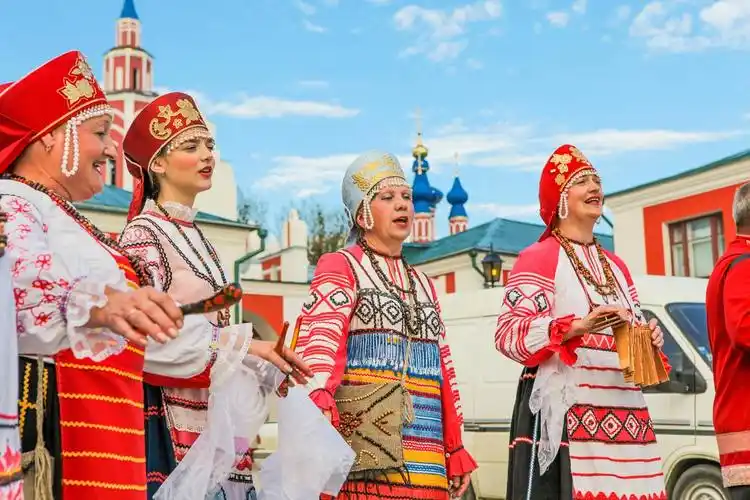
Introduction: The Chinese Citizens Who Look Russian
Imagine visiting a remote village in northern China.
The houses look European.
The church has onion-shaped domes.
People eat dark rye bread and drink milk tea.
Children have blonde hair.
Many adults have blue or green eyes.
Yet when you ask where they are from, the answer is simple:
“China.”
For many foreign travelers, this is one of the most surprising discoveries in the country.
Most people know China as a predominantly East Asian nation.
Few realize that one of China’s officially recognized ethnic groups consists of people whose ancestors came from Russia.
Today, thousands of ethnic Russians live in China.
They speak Chinese.
Carry Chinese passports.
Serve in Chinese schools, businesses, and government institutions.
Yet they continue to preserve elements of a fascinating cultural heritage that stretches across borders and centuries.
Their story is one of migration, trade, frontier life, and cultural adaptation.
It is also one of the most overlooked stories in modern China.
A Little-Known Minority
China officially recognizes 56 ethnic groups.
Among them is the Russian ethnic group.
Known in Chinese as the “Eluosi Zu,” they are one of the country’s smallest minorities.
Compared with larger ethnic groups such as:
- Han
- Zhuang
- Hui
- Uyghur
- Mongol
The Russian population is tiny.
Yet their historical significance far exceeds their numbers.
Because their story reveals how international China’s border regions have been for centuries.
Where Do China’s Russians Live?
Most ethnic Russians in China live in northern frontier regions.
The largest concentrations are found in:
- Inner Mongolia
- Heilongjiang
- Xinjiang
Among these locations, none are more famous than the villages near the Russian border.
Particularly:
- Shiwei
- Enhe
These settlements have become symbols of Russian heritage in China.
Visitors often describe them as looking more like Siberia than the China they imagined.
The Beautiful Borderlands
The grasslands and forests of northern China differ dramatically from the crowded cities of the east coast.
This region contains:
- Vast meadows
- Birch forests
- Rivers
- Snow-covered winters
The landscape closely resembles neighboring Russia.
In fact, in some places the border river is all that separates the two countries.
For centuries, people moved back and forth across these frontier regions.
That movement shaped local history.
How Russians First Arrived in China
The story begins long before modern borders existed.
Throughout the seventeenth, eighteenth, and nineteenth centuries, traders, hunters, farmers, and settlers moved through northeastern Asia.
Some Russians crossed into territories that are now part of China.
Others arrived through commercial activities along the frontier.
As transportation improved and trade expanded, Russian communities gradually developed in certain areas.
These settlers established farms, churches, schools, and businesses.
Over time, permanent communities emerged.
The Railway That Changed Everything
One of the biggest turning points came during the late nineteenth and early twentieth centuries.
The construction of railways across Northeast Asia transformed the region.
Russian engineers, workers, merchants, and administrators arrived in large numbers.
Cities such as Harbin became major centers of Russian influence.
For a period, Harbin contained:
- Russian newspapers
- Russian schools
- Russian churches
- Russian restaurants
Some historians even called it “the most Russian city outside Russia.”
The Russian Revolution and a New Wave of Migration
The early twentieth century brought enormous upheaval.
The Russian Revolution changed the course of history.
Civil war followed.
Many Russians fled political instability.
Some crossed into China.
For thousands of refugees, northeastern China offered safety and opportunity.
These newcomers strengthened existing Russian communities and added new cultural influences.
When Russians Became Chinese
As decades passed, many families settled permanently.
Children were born in China.
Businesses were established.
Communities integrated into local society.
Eventually, many descendants became Chinese citizens.
While maintaining aspects of Russian heritage, they developed a unique identity.
They were no longer simply Russians living abroad.
They became Chinese Russians.
Not Russian Nationals, But Chinese Citizens
This distinction is important.
Ethnic Russians in China are not simply expatriates.
Most are Chinese citizens whose families have lived in China for generations.
Like other ethnic minorities, they possess both:
- A distinct cultural heritage
- A Chinese national identity
To outsiders, this combination can seem unusual.
But it is a common reality in many multicultural societies around the world.
What Language Do They Speak?
Language varies greatly.
Older generations often preserved elements of Russian.
Younger generations primarily speak Mandarin Chinese.
In some communities, bilingualism remains common.
However, modernization and migration have gradually increased the use of Chinese.
Like minority languages worldwide, Russian heritage languages face challenges in preservation.
The Villages That Feel Like Siberia
Among all Russian communities in China, none attract more attention than Enhe.
Located in Inner Mongolia near the Russian border, Enhe has become famous for its distinctive atmosphere.
Visitors encounter:
- Wooden houses
- Russian-style fences
- European architectural details
- Traditional Russian foods
Walking through the village feels remarkably different from most parts of China.
Many tourists describe it as stepping into another world.
Russian Wooden Houses
Traditional Russian homes differ significantly from typical Chinese architecture.
Features often include:
- Log construction
- Decorative wood carvings
- Brightly painted window frames
- Sloping roofs
These structures help preserve a visible connection to the community’s past.
Today they are among the region’s most photographed attractions.
The Role of Religion
Historically, many ethnic Russians practiced Eastern Orthodox Christianity.
Churches served as important community centers.
Although religious life changed considerably during the twentieth century, Orthodox traditions remain part of local cultural heritage.
Visitors occasionally encounter architectural traces of this history.
A Unique Food Culture
One of the most enjoyable aspects of visiting Russian communities in China is the food.
Local cuisine combines influences from both cultures.
Popular dishes include:
Russian Bread
Dense, hearty loaves remain popular.
Sausages
A long-standing tradition throughout the region.
Dairy Products
Milk, cheese, and cream are more common than in many other parts of China.
Chinese-Russian Fusion Dishes
Generations of cultural interaction produced unique local specialties.
The result is a culinary experience unavailable elsewhere in China.
Why Many Residents Look European
Perhaps the most striking aspect for visitors is appearance.
Some ethnic Russians have:
- Blonde hair
- Light-colored eyes
- European facial features
Yet they may speak fluent Mandarin and identify strongly as Chinese.
This surprises many foreigners who mistakenly assume ethnicity and nationality must always align.
China’s Russian minority demonstrates that identity can be more complex.
Tourism and Cultural Preservation
In recent decades, tourism has helped preserve many Russian heritage communities.
Visitors are drawn by:
- Scenic landscapes
- Cultural uniqueness
- Historical curiosity
Tourism provides economic opportunities while encouraging the preservation of traditional architecture and customs.
However, communities also face challenges.
Modernization can sometimes threaten older traditions.
The Harbin Connection
No discussion of Russians in China would be complete without mentioning Harbin.
The city’s Russian influence remains visible today.
Visitors can still see:
- European architecture
- Russian bakeries
- Orthodox-inspired buildings
Many travelers first discover China’s Russian heritage through Harbin before exploring smaller communities further north.
What Foreign Visitors Usually Get Wrong
One common misconception is that these communities are recent arrivals.
In reality, many families have lived in China for generations.
Another misconception is that they are somehow “less Chinese.”
Most ethnic Russians consider themselves fully Chinese citizens while maintaining pride in their heritage.
These identities coexist naturally.
Why This Story Fascinates the World
The story of China’s Russians challenges simplistic assumptions about national identity.
Many people imagine countries as culturally uniform.
History tells a different story.
Borders shift.
People migrate.
Communities adapt.
New identities emerge.
China’s Russian minority is a perfect example of this process.
What China’s Russians Reveal About Chinese History
Their story demonstrates that China has never been completely isolated.
For centuries, the country’s frontier regions connected civilizations across Eurasia.
Merchants, settlers, missionaries, and travelers moved through these borderlands.
Their interactions helped shape modern China.
The Russian minority represents one chapter of that larger story.
Visiting China’s Russian Villages Today
Travelers seeking something unexpected often visit:
- Enhe
- Shiwei
- Harbin
These destinations offer a side of China rarely seen in travel brochures.
Instead of ancient temples and pagodas, visitors find:
- Wooden cottages
- European architecture
- Russian cuisine
- Frontier history
The experience feels both familiar and surprising.
Conclusion: A Piece of Russia Inside China
When most people imagine China, they picture bustling megacities, ancient palaces, and traditional Chinese culture.
Few imagine villages filled with Russian-style houses and blue-eyed Chinese citizens.
Yet that is exactly what exists along China’s northern frontier.
For generations, ethnic Russians have contributed to the country’s cultural diversity while preserving aspects of their ancestral heritage.
Their story reminds us that identity is rarely simple.
It evolves through migration, history, and human connection.
And in the forests and grasslands near the Russian border, one of China’s most fascinating cultural stories continues to unfold.
A story where East meets West.
Where Russia meets China.
And where both became something entirely unique.