



Introduction: The Mountain Where Gods, Monks, and Monkeys Meet
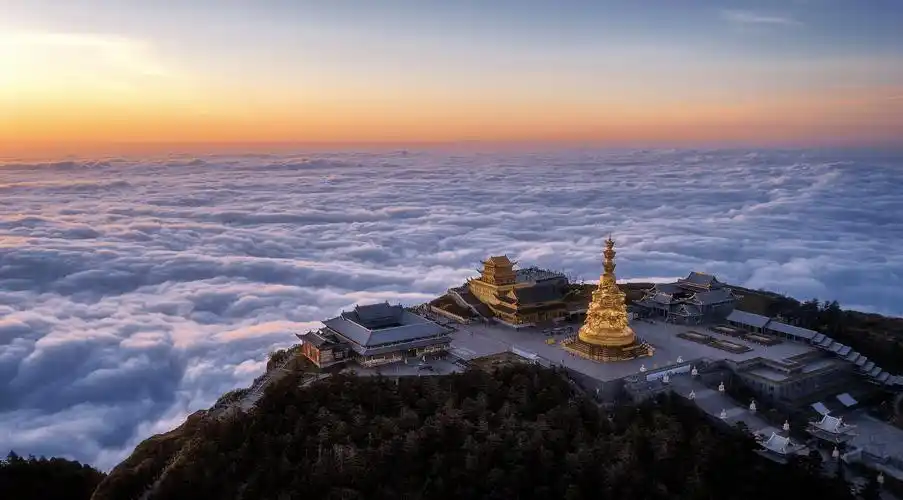
Imagine standing above a sea of clouds.
The sun rises over distant Himalayan peaks.
Ancient temple bells echo through the mist.
Monks in saffron robes walk silently along stone paths.
And then, without warning, a monkey attempts to steal your backpack.
Welcome to Mount Emei.
Few places in China combine natural beauty, religious significance, wildlife, and history as dramatically as:
Mount Emei
For more than two thousand years, emperors, pilgrims, poets, and adventurers have journeyed to this sacred mountain in southwestern China.
Today, it remains one of the most important religious destinations in East Asia and one of the most spectacular places to visit in China.
One of China’s Four Sacred Buddhist Mountains
Mount Emei occupies a unique position in Chinese culture.
It is one of the:
Four Sacred Mountains of Chinese Buddhism
The others are:
- Mount Wutai
- Mount Jiuhua
- Mount Putuo
Among Buddhists, Emei is associated with:
Samantabhadra
the Bodhisattva of wisdom and virtue.
For centuries, believers have traveled hundreds or even thousands of kilometers to worship here.
Older Than Many Countries
Buddhism arrived in China around two thousand years ago.
Some of the earliest Buddhist temples in China were established on Mount Emei.
Over time, the mountain became one of the most important centers of Buddhist learning in East Asia.
Long before many modern nations existed, pilgrims were already climbing its slopes.
The mountain witnessed:
- The rise and fall of dynasties
- Imperial expansions
- Civil wars
- Cultural transformations
Yet the temples endured.
A UNESCO World Heritage Site
Today, Mount Emei and the nearby:
Leshan Giant Buddha
are jointly recognized as a UNESCO World Heritage Site.
The designation reflects both:
- Cultural significance
- Natural beauty
The region contains hundreds of rare plant species and extraordinary biodiversity.
The Golden Summit
The most famous location on the mountain is:
Jinding (Golden Summit).
Standing over 3,000 meters above sea level, it offers breathtaking views.
On clear days, visitors can see:
- Endless mountain ranges
- Seas of clouds
- Spectacular sunrises
Many travelers describe the sunrise at Golden Summit as one of the most beautiful sights in China.
The Sea of Clouds
One reason Mount Emei became sacred is its dramatic weather.
Warm and cold air frequently collide around the mountain.
This creates:
- Dense fog
- Rolling clouds
- Atmospheric optical phenomena
Pilgrims often believed they were witnessing heavenly signs.
Even modern visitors find the scenery almost surreal.
The Mysterious Buddha Light
One of Mount Emei’s most famous legends involves a phenomenon called:
The Buddha Light.
Under rare conditions, sunlight shining through mist can create a circular rainbow surrounding a person’s shadow.
Historically, many pilgrims interpreted this as a spiritual blessing.
Scientists explain it as an optical phenomenon.
Yet seeing it remains a memorable experience.
The Mountain of Monkeys
While the temples attract pilgrims, another group of residents often steals the spotlight.
Monkeys.
Lots of monkeys.
The mountain is home to large populations of Tibetan macaques.
They are:
- Intelligent
- Curious
- Bold
And sometimes a little too bold.
Why Tourists Fear the Monkeys
Travel guides frequently warn visitors about the monkeys.
Why?
Because they have learned that humans often carry food.
The monkeys are famous for:
- Opening bags
- Stealing snacks
- Grabbing water bottles
- Inspecting backpacks
Some visitors find them adorable.
Others find them terrifying.
Either way, encounters are rarely forgotten.
A Mountain Covered in Temples
At its peak, Mount Emei reportedly contained more than one hundred temples.
Many still survive today.
Among the most famous are:
Baoguo Temple
Often the starting point for pilgrims.
Wannian Temple
One of the oldest temples on the mountain.
Huazang Temple
Located near the Golden Summit.
Each temple tells a different chapter of Emei’s long history.
The Pilgrimage Experience
For centuries, devoted pilgrims climbed the mountain on foot.
The journey could take several days.
Many travelers still choose to hike rather than take transportation.
The route passes through:
- Forests
- Streams
- Ancient staircases
- Temple complexes
The experience is as much spiritual as physical.
Why Chinese Emperors Loved Mount Emei
Throughout history, emperors supported temples on Mount Emei.
They viewed sacred mountains as places where heaven and earth connected.
Imperial patronage helped fund:
- Temple construction
- Religious ceremonies
- Infrastructure improvements
This support elevated Emei’s status throughout China.
Rare Wildlife Beyond Monkeys
The mountain’s biodiversity is remarkable.
Its forests contain:
- Rare birds
- Endemic plants
- Protected wildlife
Scientists consider the area one of China’s most important ecological zones.
Some species found here exist nowhere else on Earth.
Mount Emei in Chinese Martial Arts
Fans of kung fu movies may recognize Mount Emei.
In Chinese martial arts fiction, Emei often appears as a legendary school.
Numerous novels and films portray:
- Emei warriors
- Buddhist masters
- Female martial artists
These stories helped cement the mountain’s place in popular culture.
Why Foreign Visitors Are Fascinated
Mount Emei offers something unusual.
It combines multiple aspects of China in a single destination:
- Religion
- Nature
- History
- Wildlife
- Mythology
Visitors interested in any one of these topics often discover all the others.
More Than a Tourist Attraction
For many Chinese people, Mount Emei is not merely a scenic destination.
It is a sacred landscape.
A place for reflection.
A place for pilgrimage.
A place where centuries of faith remain visible.
This spiritual dimension distinguishes it from ordinary mountain tourism.
What Mount Emei Reveals About China
Mount Emei demonstrates something important about Chinese civilization.
Throughout history, mountains were not simply geographic features.
They were viewed as:
- Sacred spaces
- Spiritual gateways
- Sources of inspiration
The relationship between nature and spirituality remains a powerful theme in Chinese culture.
Conclusion: The Mountain Above the Clouds
Mount Emei is more than a mountain.
It is a living museum of Chinese history, religion, and natural beauty.
For over two thousand years, it has attracted emperors, monks, poets, and travelers.
Its temples preserve ancient traditions.
Its forests shelter remarkable wildlife.
Its peaks rise above clouds that have inspired countless legends.
And somewhere along its winding paths, a monkey is probably planning to steal someone’s lunch.
That combination of spirituality, history, mystery, and unpredictability is exactly what makes Mount Emei one of the most fascinating destinations in China.