


When people think of Chinese opera, they often imagine the colorful costumes and painted faces of Peking Opera. But centuries before Peking Opera became famous, another theatrical tradition was already captivating audiences across China.
That tradition is Kunqu Opera, often called the “mother of Chinese opera.”
Elegant, poetic, and deeply artistic, Kunqu is considered one of the oldest surviving forms of Chinese theater. Many scholars regard it as one of the highest achievements of traditional Chinese culture.
A 600-Year-Old Art Form
Kunqu Opera originated in the region around Kunshan, near present-day Suzhou in eastern China.
It developed during the Yuan and early Ming dynasties and reached its golden age during the Ming Dynasty (1368–1644).
At a time when Europe was experiencing the Renaissance, Chinese playwrights were creating sophisticated dramas filled with poetry, music, romance, and philosophy.
For hundreds of years, Kunqu was the most prestigious form of theater in China.
Why Is It Called the “Mother of Chinese Opera”?
Many later Chinese opera styles were influenced by Kunqu.
Its music, stage techniques, costumes, and performance methods became the foundation for numerous regional opera traditions, including Peking Opera.
Because of this influence, Kunqu is often referred to as the ancestor or mother of Chinese opera.
Understanding Kunqu helps people understand the development of Chinese theater as a whole.
A Theater of Poetry and Elegance
Unlike some later opera forms that emphasize action and spectacle, Kunqu focuses on refinement.
The performances are known for:
- Graceful movements.
- Delicate singing.
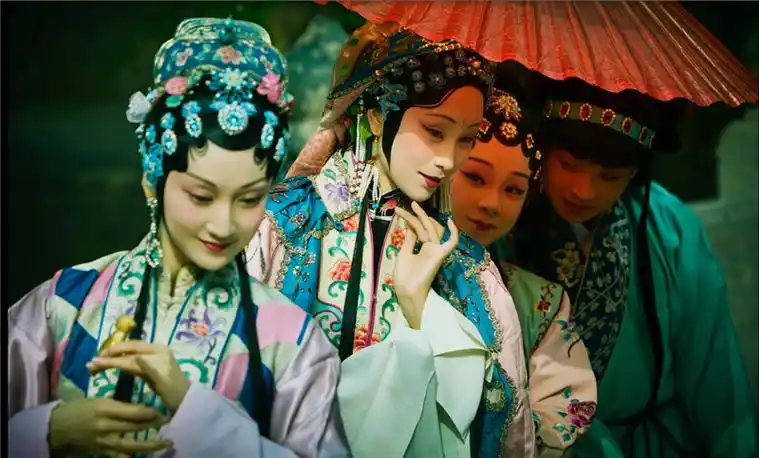
- Elegant costumes.
- Literary language.
- Poetic storytelling.
Every gesture, glance, and movement carries meaning.
Performers spend years mastering techniques that may appear effortless but require extraordinary discipline.
The Famous Story of The Peony Pavilion
The most celebrated Kunqu work is The Peony Pavilion, written by the Ming Dynasty playwright Tang Xianzu.
The story follows a young woman who falls in love with a man she meets in a dream. Her longing becomes so powerful that it transcends life and death.
Often compared to Shakespeare’s great romantic dramas, The Peony Pavilion remains one of the masterpieces of Chinese literature and theater.
Even today, it is frequently performed by Kunqu troupes throughout China.
Why Did Kunqu Decline?
By the Qing Dynasty, new regional opera styles began attracting larger audiences.
Kunqu’s sophisticated language and slow-paced performances appealed mainly to educated elites, while more accessible forms of entertainment gained popularity among ordinary people.
As a result, Kunqu gradually lost its dominant position.
By the twentieth century, many feared the art form might disappear entirely.
UNESCO Recognition and Revival
In 2001, Kunqu Opera became one of the first Chinese cultural traditions recognized by UNESCO as a Masterpiece of the Oral and Intangible Heritage of Humanity.
The designation helped spark renewed interest in preserving the art.
Today, government institutions, universities, and professional opera companies actively train new performers and introduce Kunqu to younger audiences.
Modern productions often combine traditional performances with contemporary staging to make the art more accessible.
Why Does Kunqu Still Matter?
Kunqu is more than a theatrical performance.
It is a living museum of Chinese literature, music, dance, costume design, and aesthetics.
Many of China’s greatest playwrights, poets, and artists were influenced by Kunqu traditions. The art form reflects centuries of cultural refinement and intellectual achievement.
For this reason, Kunqu remains one of the most respected treasures of Chinese civilization.
A Living Piece of Chinese History
In a world dominated by fast-paced entertainment, Kunqu Opera offers something different.
Its beauty lies in patience, subtlety, and elegance.
Watching a Kunqu performance is not simply watching a play—it is experiencing a tradition that has survived for more than six centuries and continues to connect modern audiences with China’s cultural past.
That is why Kunqu is still regarded as one of the crown jewels of Chinese performing arts.